
- BGG-Rang
- BGG #3.965
- BGG-Bewertung
- 6,9
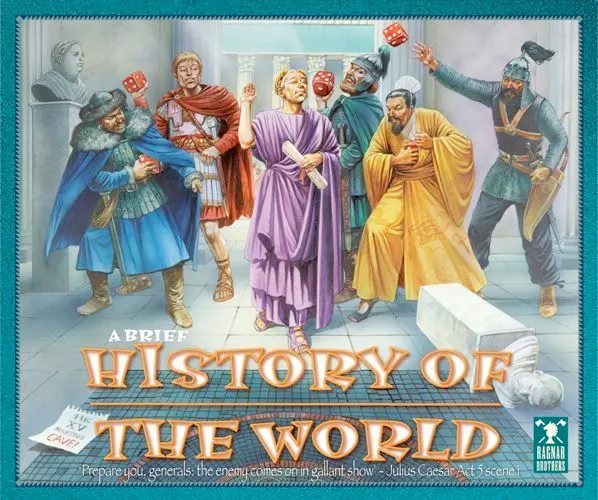
A Brief History of the World
- 3–6 Spieler
- 90–180 Min.
- Komplexität 2,9/5
- 2009
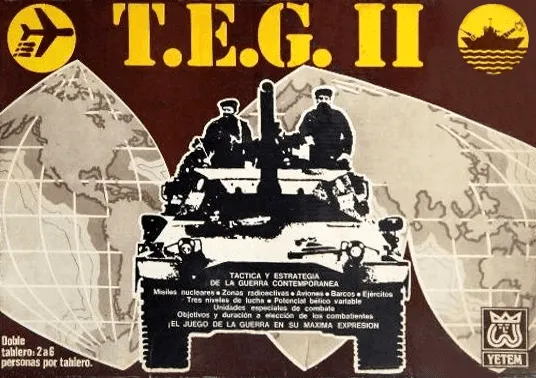
1982
Regelhilfe für T.E.G. II
Verständliche Erklärungen zu Spielzügen, Karteneffekten und strittigen Situationen mit Verweisen auf offizielle Quellen und gespeichertem Fragenverlauf.
Für 2 Personen
Was möchtest du wissen?
Antworten stammen aus dem offiziellen Regelheft, mit Seitenangabe zum Nachprüfen.
T.E.G. II ist ein Brettspiel aus dem Jahr 1982 für 2–6 Personen und mit 120 Minuten pro Partie. Die wichtigsten Mechaniken sind Area Movement, Area Majority / Influence und Simulation.




Auf Englisch
T.E.G. II is a new game from Plan Táctico y Estratégico de la Guerra (T.E.G.), involving armies, ships, aircraft, and nuclear rockets. For those who never played the T.E.G. I, as for experts strategists, the new T.E.G. proposes a different way of playing, lots of action and rapid development. Each player represents one of the great powers of the world: U.S.A., U.S.S.R., China, Japan, Eastern Europe and Western Europe. At the beginning each player chooses, according to their strategic thinking, several military targets: Control, Intervention and Non-Intervention in the various regions of the world. Each target has a value in points. All targets are placed in the Objectives Table. After the incorporations are done comes the fighting. The fighting is between ships that occupie the same region, to which reinforcements can be added, brought in from neighboring regions. The battles are resolved without dice, using a Command of Battle. Apart from the armies, ships and planes, there are other elements of exceptional strength: the nuclear missile and the special unit. They are obtained when the player gets certain levels of war potential. At the end of the game, each player sums the points of the objectives achieved. The winner is the one who got the highest score.
Laut Katalog unterstützt T.E.G. II 2–6 Personen. Diese Spanne entspricht der vom Verlag angegebenen Spielerzahl, das Spiel lässt sich also für jede Gruppengröße innerhalb dieser Spanne aufbauen. Aufbau, einzelne Regeln und Wertungsdetails können je nach Personenzahl trotzdem abweichen; prüfe daher die genaue Konfiguration in der Anleitung deiner Ausgabe.
Die angegebene Spieldauer für T.E.G. II beträgt 120 Minuten. Das ist die Schätzung des Verlags für eine vollständige Partie. Die tatsächliche Dauer hängt von der Gruppe, der Personenzahl und der Regelkenntnis ab: Erste Partien dauern meist länger, erfahrene Gruppen sind oft schneller fertig. Aufbau und Regelerklärung sind in dieser Schätzung nicht enthalten.
T.E.G. II hat bei BoardGameGeek eine Komplexitätswertung von 2,7 von 5 und gilt damit als eher leichtes Spiel. Die Wertung zeigt, wie viel Regelwissen, Planung und Entscheidungen eine typische Partie verlangt. Schwerere Spiele brauchen bei der ersten Erklärung mehr Zeit, daher hilft vor dem Spieleabend eine Vorbereitungsanleitung.
T.E.G. II gehört zu diesen Kategorien: Wargame und Modern Warfare. Die wichtigsten Mechaniken sind Area Movement, Area Majority / Influence und Simulation. Kategorien beschreiben Thema und Setting eines Spiels, Mechaniken dagegen, was die Spielenden in ihrem Zug tatsächlich tun. Jede Mechanik führt zu einer Katalogseite mit ähnlichen Spielen, falls du etwas Vergleichbares suchst.
Im Katalog ist T.E.G. II als Grundspiel aufgeführt. Es lässt sich eigenständig mit dem Material aus der Schachtel spielen und benötigt keinen weiteren Titel. Erweiterungen, sofern es welche gibt, ergänzen neues Material oder neue Regeln und sind im Katalog separat mit einem Verweis auf dieses Grundspiel aufgeführt.