
- BGG-Rang
- BGG #469
- BGG-Bewertung
- 7,5
The Godfather: Corleone's Empire
- 2–5 Spieler
- 60–90 Min.
- Komplexität 2,6/5
- 2017
2014
Regelhilfe für Three Kingdoms Redux
Verständliche Erklärungen zu Spielzügen, Karteneffekten und strittigen Situationen mit Verweisen auf offizielle Quellen und gespeichertem Fragenverlauf.
Für 3 Personen
Was möchtest du wissen?
Antworten stammen aus dem offiziellen Regelheft, mit Seitenangabe zum Nachprüfen.
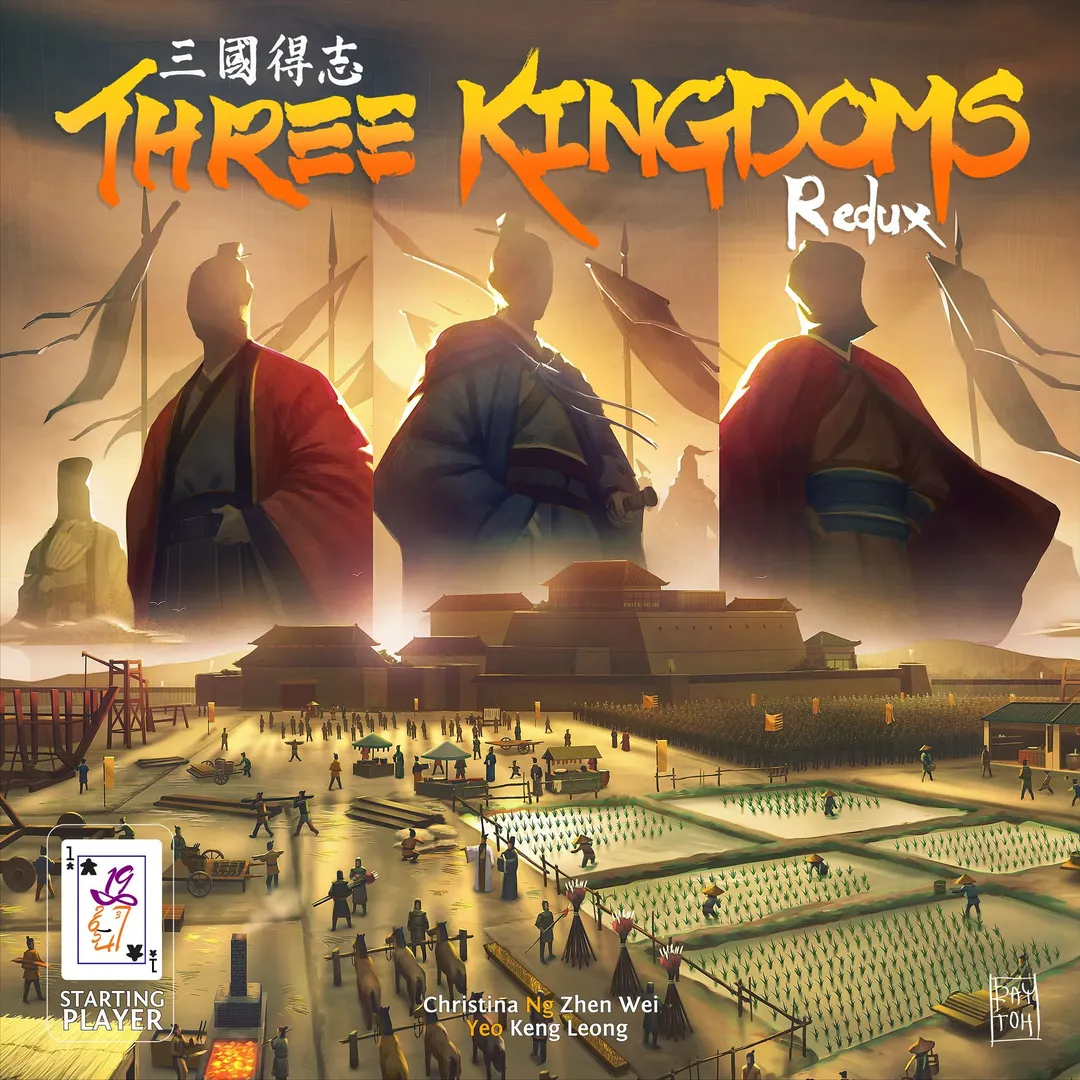
Three Kingdoms Redux ist ein Brettspiel aus dem Jahr 2014 für 3 Personen, mit 135–165 Minuten pro Partie und ab 14 Jahren. Entwickelt wurde es von Christina Ng Zhen Wei und Yeo Keng Leong; die wichtigsten Mechaniken sind Variable Player Powers, Hand Management und Auction / Bidding.




Auf Englisch
The Han Dynasty, founded in 206 BC, ruled the central plains and much of modern day China for nearly four hundred years. However, by late second century, court politics and poor governance has left it in rapid decline. The government was dominated by corrupt eunuchs and officials who levied heavy taxes on the peasants, resulting in public discontent. This culminated in the Yellow Turban Rebellion led by Zhang Jiao in 184 AD during the reign of Emperor Ling (168-189 AD). Although the Yellow Turban Rebellion was eventually put down, many surviving followers went on to become bandits and continued to create problems for the government. The Han army was unable to control the bandits and Emperor Ling granted direct administrative power over provinces and command of regional military to local lords. Many feudal lords took the opportunity to sever ties with the Han government and ruled independently. The more ambitious lords annexed neighboring territories to expand their power bases. This led to the emergence of the three power blocs of Wei, Wu and Shu, and ushered in the Three Kingdoms period. Three Kingdoms Redux is a board game that seeks to recreate the tripartite between the states of Wei, Wu and Shu. You assume the role of one of the three lords – Cao Cao leading Cao Wei, Sun Jian leading Eastern Wu or Liu Bei leading Shu Han. Players start the game from asymmetrical positions, reflecting the manpower advantages Wei enjoyed in the early part of the period. The weaker states of Wu and Shu protect themselves by forming an alliance. As a feudal lord, you manage the different aspects of running a state whilst guarding your borders against both rebellious border tribes and external enemies. Managing each aspect well earns victory points for your state. But beware, for the balance of power shifts constantly during the game. Understand and take advantage of the power shifts, and you will fulfill your grand ambition of re-unifying China! In more detail, Three Kingdoms Redux is played over a number of rounds, up to a maximum of twelve. Players bid for various actions with their general tokens. The highest bidder of each action space obtains the right to carry out the actions. These actions allow players to improve your state’s domestic development, gain military strength, construct state enhancements, increase popularity with your people, improve relationships with border tribes and gain promotion for the lord, to the next higher rank. The actions available to each player are: develop your state’s farm or marketplace, recruit or train army units, produce weapons, trade resources, construct state enhancements, control the Han emperor, demand tributes from your vassals, win support from your people, import technology, improve your relationship with your border tribe, or wage battle against other states to expand your borders. The winner is the player with the most victory points (VPs) at the end of the game.
Laut Katalog unterstützt Three Kingdoms Redux 3 Personen. Das ist die vom Verlag angegebene Spielerzahl, das Spiel ist also genau für diese Anzahl von Mitspielenden ausgelegt. Varianten für andere Gruppengrößen sind, sofern vorhanden, in der Anleitung deiner Ausgabe beschrieben; prüfe sie, bevor du eine andere Konfiguration aufbaust.
Die angegebene Spieldauer für Three Kingdoms Redux beträgt 135–165 Minuten. Das ist die Schätzung des Verlags für eine vollständige Partie. Die tatsächliche Dauer hängt von der Gruppe, der Personenzahl und der Regelkenntnis ab: Erste Partien dauern meist länger, erfahrene Gruppen sind oft schneller fertig. Aufbau und Regelerklärung sind in dieser Schätzung nicht enthalten.
Im Katalog wird Three Kingdoms Redux ab 14 Jahren empfohlen. Das ist die Empfehlung des Verlags und berücksichtigt Leseanforderungen, Regelkomplexität und Kleinteile, nicht nur das Thema. Jüngere Kinder können oft mit Hilfe eines Erwachsenen mitspielen; beachte die Altersangabe deiner Ausgabe und die Brettspielerfahrung deiner Gruppe.
Three Kingdoms Redux hat bei BoardGameGeek eine Komplexitätswertung von 4,0 von 5 und gilt damit als schweres Spiel. Die Wertung zeigt, wie viel Regelwissen, Planung und Entscheidungen eine typische Partie verlangt. Schwerere Spiele brauchen bei der ersten Erklärung mehr Zeit, daher hilft vor dem Spieleabend eine Vorbereitungsanleitung.
Three Kingdoms Redux gehört zu diesen Kategorien: Economic, Territory Building und Ancient. Die wichtigsten Mechaniken sind Variable Player Powers, Hand Management und Auction / Bidding. Kategorien beschreiben Thema und Setting eines Spiels, Mechaniken dagegen, was die Spielenden in ihrem Zug tatsächlich tun. Jede Mechanik führt zu einer Katalogseite mit ähnlichen Spielen, falls du etwas Vergleichbares suchst.
Als Autoren von Three Kingdoms Redux sind angegeben: Christina Ng Zhen Wei und Yeo Keng Leong. Diese Angaben stammen aus den veröffentlichten Spieldaten und nennen die für das Spieldesign verantwortlichen Personen, nicht die Illustratoren oder Verlage. Die Autorenseiten auf MeepleRules sammeln weitere Titel derselben Autoren – praktisch, wenn dir ein Spiel gefällt und du ähnliche Spiele suchst.
Im Katalog ist Three Kingdoms Redux als Grundspiel aufgeführt. Es lässt sich eigenständig mit dem Material aus der Schachtel spielen und benötigt keinen weiteren Titel. Erweiterungen, sofern es welche gibt, ergänzen neues Material oder neue Regeln und sind im Katalog separat mit einem Verweis auf dieses Grundspiel aufgeführt.