
- BGG-Rang
- BGG #22.557
- BGG-Bewertung
- 6,1
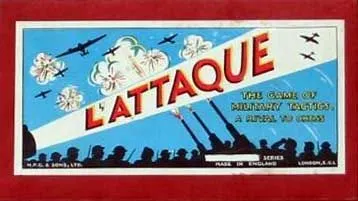
L'Attaque
- 2 Spieler
- 20 Min.
- Komplexität 1,3/5
- 1909
1932
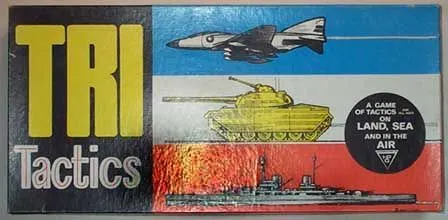
Regelhilfe für Tri-Tactics
Verständliche Erklärungen zu Spielzügen, Karteneffekten und strittigen Situationen mit Verweisen auf offizielle Quellen und gespeichertem Fragenverlauf.

Für 2 Personen
Was möchtest du wissen?
Antworten stammen aus dem offiziellen Regelheft, mit Seitenangabe zum Nachprüfen.
Tri-Tactics ist ein Brettspiel aus dem Jahr 1932 für 2 Personen, mit 240 Minuten pro Partie und ab 12 Jahren. Entwickelt wurde es von Hermance Edan und Harry Gibson; die wichtigsten Mechaniken sind Secret Unit Deployment.








Auf Englisch
Popular and intriguing military air, sea and ground forces tactics game TRI-TACTICS by Harry Gibson History: This board game was launched in 1935 by Gibsons aiming to provide an amalgamation of three other tactical board games: - L'Attaque (1909) - the U.K. rights were acquired by Gibsons in 1925. - Dover Patrol (1911) - Aviation: The Aerial Tactics Game of Attack and Defence (1925) All of these Gibsons games, marketed at the time as Series: The Big Four (Gibsons), predate Stratego (1942) by Jumbo which shares many similar aspects of play, but is now much more well known. Gameplay: The game is played on a special 12x12 board which illustrates land and sea spaces equally for each side, and each with two special squares, an HQ and a Lake containing a Naval Base. Two players, one RED, the other BLACK, command combined Navy, Airforce and Army forces, with a total of 112 prices, each player starting with 56, comprising the following: Infantry 5 Battalions - rank 1 4 Brigades - rank 2 3 Divisions - rank 3 2 Army Corps - rank 4 1 Army - rank 5 Artillery 5 Anti-Aircraft gun - rank AA 4 Field Artillery - rank FA 3 Heavy Artillery - rank HA Naval Force 4 Destoryers - rank 1 3 Cruisers - rank 2 2 Battleships - rank 3 1 Aircraft Carrier - rank 4 1 Submarine - rank SM 4 Flying Boats - rank FB Air Force 4 Reconnaissance Planes - rank 1 3 Bombers - rank 2 2 Two-Seat Fighters - rank 3 Auxiliary 8 Searchlights - rank SL At the beginning of game, these 56 pieces are placed by a player to occupy the first 5 rows of one side (but not on the HQ or Lake), with the other player doing likewise with their 56 on the opposite side’s 5 rows. This leaves two whole rows in the centre of the board empty, as well as the HQ, Lake, and 2 other squares between the two forces facing each other. All types and ranks of the pieces are hidden at the beginning of the game The object of the game is to occupy the opponent’s HQ with an Infantry piece, or the Lake with a Naval piece (not including the FB), which must approach via the river. The players draw lots to decide who commences play, by moving one piece, and thereafter play alternates between the players, by moving one piece per turn. All pieces can move one square at a time, forwards, backwards or sideways, with the exception of the Searchlight which can move multiple squares in a single direction (but only when attacking), as long as the squares are unoccupied. To attack, a player must move a piece adjacent to an opponent’s piece and announce ‘Attack’. They may choose not to, in which case they state ‘No Attack’. In that case, the opponent cannot on their turn attack that adjacent piece without first moving another of his pieces. The two adjacent pieces of each player are then revealed. The attacks are resolved by consulting the Value Table; as a general rule, the highest rank wins, but there are various combinations that apply, particularly when comparing land, sea and air pieces on land, sea or over a coastline. If successful, the attacker remains where they are, and the defender’s square becomes empty as the defender’s piece is removed. If the attacker loses, their piece is removed, and the defender’s piece remains where it is. If the pieces are the same rank, both are removed. It is allowed to place Land pieces on the sea and Naval pieces on the land, but with the risk that when attacked, any such piece found to be operating ‘out of their element’ will immediately forfeit and removed. Excluded from this rule is the FB as well as all Air Force pieces and the Searchlights. The River is a special area which is classified as Land or Sea depending on which piece is occupying it. When a Naval piece does so, the square is designated Sea, and when a Land price occupies it, then it is classified as Land. On the rest of the board, where land and sea meet, then the spaces are classified as Sea or Land depending on which is in the majority. The coastline in each case separates these defined areas of Land and Sea. Should there be an attack between a Ship and a Land piece over a coastline, the attacker is forfeit, except for HA and AA when the ordinary ruling applies. Also, Bombers and FB destroy Infantry and FA. The HQ and Lake must not be occupied but a piece may be move over these squares in consecutive turns or else be forfeit. Only Ships (not FB) may attack and capture the Lake, and to do so must move up the River (it cannot capture the Lake by entering via Land, or then it must exit via the river to sea); in doing so, in this special case it captures all Land pieces in attacks, except HA. Similarly, only Infantary pieces (not Artillery) may attack and capture the HQ. Similar to: L'Attaque Dover Patrol Aviation: The Aerial Tactics Game of Attack and Defence Stratego
Laut Katalog unterstützt Tri-Tactics 2 Personen. Das ist die vom Verlag angegebene Spielerzahl, das Spiel ist also genau für diese Anzahl von Mitspielenden ausgelegt. Varianten für andere Gruppengrößen sind, sofern vorhanden, in der Anleitung deiner Ausgabe beschrieben; prüfe sie, bevor du eine andere Konfiguration aufbaust.
Die angegebene Spieldauer für Tri-Tactics beträgt 240 Minuten. Das ist die Schätzung des Verlags für eine vollständige Partie. Die tatsächliche Dauer hängt von der Gruppe, der Personenzahl und der Regelkenntnis ab: Erste Partien dauern meist länger, erfahrene Gruppen sind oft schneller fertig. Aufbau und Regelerklärung sind in dieser Schätzung nicht enthalten.
Im Katalog wird Tri-Tactics ab 12 Jahren empfohlen. Das ist die Empfehlung des Verlags und berücksichtigt Leseanforderungen, Regelkomplexität und Kleinteile, nicht nur das Thema. Jüngere Kinder können oft mit Hilfe eines Erwachsenen mitspielen; beachte die Altersangabe deiner Ausgabe und die Brettspielerfahrung deiner Gruppe.
Tri-Tactics hat bei BoardGameGeek eine Komplexitätswertung von 2,5 von 5 und gilt damit als eher leichtes Spiel. Die Wertung zeigt, wie viel Regelwissen, Planung und Entscheidungen eine typische Partie verlangt. Schwerere Spiele brauchen bei der ersten Erklärung mehr Zeit, daher hilft vor dem Spieleabend eine Vorbereitungsanleitung.
Tri-Tactics gehört zu diesen Kategorien: Wargame und World War II. Die wichtigsten Mechaniken sind Secret Unit Deployment. Kategorien beschreiben Thema und Setting eines Spiels, Mechaniken dagegen, was die Spielenden in ihrem Zug tatsächlich tun. Jede Mechanik führt zu einer Katalogseite mit ähnlichen Spielen, falls du etwas Vergleichbares suchst.
Als Autoren von Tri-Tactics sind angegeben: Hermance Edan und Harry Gibson. Diese Angaben stammen aus den veröffentlichten Spieldaten und nennen die für das Spieldesign verantwortlichen Personen, nicht die Illustratoren oder Verlage. Die Autorenseiten auf MeepleRules sammeln weitere Titel derselben Autoren – praktisch, wenn dir ein Spiel gefällt und du ähnliche Spiele suchst.
Im Katalog ist Tri-Tactics als Grundspiel aufgeführt. Es lässt sich eigenständig mit dem Material aus der Schachtel spielen und benötigt keinen weiteren Titel. Erweiterungen, sofern es welche gibt, ergänzen neues Material oder neue Regeln und sind im Katalog separat mit einem Verweis auf dieses Grundspiel aufgeführt.