
- BGG-Rang
- BGG #5.418
- BGG-Bewertung
- 6,5
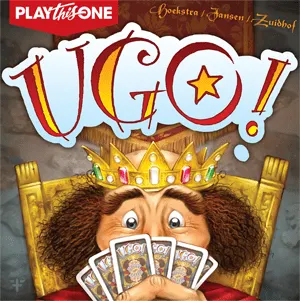
UGO!
- 2–4 Spieler
- 40 Min.
- Komplexität 1,6/5
- 2013
2004
Regelhilfe für UWO
Verständliche Erklärungen zu Spielzügen, Karteneffekten und strittigen Situationen mit Verweisen auf offizielle Quellen und gespeichertem Fragenverlauf.
Für 2 Personen
Was möchtest du wissen?
Antworten stammen aus dem offiziellen Regelheft, mit Seitenangabe zum Nachprüfen.
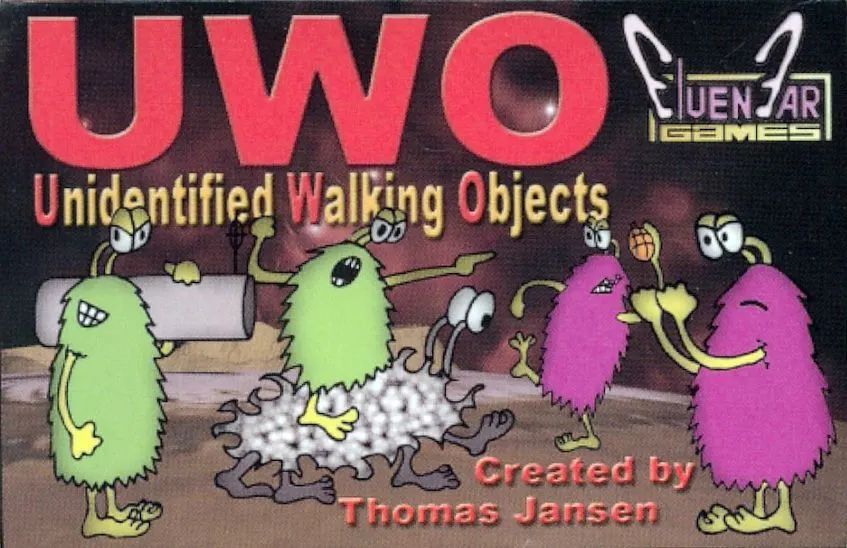
UWO ist ein Brettspiel aus dem Jahr 2004 für 2 Personen, mit 45 Minuten pro Partie und ab 10 Jahren. Entwickelt wurde es von Thomas Jansen; die wichtigsten Mechaniken sind Hand Management, Square Grid und Grid Movement.


Auf Englisch
UWO's (unidentified walking objects) are residents of the planet Znorf. There are two kinds of UWO; The Gnorfs and the Pnorfs. Both of them are able to morf. But that is something that will be explained later on. The Gnorfs think that the Pnorfs are a group of ugly creatures and that feeling is completely mutual. All the more reason for them to start a war! beginning of the game UWO is a cardgame and a boardgame at the same time. Both players have six energy cards. The playing field is formed by the energy cards of both players. One player places them horizontally, directly in front of him. The other player does this at the side vertically, just like on the photo. The playing field is between these energy cards. Both players place their ten 'regular' UWO's of their own color in front of them in two rows of five each. The players shuffle their pack of cards and place them both upside down in front of them. energy Just like life on our planet, life on Znorf is expensive too. Everything you do will cost you "Energy". you have to pay it for morfing, walking or fighting. Strong UWO's use much energy. If both players used all of their six energy, then a round is over. Everyone gets back his energy. But beware! If you're out of energy and your opponent isn't yet, he will play several turns at once! And for your opponent, weak (and cheap) UWO's come in handy now. They can do a lot of damage to you! many different UWO's There are no less than eight different UWO's in the game. Some are riding Knorfs (strange animails). They can trample everyone. Others are cowards, hiding in bunkers, etc. UWO's carry many different weapons. Lasers, dynamite, granades, bazooka's, etc. The bazooka UWO for instance, is one of the coolest of the gang and he himself thinks so too. He is extremely powerful. He can even blow up tanks! Unfortunately, such a bazooka is a great danger to our tiny UWO. Each time he has shot someone, he will be knocked out until the end of your next turn! UWO's are specialists. Every UWO has protection against a specific other UWO. For instance, a UWO in a tank has protection against one who fights with his bare hands. dynamite UWO Well, let's just say there's only one of it on each side. One who can be quite important to both players... morfing UWO's can morf in exchange for one energy point: UWO cards may be placed on UWO's that are already in the game. This way, a regular UWO can be morfed into anything you want to, just like that! This can be very useful. Imagine a laser UWO threatening you. Your opponent announces that it's going to attack!! Don't panic, his UWO can never hit you when you are hiding in a bunker! So, when you have this card, just morf your furry alien into one and shoot back...and hope your opponent doesn't morf his UWO into a grenade UWO... the pack of cards At the end of each turn each player may refill his/her cards to 3. But beware, players can run out of cards. The game still goes on untill all UWO's of one player in the battlefield are destroyed. It is very easy for an opponent to adapt his army to yours, when you are not able to morf anymore! Imagine your opponent creating a small army of laser UWO's to attack your last bazooka UWO! They have protection against this weapon. You may panic now, cause your lost. In the pack of cards, there are also nine "miss cards." When you play this card, the shot will automatically be declared "missed" and of course you will have the chance to shoot back with this UWO. But don't play these cards to fast! Smart opponents remember how many you have left. When you lost them all, your opponent knows that every shot will be a hit. Sometimes it's smarter to just sacrifice a UWO, than to play a miss card.
Laut Katalog unterstützt UWO 2 Personen. Das ist die vom Verlag angegebene Spielerzahl, das Spiel ist also genau für diese Anzahl von Mitspielenden ausgelegt. Varianten für andere Gruppengrößen sind, sofern vorhanden, in der Anleitung deiner Ausgabe beschrieben; prüfe sie, bevor du eine andere Konfiguration aufbaust.
Die angegebene Spieldauer für UWO beträgt 45 Minuten. Das ist die Schätzung des Verlags für eine vollständige Partie. Die tatsächliche Dauer hängt von der Gruppe, der Personenzahl und der Regelkenntnis ab: Erste Partien dauern meist länger, erfahrene Gruppen sind oft schneller fertig. Aufbau und Regelerklärung sind in dieser Schätzung nicht enthalten.
Im Katalog wird UWO ab 10 Jahren empfohlen. Das ist die Empfehlung des Verlags und berücksichtigt Leseanforderungen, Regelkomplexität und Kleinteile, nicht nur das Thema. Jüngere Kinder können oft mit Hilfe eines Erwachsenen mitspielen; beachte die Altersangabe deiner Ausgabe und die Brettspielerfahrung deiner Gruppe.
UWO hat bei BoardGameGeek eine Komplexitätswertung von 1,7 von 5 und gilt damit als leichtes Spiel. Die Wertung zeigt, wie viel Regelwissen, Planung und Entscheidungen eine typische Partie verlangt. Schwerere Spiele brauchen bei der ersten Erklärung mehr Zeit, daher hilft vor dem Spieleabend eine Vorbereitungsanleitung.
UWO gehört zu diesen Kategorien: Card Game, Humor und Abstract Strategy. Die wichtigsten Mechaniken sind Hand Management, Square Grid und Grid Movement. Kategorien beschreiben Thema und Setting eines Spiels, Mechaniken dagegen, was die Spielenden in ihrem Zug tatsächlich tun. Jede Mechanik führt zu einer Katalogseite mit ähnlichen Spielen, falls du etwas Vergleichbares suchst.
Als Autoren von UWO sind angegeben: Thomas Jansen. Diese Angaben stammen aus den veröffentlichten Spieldaten und nennen die für das Spieldesign verantwortlichen Personen, nicht die Illustratoren oder Verlage. Die Autorenseiten auf MeepleRules sammeln weitere Titel derselben Autoren – praktisch, wenn dir ein Spiel gefällt und du ähnliche Spiele suchst.
Im Katalog ist UWO als Grundspiel aufgeführt. Es lässt sich eigenständig mit dem Material aus der Schachtel spielen und benötigt keinen weiteren Titel. Erweiterungen, sofern es welche gibt, ergänzen neues Material oder neue Regeln und sind im Katalog separat mit einem Verweis auf dieses Grundspiel aufgeführt.