
- BGG-Rang
- BGG #5.638
- BGG-Bewertung
- 7,0
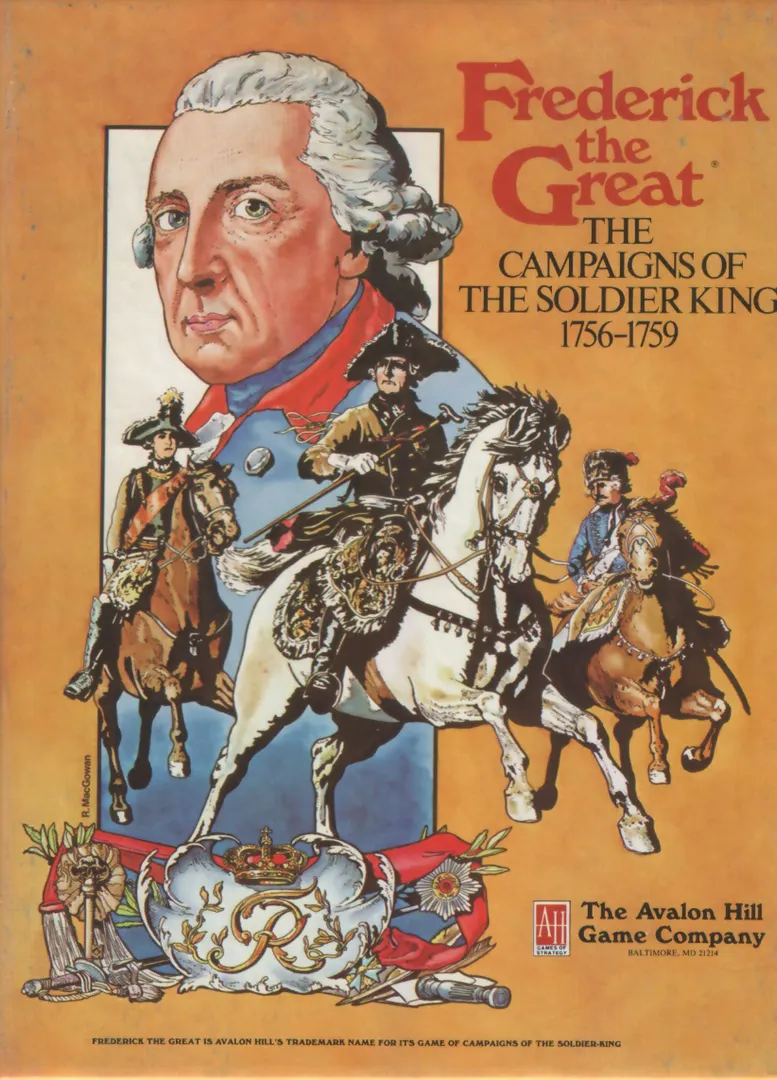
Frederick the Great: The Campaigns of The Soldier King 1756-1759
- 2–4 Spieler
- 180–240 Min.
- Komplexität 2,7/5
- 1975
1976
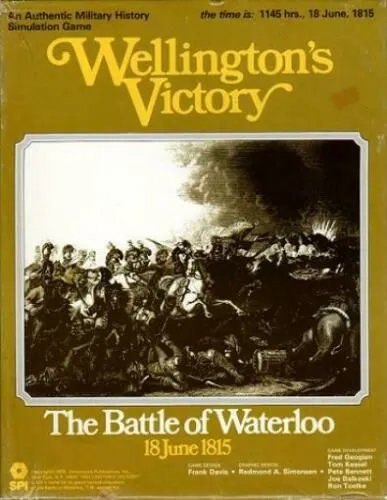
Regelhilfe für Wellington's Victory: Battle of Waterloo Game – June 18th, 1815
Verständliche Erklärungen zu Spielzügen, Karteneffekten und strittigen Situationen mit Verweisen auf offizielle Quellen und gespeichertem Fragenverlauf.
Für 2 Personen
Was möchtest du wissen?
Antworten stammen aus dem offiziellen Regelheft, mit Seitenangabe zum Nachprüfen.
Wellington's Victory: Battle of Waterloo Game – June 18th, 1815 ist ein Brettspiel aus dem Jahr 1976 für 2 Personen, mit 240 Minuten pro Partie und ab 12 Jahren. Entwickelt wurde es von Frank Davis; die wichtigsten Mechaniken sind Dice Rolling, Hexagon Grid und Ratio / Combat Results Table.






Auf Englisch
[from the back of the flatpack edition] Wellington's Victory : The Battle of Waterloo - Four-color 68” x 44” contour map in four sections - Innovative Fire and Shock Combat mechanics - Line, Column, Square, Skirmish and Cavalry formations - Hougomont, La Haye Sainte and Plancenoit Scenarios - 40 Game-Turn Grand Battle Scenario Wellington's Victory is a grand tactical simulation of the Battle of Waterloo which occurred on June 18, 1815, at a minor crossroads south of Brussels, Belgium. The battle marked the first and only encounter of history's two most renowned generals, Sir Arthur Wellesley, Duke of Wellington, and Napoleon Bonaparte, Emperor of France. A brutal day-long French assault against the British held ridge brought Wellington's army to the brink of defeat. By later afternoon, however, the arrival of Wellington's allies tipped the odds decisively against the French; Napoleon chose to stake his empire on the outcome of a final attack by his most trusted troops – the Imperial Guard. Wellington's Victory is played on an innovative game map composed of four 34” x 22” map sections on which significant differences in ground contours are differentiated by color. There are five distinct contour levels depicted on the map as well as an extremely accurate survey of all battle field terrain features including Hougomont, La Haye Sainte, and almost every other farm and dwelling, woods and orchards, streams and ponds, and raised and sunken roads. Each of more than 500 French, Prussian and Anglo-Dutch combat and command units are fully identified by battalion, regiment, brigade, division and corps designations as well as numerical game values which differentiate each unit's strength, effectiveness, and mobility. The game utilizes a fifteen minute Game-Turn. Each mapsheet hex represents a distance of 100 yards. Each Strength Point represents 100 infantry or cavalry troops or one gun or howitzer within an artillery battery. Each Game-Turn employs a unique, asymmetrical, sequence of play in which Players alternately participate in a series of Phases covering activities which include the execution of chain of command mechanics (such as activating and committing reserve formations and initiating cavalry charges), rallying disordered and routed units, executing facing and formation changes (including a repertoire of infantry formations such as column, line, square and open order or skirmish formation), regular and grand tactical movement, and finally executing artillery and small arms fire as well as infantry and cavalry shock command. The Fire and Shock Combat mechanics which decide the battle were also designed to yield realistic results without sacrificing playability. Fire resolution requires no arithmetic calculation since each unit fires separately. The Relative Firepower Table used to resolve Fire Combat is a new type of CRT which directly interrelates the strength, formation and quality of the firing unit with the formation and terrain cover employed by the defending unit. The Shock Combat Table is also unique in that it employs an “odds” comparison to account for Troop strength differences between the attacker and defender and a “differential” comparison to account for any qualitative difference between the opposing forces. Losses, which are recorded directly on the map by placing a Strength marker under the unit suffering casualties, may result from either Fire or Shock combat. In general, however, Shock Combat is depicted as a “morale showdown” more useful for gaining ground than inflicting casualties. Morale, which Napoleon deemed to be three times as important as numerical strength on the battlefield, is accurately accounted for in the Effectiveness Rating assigned to every infantry battalion, cavalry regiment and artillery battery crew. Buyer's Guide for WELLINGTON'S VICTORY The following ratings are based on at least 100 player-replies to surveys conducted through Strategy & Tactics Magazine. Ratings are on a 1 (worst) to 9 (best) scale. Average ratings (for over 60 historical games in print) are: Acceptability-6.00, Complexity-5.00. Acceptability Rating: New Game Complexity Rating: (est.) 7.8 Avg. Playing Time [hrs.] (est.) 6.0 “Acceptability” depends a lot on which historical period interests you the most. “Complexity” ratings for other games are, for example, Monopoly – 2.34; Afrika Korps – 3.48; Diplomacy – 4.51; France, 1940 – 5.78; PanzerBlitz – 7.01. Most games average 2-3 hours playing time.
Laut Katalog unterstützt Wellington's Victory: Battle of Waterloo Game – June 18th, 1815 2 Personen. Das ist die vom Verlag angegebene Spielerzahl, das Spiel ist also genau für diese Anzahl von Mitspielenden ausgelegt. Varianten für andere Gruppengrößen sind, sofern vorhanden, in der Anleitung deiner Ausgabe beschrieben; prüfe sie, bevor du eine andere Konfiguration aufbaust.
Die angegebene Spieldauer für Wellington's Victory: Battle of Waterloo Game – June 18th, 1815 beträgt 240 Minuten. Das ist die Schätzung des Verlags für eine vollständige Partie. Die tatsächliche Dauer hängt von der Gruppe, der Personenzahl und der Regelkenntnis ab: Erste Partien dauern meist länger, erfahrene Gruppen sind oft schneller fertig. Aufbau und Regelerklärung sind in dieser Schätzung nicht enthalten.
Im Katalog wird Wellington's Victory: Battle of Waterloo Game – June 18th, 1815 ab 12 Jahren empfohlen. Das ist die Empfehlung des Verlags und berücksichtigt Leseanforderungen, Regelkomplexität und Kleinteile, nicht nur das Thema. Jüngere Kinder können oft mit Hilfe eines Erwachsenen mitspielen; beachte die Altersangabe deiner Ausgabe und die Brettspielerfahrung deiner Gruppe.
Wellington's Victory: Battle of Waterloo Game – June 18th, 1815 hat bei BoardGameGeek eine Komplexitätswertung von 4,2 von 5 und gilt damit als schweres Spiel. Die Wertung zeigt, wie viel Regelwissen, Planung und Entscheidungen eine typische Partie verlangt. Schwerere Spiele brauchen bei der ersten Erklärung mehr Zeit, daher hilft vor dem Spieleabend eine Vorbereitungsanleitung.
Wellington's Victory: Battle of Waterloo Game – June 18th, 1815 gehört zu diesen Kategorien: Wargame und Napoleonic. Die wichtigsten Mechaniken sind Dice Rolling, Hexagon Grid und Ratio / Combat Results Table. Kategorien beschreiben Thema und Setting eines Spiels, Mechaniken dagegen, was die Spielenden in ihrem Zug tatsächlich tun. Jede Mechanik führt zu einer Katalogseite mit ähnlichen Spielen, falls du etwas Vergleichbares suchst.
Als Autoren von Wellington's Victory: Battle of Waterloo Game – June 18th, 1815 sind angegeben: Frank Davis. Diese Angaben stammen aus den veröffentlichten Spieldaten und nennen die für das Spieldesign verantwortlichen Personen, nicht die Illustratoren oder Verlage. Die Autorenseiten auf MeepleRules sammeln weitere Titel derselben Autoren – praktisch, wenn dir ein Spiel gefällt und du ähnliche Spiele suchst.
Im Katalog ist Wellington's Victory: Battle of Waterloo Game – June 18th, 1815 als Grundspiel aufgeführt. Es lässt sich eigenständig mit dem Material aus der Schachtel spielen und benötigt keinen weiteren Titel. Erweiterungen, sofern es welche gibt, ergänzen neues Material oder neue Regeln und sind im Katalog separat mit einem Verweis auf dieses Grundspiel aufgeführt.