- BGG rank
- BGG #3,696
- BGG rating
- 7.5
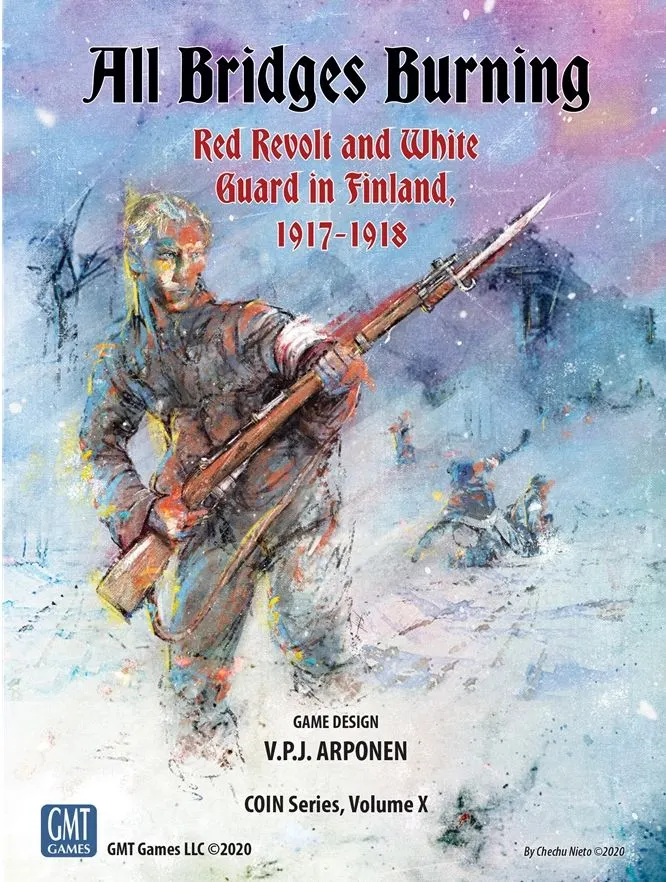
All Bridges Burning: Red Revolt and White Guard in Finland, 1917-1918
2020
Rules assistance for All Bridges Burning: Red Revolt and White Guard in Finland, 1917-1918
Plain-language explanations of turns, card effects and disputed situations, with official source references and saved question history.
- 1–3 players
- 180–360 min
- 14+
- Complexity 3.6/5

For 1 player
Rules assistant for All Bridges Burning: Red Revolt and White Guard in Finland, 1917-1918
What would you like to know?
Answers come from the official rulebook, with the page to check.
All Bridges Burning: Red Revolt and White Guard in Finland, 1917-1918 is a board game released in 2020 for 1–3 players, 180–360 minutes per game, and ages 14 and up. It was designed by VPJ Arponen and its main mechanics are Variable Player Powers, Area Movement, and Dice Rolling.
About the game
The year is 1917. Russia’s Tsar Nicholas II has abdicated and Russia slides toward an ever deepening internal crisis. On the western edge of the vast Russian Empire, the uncertainty in Russia is giving rise to a power vacuum in the semi-autonomous Grand Duchy of Finland. For many across the Finnish political spectrum, the turmoil in Russia looks like an opportunity to fulfill the dream of Finnish national independence. Yet the competing factions are unable to agree on a common political vision for the country. By January 1918, a bloody civil war will have broken out in Finland. All Bridges Burning recreates the political and military affairs of the Finnish civil war in a new COIN System volume for three players. The Reds seek to stage a working class revolt and then hold onto their gains, while the White Senate forces seek to reassert control. A third, non-violent Social Democratic faction fights for the survival of moderate leftism and political reform. All three factions must keep the national sentiment conciliatory enough for a post-conflict settlement and national independence. In addition, the non-player powers of Germany and Russia offer military assistance to the Senate and the Reds, respectively. Excessive foreign involvement, however, could quash the dream of Finnish independence and prompt a collective loss of all three player factions. Historical events, asymmetrical action menus, as well as extensive historical design notes familiarize the players with the historical period. A unique sequence of play for three factions poses players –whether veteran or new to the COIN Series– fresh challenges in selecting from the asymmetric commands and special activities. The Reds will find themselves needing to split time and resources between competing tasks of solidifying the Red revolt by creating working organs of civilian administration on the one hand, and fighting an increasingly desperate war against a far more powerful enemy on the other. The White Senate faction, in contrast, has a more traditional war to fight. The Senate will want to enhance their military performance by capabilities such as armored trains, cannons, as well as the Finnish, German-trained 27th Jaeger Battalion. Meanwhile the Social Democrats will be focused on building and maintaining underground networks of information, distributing news across the fronts, and advancing a stagnating political process while fending off retributions from the two warring factions. A simple but effective card-driven non-player system enables the game to be played solitaire as well as in a two-player mode. The structure of the sequence of play, the character of the commands and special activities in the game, the smaller number of players, and compact size combine to enable All Bridges Burning to play fast. The solitaire system has been designed to preserve that speed and fluidity of play. —description from the publisher
Mechanics
Designers
Publishers
- GMT Games
Questions and answers
All Bridges Burning: Red Revolt and White Guard in Finland, 1917-1918 supports 1–3 players according to the catalogue. This range comes from the publisher’s listed player count, so the game can be set up for any group size within it. Some setups, rules and scoring details may still vary by player count, so check your edition’s rulebook for the exact configuration.
The listed playing time for All Bridges Burning: Red Revolt and White Guard in Finland, 1917-1918 is 180–360 minutes. This is the publisher’s estimate for a full game. The actual duration depends on the group, the player count and familiarity with the rules: first sessions usually run longer, while experienced groups often finish faster. Setup and teaching time are not included in this estimate.
The catalogue lists All Bridges Burning: Red Revolt and White Guard in Finland, 1917-1918 for ages 14 and up. This is the publisher’s recommendation and reflects reading demands, rule complexity and small components rather than theme alone. Younger players can often join with help from an adult, so check the age guidance on your edition and consider your group’s experience with board games.
All Bridges Burning: Red Revolt and White Guard in Finland, 1917-1918 has a complexity rating of 3.6 out of 5 from BoardGameGeek players, which makes it a medium-weight game. The rating reflects how much rules knowledge, planning and decision-making a typical game demands. Expect a longer first teach for heavier games, and use a preparation guide before game night.
All Bridges Burning: Red Revolt and White Guard in Finland, 1917-1918 belongs to these categories: Wargame and Civil War. Its main mechanics are Variable Player Powers, Area Movement, and Dice Rolling. Categories describe the theme and setting of a game, while mechanics describe what players actually do on their turns. Each mechanic links to a catalogue hub with similar games, which helps when you want something comparable.
The credited designers of All Bridges Burning: Red Revolt and White Guard in Finland, 1917-1918 are: VPJ Arponen. These credits come from the published game data and name the people responsible for the game’s design, not its illustrators or publishers. Designer pages on MeepleRules collect other titles by the same designers, which helps when you enjoy a game and want to find similar ones.
The catalogue lists All Bridges Burning: Red Revolt and White Guard in Finland, 1917-1918 as a base game. It can be played on its own with the components in the box and does not require any other title. Expansions, if any exist, add new content or rules on top of it and are listed separately in the catalogue with a link back to this base game.