- BGG rank
- BGG #2,891
- BGG rating
- 8.0
Brotherhood & Unity
2020
Rules assistance for Brotherhood & Unity
Plain-language explanations of turns, card effects and disputed situations, with official source references and saved question history.
- 2–3 players
- 120–240 min
- 14+
- Complexity 3.0/5

For 2 players
Rules assistant for Brotherhood & Unity
What would you like to know?
Answers come from the official rulebook, with the page to check.
Brotherhood & Unity is a board game released in 2020 for 2–3 players, 120–240 minutes per game, and ages 14 and up. It was designed by Tomislav Cipcic and its main mechanics are Dice Rolling, Point to Point Movement, and Simulation.
About the game
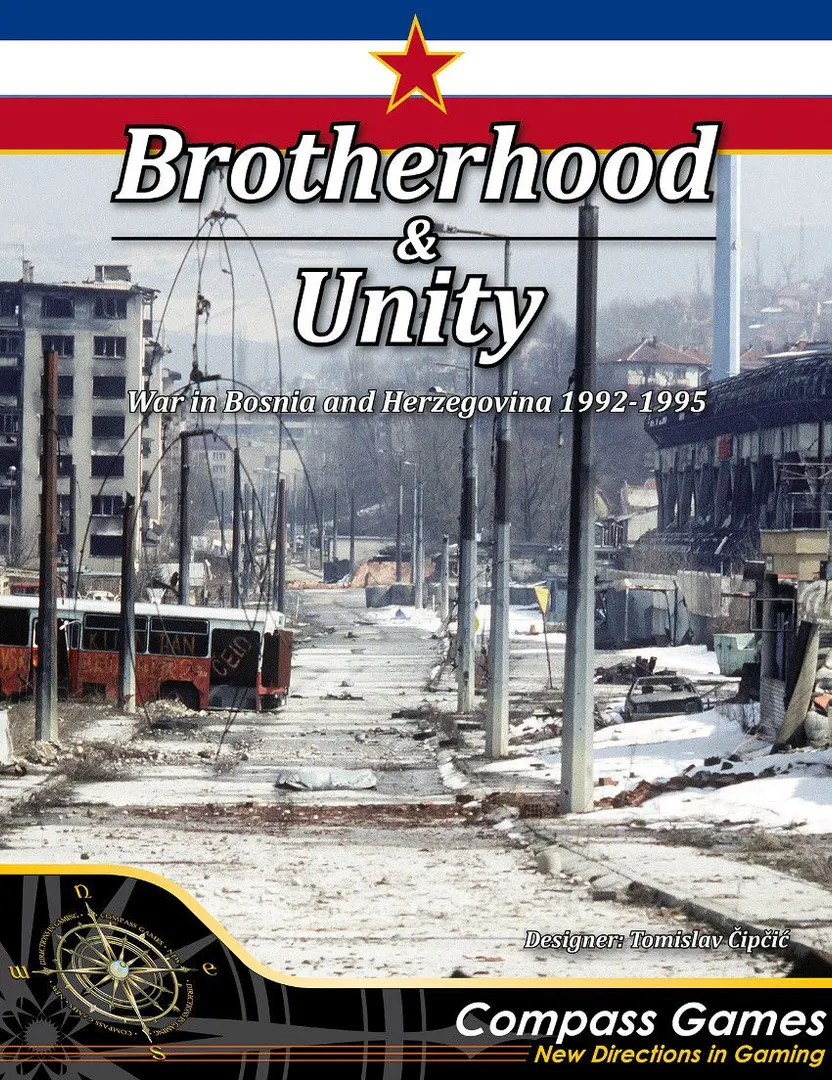
Winston Churchill once said - "The Balkans produce more history than they can consume." And the history of Bosnia and Herzegovina showed just that. The war that erupted in the spring of 1992 brought bitter fighting, indiscriminate shelling of civilians and a wave of atrocities. The war was fought by: three local ethnic groups (Bosniaks, Serbs and Croats), paramilitary formations from Serbia and Krajina, Croatian armed forces, foreign Muslim volunteers, UN peacekeepers, and NATO airforce. Events such as the Siege of Sarajevo and the Srebrenica massacre became iconic of the conflict, as the war became the single most important historical event in Balkans since the WW2. And still - it's objective history has yet to be written. Brotherhood & Unity is a 2-3 player card driven wargame which depicts the war in Bosnia and Herzegovina from 1992-1995 ("Bosnian War"). The game shows all of the major events: from the siege of Sarajevo (shown in separate, detailed map), to the ferocious battles for the Posavina corridore, and desperate defence of the Bosniak enclaves. Main features are: Point-To-Point movement system, play driven by Strategy Cards, quick combat resolution (no CRT), streamlined rules and fast gameplay. Interaction between warring sides (Bosniaks, Serbs and Croats) creates an intensive and exciting gameplay experience. Player's military strength fluctuates based on historical facts, with Serbs starting superior in all aspects, and Bosniaks struggling to organize an effective fighting formation. Military units represent Brigades - standard military formations of the time, ranging from 1500-2000 soldiers. They have different combat and movement values (based on historical data), which forces players to use different tactics for different opponents. Majority of these units are non-motorized infantry formations (moving only several spaces per round), but with the use of special offensive cards players can increase their mobility and surprise the opponents. The game simulates three distinct sides in the war: Bosniaks, Serbs and Croats - with no clear border separating them. That provides an interesting set of choices to players: to attack or to fortify, whom to ally with, and when to change sides. That leads to many turnarounds and pragmatical alliances with former enemies - as was historically the case. Each player gets a deck of Strategy Cards, simulating a variety of historical events. The player starts an action round by playing a Strategy Card from his hand. A card can be played as an event (Combat Card, Offensive, Interrupt, Foreign Units and Other) or as one of the game actions (Movement, Attack, Strategic Redeployment, Diplomatic Action or Reinforcement). The events and card values have been carefully created to mimic the historical events and choices. Since each game uses only a part of the available card deck, players can't be certain which cards will be drawn during the game. That creates a "card fog-of-war" and makes the game more replayable. Game uses Strategic Will point system to keep track of the victories and losses, and to determine the final score. It is affected by a number of things: capturing or losing regions, capturing or losing key spaces, eliminating or losing units, and as a result of events. One of the most important aspects of the game is capturing player's own key regions - which were different for each side, and which reflects the different aims the each side had. The Foreign Attitude is another major track in the game which represents the diplomatic stance of foreign powers (European countries, USA, Russia, and UN) towards a player. It is affected by capturing cities (thus creating refugee crisis) and as a result of events, and generally represents a player's international reputation. When it reaches certain levels, negative effects occur - from reduction of movement, to NATO air strikes, to even losing the game. The game enables player to invite United Nations to create UN Safe Areas, thus giving a player some kind of protection from being overrun. NATO Air Strike happens when players overreach themselves, capturing too many cities too quickly, thus creating a major refugee crisis and media outcry. Without careful diplomatic balancing, the greatest offensive can thus be derailed and bring a player to the brink of destruction. Supplies are scarce and can be cut-off, thus starving and eventually eliminating the unsupplied units. Combat results are easy to calculate, and are based on unit attack and defence values modified by terrain and die roll results (no CRT is used). Rules are streamlined to reduce clutter and unnecessary actions, which enables a fast gameplay - the full game is usually played in bit over two hours. The name "Brotherhood and Unity“ comes from a socialist Yugoslavia doctrine created to inspire unity between 7 nations from which Yugoslavia was created. It was also a main motto behind the Socialist Republic of Bosnia and Herzegovina – nicknamed „Small Yugoslavia“ due to its ethnical, cultural and religious diversity. The irony is that when B&H got engulfed in a war, there was neither brotherhood nor unity to be found .. what followed was four years of bloody warfare. It remains to be seen will B&H rise above the legacy of The War and reach (or surpass) the prosperity it enjoyed during a socialist Yugoslavia. Product Information: Complexity: 5 out of 10 Solitaire suitability: 5 out of 10 Time Scale: 1 year per turn, 2 months per action round Map Scale: Point-to-point strategic level Unit Scale: Brigades Number of Players: 2 to 3 Suitability for Solitaire: Medium Average Time to Play: 2 to 3 hours Components: 1 22"x34" Mounted Map 260 9/16" Counters 96 Strategy cards (in 3 decks: Serbian, Croatian and Bosniak) 3 Player aid cards 1 Rulebook 1 Ten-sided die 1 Box and lid set
Categories
Designers
Publishers
- Ediciones MasQueOca
- Compass Games
- NAC Wargames
Questions and answers
Brotherhood & Unity supports 2–3 players according to the catalogue. This range comes from the publisher’s listed player count, so the game can be set up for any group size within it. Some setups, rules and scoring details may still vary by player count, so check your edition’s rulebook for the exact configuration.
The listed playing time for Brotherhood & Unity is 120–240 minutes. This is the publisher’s estimate for a full game. The actual duration depends on the group, the player count and familiarity with the rules: first sessions usually run longer, while experienced groups often finish faster. Setup and teaching time are not included in this estimate.
The catalogue lists Brotherhood & Unity for ages 14 and up. This is the publisher’s recommendation and reflects reading demands, rule complexity and small components rather than theme alone. Younger players can often join with help from an adult, so check the age guidance on your edition and consider your group’s experience with board games.
Brotherhood & Unity has a complexity rating of 3.0 out of 5 from BoardGameGeek players, which makes it a medium-weight game. The rating reflects how much rules knowledge, planning and decision-making a typical game demands. Expect a longer first teach for heavier games, and use a preparation guide before game night.
Brotherhood & Unity belongs to these categories: Wargame, Political, and Modern Warfare. Its main mechanics are Dice Rolling, Point to Point Movement, and Simulation. Categories describe the theme and setting of a game, while mechanics describe what players actually do on their turns. Each mechanic links to a catalogue hub with similar games, which helps when you want something comparable.
The credited designers of Brotherhood & Unity are: Tomislav Cipcic. These credits come from the published game data and name the people responsible for the game’s design, not its illustrators or publishers. Designer pages on MeepleRules collect other titles by the same designers, which helps when you enjoy a game and want to find similar ones.
The catalogue lists Brotherhood & Unity as a base game. It can be played on its own with the components in the box and does not require any other title. Expansions, if any exist, add new content or rules on top of it and are listed separately in the catalogue with a link back to this base game.