
- BGG rank
- BGG #13,264
- BGG rating
- 8.0
Club Stories
- 1–2 players
- 60–90 min
- Complexity 2.7/5
- 2017
2020
Rules assistance for Everything Lost
Plain-language explanations of turns, card effects and disputed situations, with official source references and saved question history.
For 1 player
What would you like to know?
Answers come from the official rulebook, with the page to check.
Everything Lost is a board game released in 2020 for 1 player, 45–90 minutes per game, and ages 14 and up. It was designed by Thomas Jansen and its main mechanics are Push Your Luck, Dice Rolling, and Paper-and-Pencil.



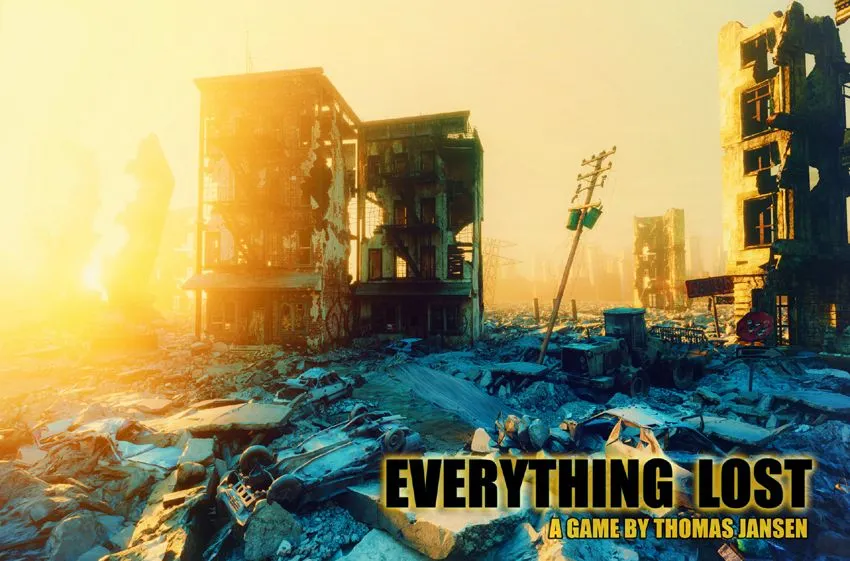
Everything Lost is a thematic solo game set in an apocalyptic world in which you are the hero. One day, you wake up. Like always, the first thing you do is open your curtains to look outside......to find out this day is different. You are stunned. Everything is lost. Your town is destroyed. Roads are gone, rubble is everywhere. Most buildings which are still standing look like skeletons. A few people are out there, stumbling goalless between the chaos, like... zombies. What is this? What happened? For how long have you been sleeping? You open your fridge. The smell! You close it fast. You feel a cold breeze. You look up. You notice almost half of your roof is missing. You’re shaking. It’s freezing. You start to feel a primal drift. You realize no one is here to help you. You have got to take care of things. Danger is out there. Instinctively you grab a tool from your toolbox and go outside. A game of Everything Lost consists of 4 chapters. In every chapter you choose 1 (out of 2 or 3) missions to play. Each mission starts at your home, the centre of town. You explore the 4 sectors surrounding your home. When you survive all 4 missions, you win. Search for food, repair your roof, steal a bulldozer and ram a warehouse, save survivors from a mall, eliminate a gang of outlaws, etc. Next time you may follow a different path, by choosing different missions. On your map you draw the city with your pencil as the game progresses. Your 5 white dice represent your energy. Use them well. If you spend a lot of dice, your chances will increase, but you will run out of dice fast. When you do, you will need to rest to get them back. This is risky. The mob will grow and events will force you to make difficult choices. Break in buildings to find useful things and weapons, search the rubble, fight zombies and look for survivors. Convince them to join your team. Get more experienced and unlock new skills and actions. Eventually you will craft new weapons, climb buildings and attack the mob from above, or ambush them. Who’s the boss now? But only if you are a real survivor. Will you earn yourself one of the 4 available nicknames? Good luck! —description from the designer
Everything Lost supports 1 player according to the catalogue. This is the publisher’s listed player count, so the game is designed for exactly that number of participants. Variants for other group sizes, if any, are described in the rulebook of your edition, so check it before setting up a different configuration.
The listed playing time for Everything Lost is 45–90 minutes. This is the publisher’s estimate for a full game. The actual duration depends on the group, the player count and familiarity with the rules: first sessions usually run longer, while experienced groups often finish faster. Setup and teaching time are not included in this estimate.
The catalogue lists Everything Lost for ages 14 and up. This is the publisher’s recommendation and reflects reading demands, rule complexity and small components rather than theme alone. Younger players can often join with help from an adult, so check the age guidance on your edition and consider your group’s experience with board games.
Everything Lost has a complexity rating of 2.3 out of 5 from BoardGameGeek players, which makes it a medium-light game. The rating reflects how much rules knowledge, planning and decision-making a typical game demands. Expect a longer first teach for heavier games, and use a preparation guide before game night.
Everything Lost belongs to these categories: Dice, Zombies, and Exploration. Its main mechanics are Push Your Luck, Dice Rolling, and Paper-and-Pencil. Categories describe the theme and setting of a game, while mechanics describe what players actually do on their turns. Each mechanic links to a catalogue hub with similar games, which helps when you want something comparable.
The credited designers of Everything Lost are: Thomas Jansen. These credits come from the published game data and name the people responsible for the game’s design, not its illustrators or publishers. Designer pages on MeepleRules collect other titles by the same designers, which helps when you enjoy a game and want to find similar ones.
The catalogue lists Everything Lost as a base game. It can be played on its own with the components in the box and does not require any other title. Expansions, if any exist, add new content or rules on top of it and are listed separately in the catalogue with a link back to this base game.