

- BGG rank
- BGG #175
- BGG rating
- 7.5
Pandemic
- 2–4 players
- 45 min
- Complexity 2.4/5
- 2008
2018
Rules assistance for Fall of Rome
Plain-language explanations of turns, card effects and disputed situations, with official source references and saved question history.
For 1 player
What would you like to know?
Answers come from the official rulebook, with the page to check.
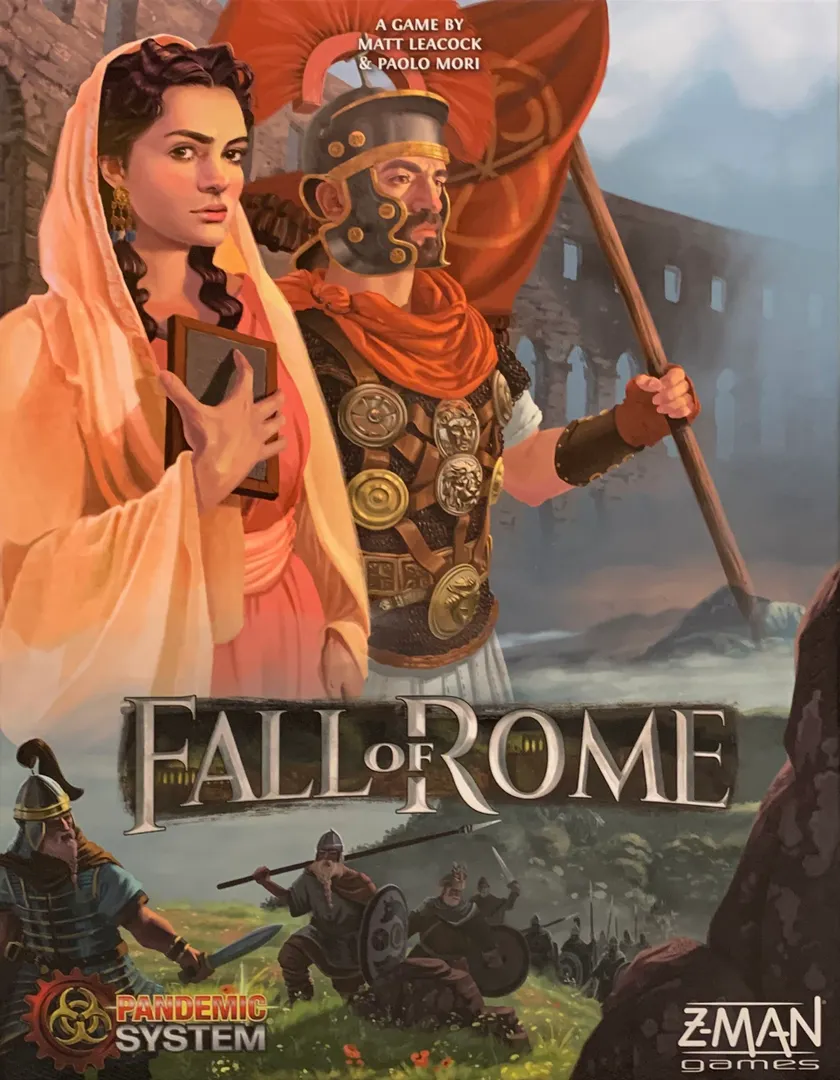
Fall of Rome is a board game released in 2018 for 1–5 players, 45–60 minutes per game, and ages 8 and up. It was designed by Matt Leacock and Paolo Mori and its main mechanics are Variable Player Powers, Hand Management, and Set Collection.








At the height of its power, the Roman Empire held more than two million square miles of territory containing over a hundred million people. Throughout the centuries of its existence, the Empire brought major advancements in engineering, architecture, science, art, and literature. By the beginning of the 5th Century, decades of political corruption, economic crisis, and an overburdened military had exacted a severe toll on the stability of the Empire. This paved the way for severe incursions from aggressive barbarian tribes, leading to a decline from which Rome would not recover. Now citizens, soldiers, and allies of Rome must unite to protect the Empire. Combining the cooperative gameplay of Pandemic with innovative new mechanisms, Pandemic: Fall of Rome takes players back in history to the time of the world's greatest empire: Rome. A weakened military has left the borders open to invasion from countless tribes such as the Anglo-Saxons, Goths, Vandals, and Huns. As you march through the Roman Empire, you must recruit armies, fortify cities, forge alliances, and face off against the invading hordes in battle. Simply defending Rome is not enough; players must find a way to stop the incursions and find peace with their neighboring peoples. Players collect sets of matching-colored cards to forge an alliance with the different tribes. In doing so, they gain the ability to use cards matching the tribe to convert other members of that tribe into Roman soldiers, furthering their ability to hold the line against other invaders. Take on unique roles with special abilities to improve your team's chances to protect against the invaders. Work together, use your skills wisely, and stop the fall of Rome! Pandemic: Fall of Rome includes a solitaire mode in which the player takes on the burden of being the Emperor and commands three different roles to try to protect the city from the invading hordes. Players who want a more difficult game can try the "Roma Caput Mundi" challenge by adding more Revolt cards to the deck; they must also respect the law in Rome that Roman legions are not allowed in the city. —description from the publisher
Fall of Rome supports 1–5 players according to the catalogue. This range comes from the publisher’s listed player count, so the game can be set up for any group size within it. Some setups, rules and scoring details may still vary by player count, so check your edition’s rulebook for the exact configuration.
The listed playing time for Fall of Rome is 45–60 minutes. This is the publisher’s estimate for a full game. The actual duration depends on the group, the player count and familiarity with the rules: first sessions usually run longer, while experienced groups often finish faster. Setup and teaching time are not included in this estimate.
The catalogue lists Fall of Rome for ages 8 and up. This is the publisher’s recommendation and reflects reading demands, rule complexity and small components rather than theme alone. Younger players can often join with help from an adult, so check the age guidance on your edition and consider your group’s experience with board games.
Fall of Rome has a complexity rating of 2.5 out of 5 from BoardGameGeek players, which makes it a medium-light game. The rating reflects how much rules knowledge, planning and decision-making a typical game demands. Expect a longer first teach for heavier games, and use a preparation guide before game night.
Fall of Rome belongs to these categories: Ancient. Its main mechanics are Variable Player Powers, Hand Management, and Set Collection. Categories describe the theme and setting of a game, while mechanics describe what players actually do on their turns. Each mechanic links to a catalogue hub with similar games, which helps when you want something comparable.
The credited designers of Fall of Rome are: Matt Leacock and Paolo Mori. These credits come from the published game data and name the people responsible for the game’s design, not its illustrators or publishers. Designer pages on MeepleRules collect other titles by the same designers, which helps when you enjoy a game and want to find similar ones.
The catalogue lists Fall of Rome as a base game. It can be played on its own with the components in the box and does not require any other title. Expansions, if any exist, add new content or rules on top of it and are listed separately in the catalogue with a link back to this base game.