- BGG rank
- BGG #2,274
- BGG rating
- 6.9
Château Roquefort
- 2–4 players
- 30 min
- Complexity 1.6/5
- 2007
2017
Rules assistance for Five Little Fish
Plain-language explanations of turns, card effects and disputed situations, with official source references and saved question history.
What would you like to know?
Answers come from the official rulebook, with the page to check.
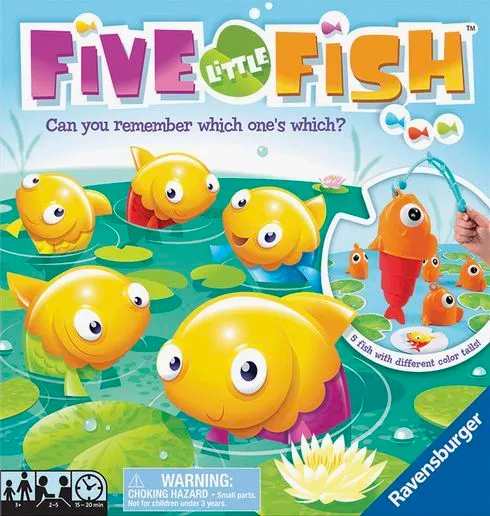
Five Little Fish is a board game released in 2017 for 2–4 players and ages 3 and up. Its main mechanics are Memory.





Fish or Frog, what’s hiding under the Lily Pads? It’s a classic game of matching with a clever twist that will keep parents and children guessing. Flip a Lily Pad Card to see which fish you need to catch. Use a Fishing Rod to hook the fish you think will match. Reel it in to reveal its telescoping colored tail. If it’s a match, you keep the catch! Pay close attention! If you flip over Grumpy Frog’s Lily Pad, you throw a fish back. Can you remember which one’s which? Catch the most fish to win! Place all the Little Fish in the center of the table so the heads face up, and the telescoping tails are tucked inside. Shuffle the Little Fish so no one knows which one’s which and put the Fishing Rods to the side. Shuffle the Lily Pad cards and lay them face down around the Little Fish. The youngest player goes first! Start by turning over a Lily Pad Card of your choice. If the Lily Pad shows a… Fish – Take a Fishing Rod, choose any one of the Little Fish on the table and hook it with the Fishing Rod. Lift the Little Fish so that everyone can see which colored body falls out from underneath the head. If it matches the fish shown on the Lily Pad Card, place it down on the table in front of you, making sure to collapse the body back inside its head. If there is no match, then the Little Fish you chose remains in its current position. Rainbow Fish – Choose ANY one of the Little Fish and drag it in front of you. Do NOT lift it up and reveal the color of the body. If there are no Little Fish in the middle of the table, then you may take one Little Fish sitting in front of another player, careful to not reveal the body of the Little Fish. Grumpy Frog – Bad Luck! Push one of your Little Fish from in front of you back in the middle of the table. Do NOT lift it up and reveal the colored body inside. If you don’t have a Little Fish in front of you then nothing happens and your turn is over. If you turn over a Lily Pad card that reveals a Little Fish that you think is already in front of you, then you can use a Fishing Rod to lift it up and show the match. If you’re correct, you may turn over another Lily Pad Card and have another turn. If you do not reveal the matching Little Fish, your turn is over. The game ends when all the Lily Pad Cards have been discarded. The player with the most fish in front of them wins! If it’s a tie, players will check the tail tips of their Little Fish – the player with the highest number on their Little Fish wins the game!
Five Little Fish supports 2–4 players according to the catalogue. This range comes from the publisher’s listed player count, so the game can be set up for any group size within it. Some setups, rules and scoring details may still vary by player count, so check your edition’s rulebook for the exact configuration.
The catalogue lists Five Little Fish for ages 3 and up. This is the publisher’s recommendation and reflects reading demands, rule complexity and small components rather than theme alone. Younger players can often join with help from an adult, so check the age guidance on your edition and consider your group’s experience with board games.
Five Little Fish has a complexity rating of 1.0 out of 5 from BoardGameGeek players, which makes it a light game. The rating reflects how much rules knowledge, planning and decision-making a typical game demands. Expect a longer first teach for heavier games, and use a preparation guide before game night.
Five Little Fish belongs to these categories: Animals, Children's Game, and Memory. Its main mechanics are Memory. Categories describe the theme and setting of a game, while mechanics describe what players actually do on their turns. Each mechanic links to a catalogue hub with similar games, which helps when you want something comparable.
The catalogue lists Five Little Fish as a base game. It can be played on its own with the components in the box and does not require any other title. Expansions, if any exist, add new content or rules on top of it and are listed separately in the catalogue with a link back to this base game.


