

- BGG rank
- BGG #9,829
- BGG rating
- 8.0
Fatal Alliances: The Great War 1914-1918
- 2–6 players
- 240–1200 min
- Complexity 4.1/5
- 2016
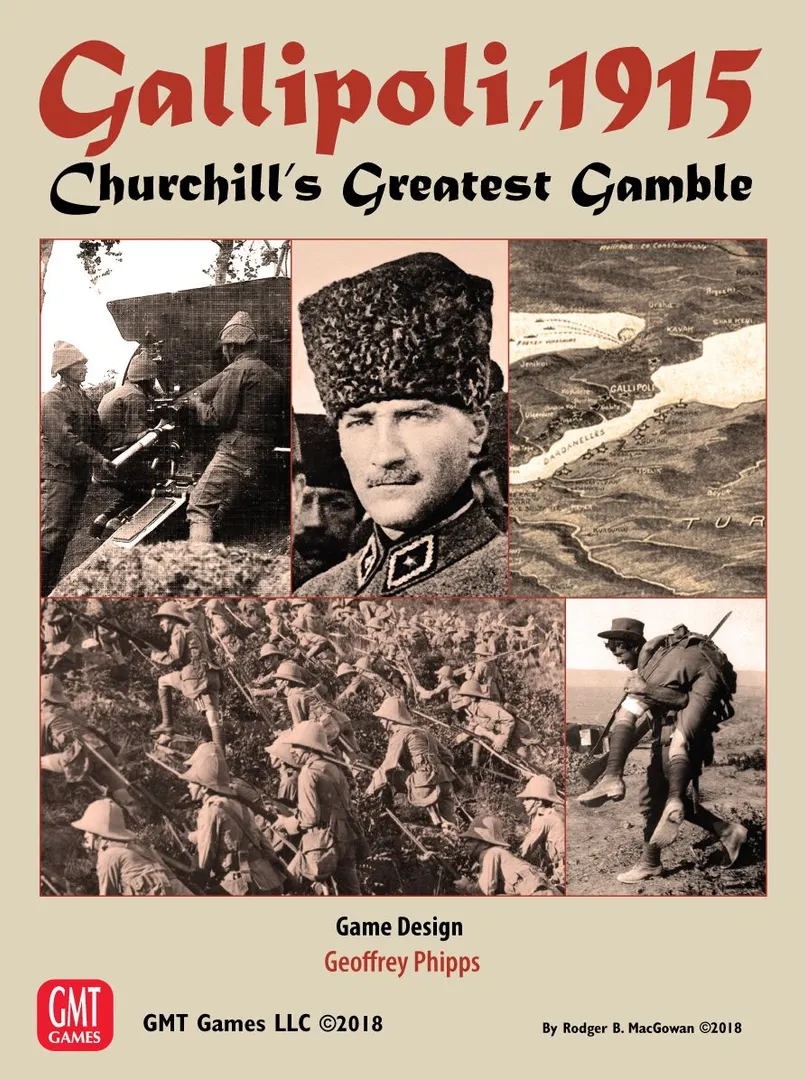
2018
Rules assistance for Gallipoli, 1915: Churchill's Greatest Gamble
Plain-language explanations of turns, card effects and disputed situations, with official source references and saved question history.
For 1 player
What would you like to know?
Answers come from the official rulebook, with the page to check.
Gallipoli, 1915: Churchill's Greatest Gamble is a board game released in 2018 for 1–4 players, 240 minutes per game, and ages 16 and up. It was designed by Geoffrey Phipps and its main mechanics are Dice Rolling, Grid Movement, and Hexagon Grid.






"Gallipoli, 1915: Churchill's Greatest Gamble", realistically covers the first three days of the campaign, a time of wild maneuver, of decisive attacks parried by the timely arrival of reinforcements, and the onset of trench warfare. Speed - but not reckless haste - is the key to success. On 25th April 1915, Winston Churchill, First Lord of the Admiralty, launched a hastily assembled force of British, Australian, New Zealand and French troops against the Turkish defenses on the Gallipoli peninsula. Their goal was to capture the forts that guarded the Dardanelles. With that achieved, the British and French Fleets would sail to Constantinople, topple the Ottoman government, and open up a supply line to Russia. However, defending the beaches was an equal number of Turkish divisions, hardened in the recent Balkan Wars, led by well-trained Turkish officers, supported by advisors from the German General Staff. An hour before dawn, in complete silence, the Anzacs rowed ashore at Ari Burnu, a place later to be famous as Anzac Cove. The Royal Navy had landed them in the wrong place! Huge dirt cliffs and scrub-choked washouts confronted them, rather than a beach and low dunes. Nevertheless inland they went, overrunning the Turkish pickets, only to become hopelessly confused by the night landing, jigsaw terrain, and inexperience. Several miles inland, a gifted Turkish Officer, Mustafa Kemal, was reviewing his regiment after night maneuvers above Ari Burnu. Kemal's quick and furious counter-attack saved the day for the Ottomans, and set him on the path to become the founder of modern Turkey. Further south, at Cape Helles, the Lancashire Fusiliers won six Victoria Crosses - before breakfast - as they ripped through the barbed wire on the beach. The invaders never reached even their first day's objectives, although the Turks only avoided defeat by a hair's breadth. With a different plan, they might have thrown the invaders back into the sea. The map scale is 400 metres per hex and covers the entire peninsula from north of Anzac Cove to Cape Helles, based on the 1922 British Ordnance Survey (i.e. from Anzac to Helles, including all the forts in between). Players can choose to land at the historical beaches, or create their own plans. This wargame system emphasizes command and control. Players command by Brigade and Regiment. To be successful, a player must plan for the eventual exhaustion of their troops, rotating them out of line to rest and recover stragglers. The result is an accurate modeling of the tempo of these battles. Infantry combat is ranged rifle and MG fire, culminating in close assault. Artillery is powerful but ultimately limited. Shrapnel from the standard field guns is deadly against troops in the open, but only the rare howitzers firing high-angle HE can deal with trenches. Daylight turns are two hours, night turns are four hours.
Gallipoli, 1915: Churchill's Greatest Gamble supports 1–4 players according to the catalogue. This range comes from the publisher’s listed player count, so the game can be set up for any group size within it. Some setups, rules and scoring details may still vary by player count, so check your edition’s rulebook for the exact configuration.
The listed playing time for Gallipoli, 1915: Churchill's Greatest Gamble is 240 minutes. This is the publisher’s estimate for a full game. The actual duration depends on the group, the player count and familiarity with the rules: first sessions usually run longer, while experienced groups often finish faster. Setup and teaching time are not included in this estimate.
The catalogue lists Gallipoli, 1915: Churchill's Greatest Gamble for ages 16 and up. This is the publisher’s recommendation and reflects reading demands, rule complexity and small components rather than theme alone. Younger players can often join with help from an adult, so check the age guidance on your edition and consider your group’s experience with board games.
Gallipoli, 1915: Churchill's Greatest Gamble has a complexity rating of 4.3 out of 5 from BoardGameGeek players, which makes it a heavy game. The rating reflects how much rules knowledge, planning and decision-making a typical game demands. Expect a longer first teach for heavier games, and use a preparation guide before game night.
Gallipoli, 1915: Churchill's Greatest Gamble belongs to these categories: Wargame and World War I. Its main mechanics are Dice Rolling, Grid Movement, and Hexagon Grid. Categories describe the theme and setting of a game, while mechanics describe what players actually do on their turns. Each mechanic links to a catalogue hub with similar games, which helps when you want something comparable.
The credited designers of Gallipoli, 1915: Churchill's Greatest Gamble are: Geoffrey Phipps. These credits come from the published game data and name the people responsible for the game’s design, not its illustrators or publishers. Designer pages on MeepleRules collect other titles by the same designers, which helps when you enjoy a game and want to find similar ones.
The catalogue lists Gallipoli, 1915: Churchill's Greatest Gamble as a base game. It can be played on its own with the components in the box and does not require any other title. Expansions, if any exist, add new content or rules on top of it and are listed separately in the catalogue with a link back to this base game.