- BGG rank
- BGG #2,859
- BGG rating
- 7.9
Gandhi: The Decolonization of British India, 1917 – 1947
2019
Rules assistance for Gandhi: The Decolonization of British India, 1917 – 1947
Plain-language explanations of turns, card effects and disputed situations, with official source references and saved question history.
- 1–4 players
- 90–240 min
- 14+
- Complexity 4.2/5

For 1 player
Rules assistant for Gandhi: The Decolonization of British India, 1917 – 1947
What would you like to know?
Answers come from the official rulebook, with the page to check.
Gandhi: The Decolonization of British India, 1917 – 1947 is a board game released in 2019 for 1–4 players, 90–240 minutes per game, and ages 14 and up. It was designed by Bruce Mansfield and its main mechanics are Variable Player Powers, Area Movement, and Dice Rolling.
About the game
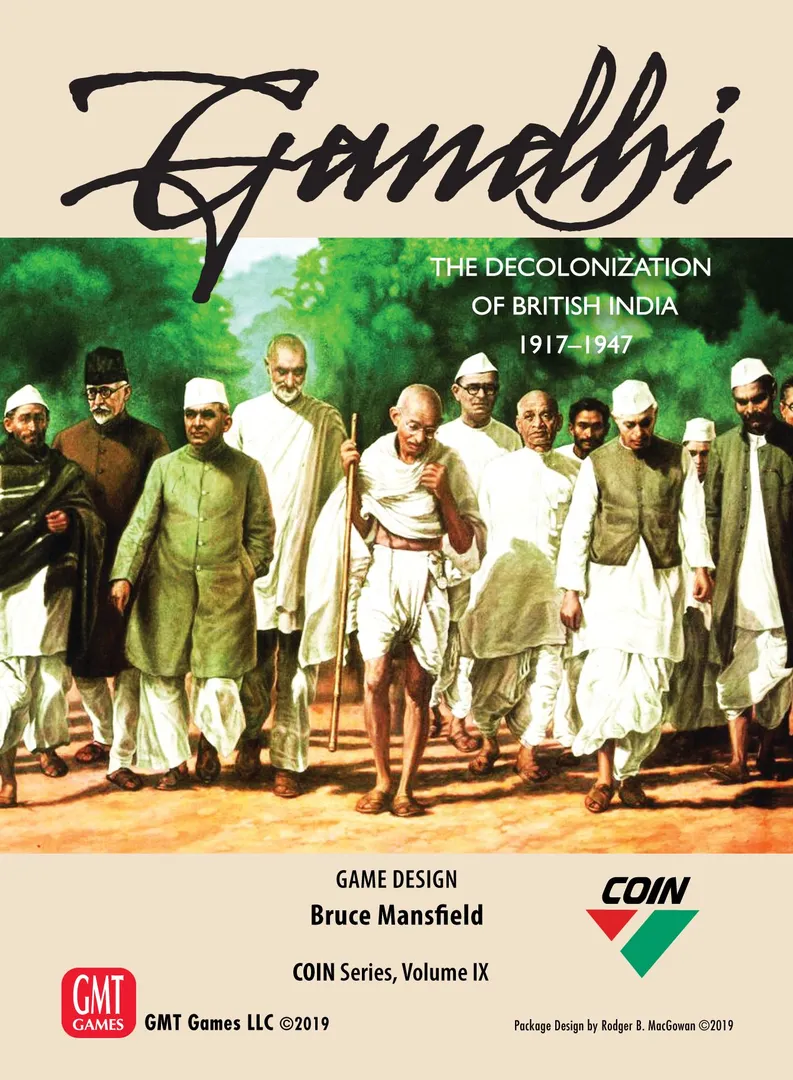
Gandhi: The Decolonization of British India, 1917–1947 is Volume IX in GMT’s acclaimed COIN Series. Exploring one of the world’s most prominent experiments with nonviolent resistance, Gandhi takes us to the subcontinent of India, the jewel in the crown of the British Empire, for a detailed look at the final decades of the British Raj. 1 to 4 players compete to determine the future of India; will the transition to home rule be a peaceful one, will India be split apart by partition or civil war, or will it remain firmly in the grip of empire? Gandhi offers a fresh perspective on the history of insurgency with the addition of a new type of faction to the COIN Series, the Nonviolent (NV) faction, while retaining the multi-faction, asymmetrical, card-assisted system of earlier titles in the COIN Series. COIN veterans will be able to jump right in. Other features include: Gandhi as the game’s sole leader piece. Nonviolent operations and special activities. Nonviolent activists that are always active, but generally immune from Raj actions until engaged in protests (or caught up in post-terror reprisals). Protests that erode support but leave activists vulnerable to arrest by Raj forces. A Hindu-Muslim Unity track that measures tensions between these two communities, affecting resources, operations, and victory. A British Rule track that reflects shifts in colonial policy in response to events on the map, from resolve to restraint, affecting the cost of several actions. British Viceroys who come and go with each passing campaign and have their own unique effects on each faction. An out-of-play jail space that holds nonviolent forces arrested during martial law. Pieces can be kept in jail over several campaigns, but at a cost to the Raj. Independent Princely States that are never controlled by any faction, yet offer a haven for violent and nonviolent insurgents alike. Short and medium-length scenarios that allow for the study of different periods of the struggle against British rule in India. Support for solitaire, 2-player, 3-player, and 4-player games. In Gandhi, players will face a range of difficult and interesting strategic choices. Following in the innovative footsteps of previous COIN titles, Gandhi weaves together historical, political, and cultural threads and offers an opportunity to study nonviolent and violent resistance in one of the most significant colonial possessions from the age of European imperialism. Civil disobedience and non-cooperation, protests and terror, imperialism and constructive programme, growing unrest, negotiation, agitation, assassination, persuasion, boycotts, martial law, and many other options await. “Gandhi made it impossible for us to go on ruling India, but at the same time he made it possible for us to abdicate without rancor and without dishonour.” — British Historian Arnold Toynbee
Categories
Mechanics
Designers
Publishers
- GMT Games
Questions and answers
Gandhi: The Decolonization of British India, 1917 – 1947 supports 1–4 players according to the catalogue. This range comes from the publisher’s listed player count, so the game can be set up for any group size within it. Some setups, rules and scoring details may still vary by player count, so check your edition’s rulebook for the exact configuration.
The listed playing time for Gandhi: The Decolonization of British India, 1917 – 1947 is 90–240 minutes. This is the publisher’s estimate for a full game. The actual duration depends on the group, the player count and familiarity with the rules: first sessions usually run longer, while experienced groups often finish faster. Setup and teaching time are not included in this estimate.
The catalogue lists Gandhi: The Decolonization of British India, 1917 – 1947 for ages 14 and up. This is the publisher’s recommendation and reflects reading demands, rule complexity and small components rather than theme alone. Younger players can often join with help from an adult, so check the age guidance on your edition and consider your group’s experience with board games.
Gandhi: The Decolonization of British India, 1917 – 1947 has a complexity rating of 4.2 out of 5 from BoardGameGeek players, which makes it a heavy game. The rating reflects how much rules knowledge, planning and decision-making a typical game demands. Expect a longer first teach for heavier games, and use a preparation guide before game night.
Gandhi: The Decolonization of British India, 1917 – 1947 belongs to these categories: Wargame and Modern Warfare. Its main mechanics are Variable Player Powers, Area Movement, and Dice Rolling. Categories describe the theme and setting of a game, while mechanics describe what players actually do on their turns. Each mechanic links to a catalogue hub with similar games, which helps when you want something comparable.
The credited designers of Gandhi: The Decolonization of British India, 1917 – 1947 are: Bruce Mansfield. These credits come from the published game data and name the people responsible for the game’s design, not its illustrators or publishers. Designer pages on MeepleRules collect other titles by the same designers, which helps when you enjoy a game and want to find similar ones.
The catalogue lists Gandhi: The Decolonization of British India, 1917 – 1947 as a base game. It can be played on its own with the components in the box and does not require any other title. Expansions, if any exist, add new content or rules on top of it and are listed separately in the catalogue with a link back to this base game.