

- BGG rank
- BGG #11,283
- BGG rating
- 7.5
Final Act
- 2 players
- 50–70 min
- Complexity 2.1/5
- 2016
2019
Rules assistance for GladiGala
Plain-language explanations of turns, card effects and disputed situations, with official source references and saved question history.
For 2 players
What would you like to know?
Answers come from the official rulebook, with the page to check.
GladiGala is a board game released in 2019 for 2–4 players, 45–60 minutes per game, and ages 10 and up. It was designed by Sharon Katz and its main mechanics are Simultaneous Action Selection and Action Queue.


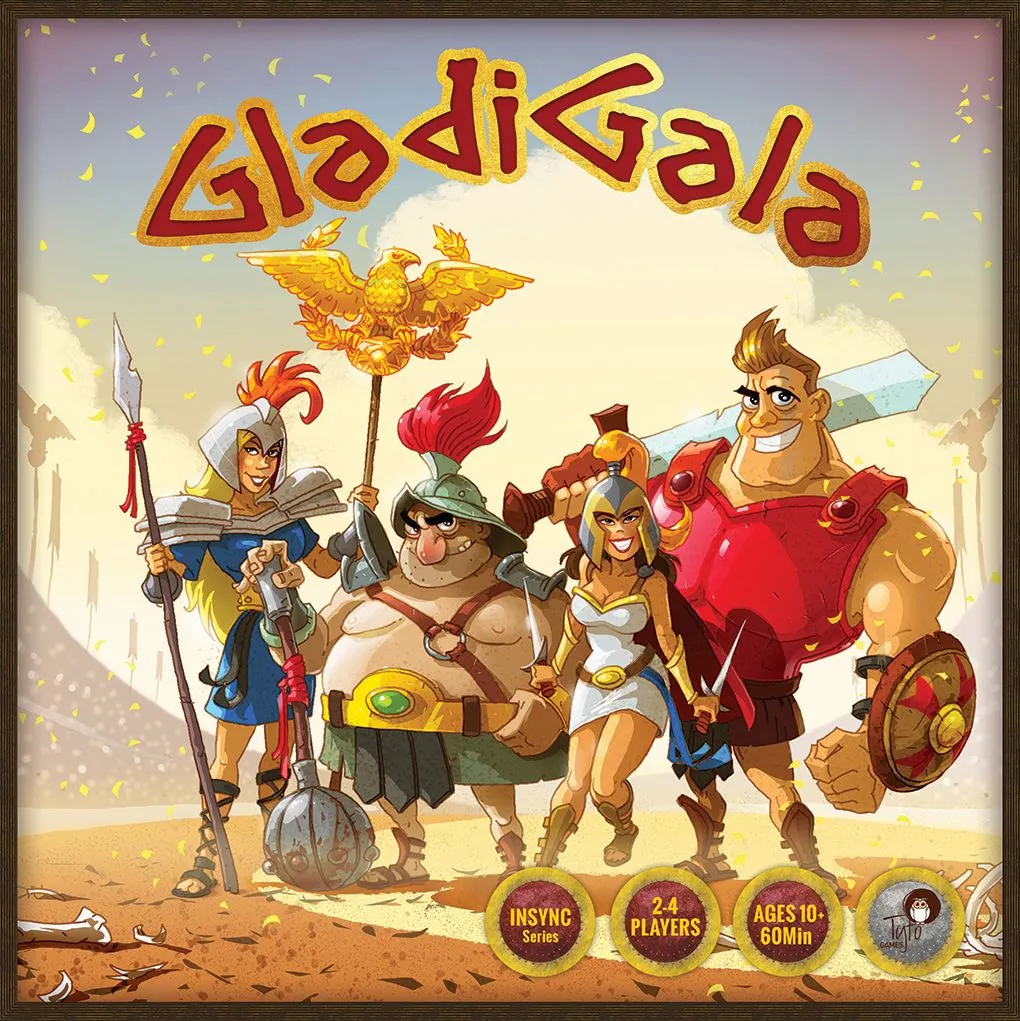
GladiGala is a 2-4 player skirmish style family game of fast paced tactics and simultaneous play – a tactical rush for fame & fortune. In GladiGala players take the role of gladiator school leaders who meet in the arena for a day of a tactical show off. Your objective is to finish the day (after playing 2 matches, morning and afternoon) as the most decorated gladiator school of Rome, and winner of the day! Players can achieve this in 2 ways: either capture an opponent's Eagle (and receive Medal of Eagle), or by having the most denarii (GladiGala's coins) in your Treasury as a match ends (receive Medal of Coin). In GladiGala all the results of what happens in the arena are translated into coins, by which players can also manage their gladiator team during the match (upgrade a hurt gladiator, create advanced maneuvers, or enter the arena's "Safe Zone"). As a Gladiator School Leader it is up to you to gain coins and fill your Treasury for marvelous tactical performances and for making accurate strategic choices. Outwit your opponents, make the most of your gladiators' formation, manage your Treasury wisely, and get the crowds on your side chanting GladiGala's mantra: "Always aim for an eagle – always stand guard!" GladiGala is a simultaneous game played in multiple rounds. First, players use magnetic panels/cards to give movements, maneuvering, and action orders to all gladiators. Each game players enter the arena with a different gladiator formation, made from GladiGala's 4 gladiator types: Sword, Spear, Dagger, and Club, each has a different set of abilities. After giving movements orders, players place their attacks trying to anticipate their opponent's moves. Finally, cards are revealed and all gladiators perform accordingly. A gladiator moving to an attacked area is marked as "Hit". A gladiator hit twice is out of the arena! Welcome to Rome, 101 A.D. The city's center stage is set up and ready for GladiGala, the year's greatest show of skill in the arena. Rome's 4 finest Gladiator Schools; ACADEMIA – LEO – SOLIS & SPIRITUS – appear in the arena for a glorious day of tactical contest in the pursuit of title and Medal of Champion! Morning rises and the crowds make their way to the arena. The teams all gear up, final preparations are made, last instructions are given. Your gladiator formation for the morning match is set and ready to head out the gate. Your gladiators are holding to their eagle, your house symbol of honor and respect. You hope they will be holding it to the end… Trumpets are blown, the crowds are ecstatic: "open the gates!" you hear them shouting, frantic. GladiGala begins: Shlak Shlak Shlak – all gates are raised announcing it's time to storm Rome's most celebrated central stage! —description from the designer
GladiGala supports 2–4 players according to the catalogue. This range comes from the publisher’s listed player count, so the game can be set up for any group size within it. Some setups, rules and scoring details may still vary by player count, so check your edition’s rulebook for the exact configuration.
The listed playing time for GladiGala is 45–60 minutes. This is the publisher’s estimate for a full game. The actual duration depends on the group, the player count and familiarity with the rules: first sessions usually run longer, while experienced groups often finish faster. Setup and teaching time are not included in this estimate.
The catalogue lists GladiGala for ages 10 and up. This is the publisher’s recommendation and reflects reading demands, rule complexity and small components rather than theme alone. Younger players can often join with help from an adult, so check the age guidance on your edition and consider your group’s experience with board games.
GladiGala has a complexity rating of 1.0 out of 5 from BoardGameGeek players, which makes it a light game. The rating reflects how much rules knowledge, planning and decision-making a typical game demands. Expect a longer first teach for heavier games, and use a preparation guide before game night.
GladiGala belongs to these categories: Ancient. Its main mechanics are Simultaneous Action Selection and Action Queue. Categories describe the theme and setting of a game, while mechanics describe what players actually do on their turns. Each mechanic links to a catalogue hub with similar games, which helps when you want something comparable.
The credited designers of GladiGala are: Sharon Katz. These credits come from the published game data and name the people responsible for the game’s design, not its illustrators or publishers. Designer pages on MeepleRules collect other titles by the same designers, which helps when you enjoy a game and want to find similar ones.
The catalogue lists GladiGala as a base game. It can be played on its own with the components in the box and does not require any other title. Expansions, if any exist, add new content or rules on top of it and are listed separately in the catalogue with a link back to this base game.