- BGG rank
- BGG #15,729
- BGG rating
- 7.7
Guam: Return to Glory
2017
Rules assistance for Guam: Return to Glory
Plain-language explanations of turns, card effects and disputed situations, with official source references and saved question history.
- 1–4 players
- 120–2100 min
- Complexity 3.7/5

For 1 player
Rules assistant for Guam: Return to Glory
What would you like to know?
Answers come from the official rulebook, with the page to check.
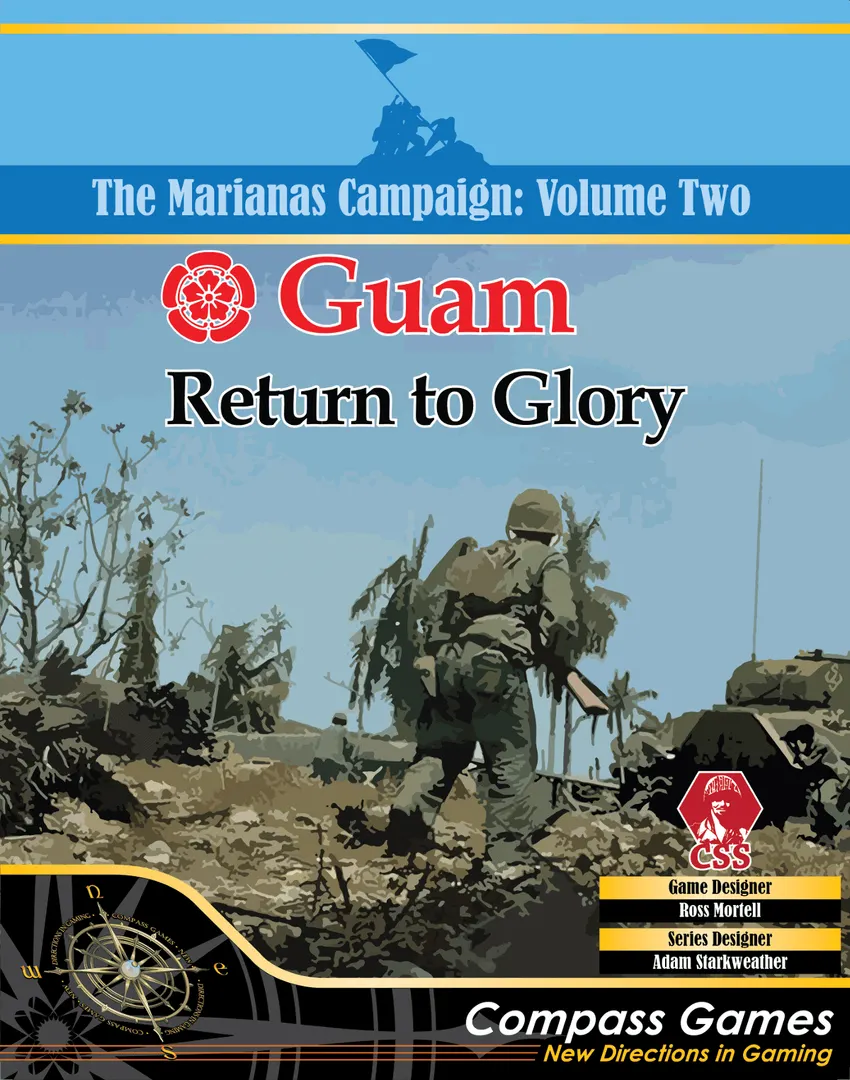
Guam: Return to Glory is a board game released in 2017 for 1–4 players and 120–2100 minutes per game. It was designed by Adam Starkweather and Ross Mortell and its main mechanics are Dice Rolling, Hexagon Grid, and Chit-Pull System.
About the game
On the 8th December 1941 American soil was invaded for the first time in the war, the small American and Guananian garrison was overrun and 2 days later the Govenor surrendered the Island to the Japanese. On 21st July 1944 the Americans would return to retake the island and drive the Japanese invaders off; a day that is still celebrated as 'Liberation Day'. There were many reasons why the Americans decided to invade Guam not least of which was the fact that the station of the trans-Pacific cable and the naval radio station at Agana made it a focal point of the communication network in the Pacific. It also had the best anchorage in the Marianas, 2 airstrips and, of course, it was an American Protectorate. The only beaches suitable for an invasion are located on the south-western side of the island. The Japanese knew this as well and had prepared accordingly. Another thing unique to the planning was that the 2 landing beaches chosen would be 7 miles apart. It was unprecedented for two landing forces to land with such a wide separation. Guam – Return to Glory will be the second game to utilize the Company Scale System (CSS) by Adam Starkweather and will come on 4 maps. The game will come with 6 scenarios and 1 campaign game: W-Day – Fortune favors the bold – This is the first day of the Invasion on the northern beaches. 3rd Marine Division must land against Japanese defenders dug-in on a ridge overlooking the beaches. Single map and 8 turns long. W-Day – Send in the Fire Brigade – This is the first day of the Invasion on the southern beaches. The 1st Provisional Marine Brigade must land and fight their way north towards Orote Peninsular to join up the to beachheads. Single map and 8 turns long. W-DAY - This is the first day of the Invasion on the both beaches. The 1st Provisional Marine Brigade must land and fight their way north, whilst the 3rd Marines fight their way south and the two forces try to join up the two beachheads near Orote Peninsular. Two maps and 8 turns long. Orote Peninsular – The first 8 days of the fighting saw the Americans expand their beachheads and join up so as to cut off the Orote peninsular with it's important airfield. Once it was cut off, the Americans, then, had to force their way into the heaviest defended area on Guam not knowing that the Japanese were preparing a Sake fueled Banzai charge. Two maps and 72 turns long. Into the Jungle - This scenario covers 3rd Marine Division's drive north of the beachheads to take the town of Agana and the airfield at Tiyan. One map and 27 turns long. Santa Rosa - This scenario covers 77th Infantry Division's attack to isolate the area around Mount Santa Rosa . One map and 27 turns long. The Battle for Guam – The full historical campaign from 21st July- 10th August (188 Turns). This game covers the full fight for Guam in 1944, from the first invasion at Asan, in the north, and Agat, in the south through the vicious fighting in the thick vegetation at the south end of the island and the final Japanese stand in the north. Complexity: 6 Solitaire Suitability:8 Time Scale: 1 turn = 2 hours Map Scale: 1 hex = 500 meters Unit Scale: Companies and below Players: Best with 2 players but can be played with up to 4 players as well as solitaire Playing Time: 2-35 hours Series Designer: Adam Starkweather Game Designer: Ross Mortell Developer: Adam Starkweather Artist: Antonio Pinar Peña Components: 4 maps 6 countersheets 1 series Rulesbook 1 game specific rulesbook 7 player aids, charts, tables cards 2 ten-sided dice 1 Box and Lid set
Categories
Designers
Publishers
- Compass Games
Questions and answers
Guam: Return to Glory supports 1–4 players according to the catalogue. This range comes from the publisher’s listed player count, so the game can be set up for any group size within it. Some setups, rules and scoring details may still vary by player count, so check your edition’s rulebook for the exact configuration.
The listed playing time for Guam: Return to Glory is 120–2100 minutes. This is the publisher’s estimate for a full game. The actual duration depends on the group, the player count and familiarity with the rules: first sessions usually run longer, while experienced groups often finish faster. Setup and teaching time are not included in this estimate.
Guam: Return to Glory has a complexity rating of 3.7 out of 5 from BoardGameGeek players, which makes it a medium-weight game. The rating reflects how much rules knowledge, planning and decision-making a typical game demands. Expect a longer first teach for heavier games, and use a preparation guide before game night.
Guam: Return to Glory belongs to these categories: Wargame and World War II. Its main mechanics are Dice Rolling, Hexagon Grid, and Chit-Pull System. Categories describe the theme and setting of a game, while mechanics describe what players actually do on their turns. Each mechanic links to a catalogue hub with similar games, which helps when you want something comparable.
The credited designers of Guam: Return to Glory are: Adam Starkweather and Ross Mortell. These credits come from the published game data and name the people responsible for the game’s design, not its illustrators or publishers. Designer pages on MeepleRules collect other titles by the same designers, which helps when you enjoy a game and want to find similar ones.
The catalogue lists Guam: Return to Glory as a base game. It can be played on its own with the components in the box and does not require any other title. Expansions, if any exist, add new content or rules on top of it and are listed separately in the catalogue with a link back to this base game.