

- BGG rank
- BGG #15,226
- BGG rating
- 7.2
Desert Fox Deluxe
- 2 players
- 180–2880 min
- Complexity 3.1/5
- 2016
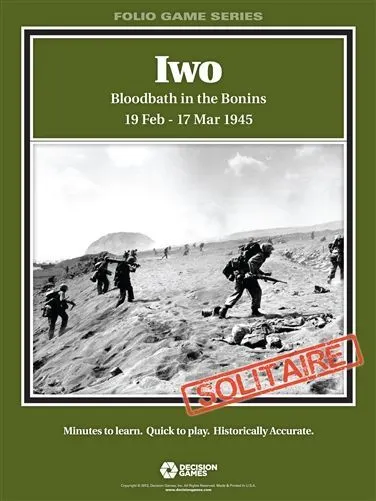
2013
Rules assistance for Iwo: Bloodbath in the Bonins 19 Feb – 17 Mar 1945
Plain-language explanations of turns, card effects and disputed situations, with official source references and saved question history.
For 1 player
What would you like to know?
Answers come from the official rulebook, with the page to check.
Iwo: Bloodbath in the Bonins 19 Feb – 17 Mar 1945 is a board game released in 2013 for 1–2 players, 60–120 minutes per game, and ages 12 and up. It was designed by Chris Perello and its main mechanics are Dice Rolling, Hexagon Grid, and Simulation.




Iwo, Bloodbath in the Bonins 19 Feb – 17 Mar 1945, is a solitaire board-wargame using a modification of the Series: Fire & Movement combat system (Decision Games). Developed to portray the mechanized battlefields of a later generation, F&M stresses the use of fire support to generate breakthroughs, followed by a rapid penetration by mobile reserves. Iwo Jima was a critical point on the flight path of US bombers from their Saipan bases to their Japanese targets. The island would be a refuge for malfunctioning or damaged bombers coming or going. An obvious target for a US amphibious assault, the Japanese had reinforced the garrison and dug miles of tunnels the length and breadth of the island. Their goal was to inflict maximum casualties on the Americans to force them to reconsider the seemingly inevitable invasion of Japan. The resulting battle was brutal, even by the standards of the Pacific War. On Iwo, the Japanese fought from within an extensive tunnel network, neutralizing the usual fire support effects and limiting maneuver to the US approach to each fortified position. The Japanese units are hidden, their strength revealed only at the instant of combat, so the US player must mass against a position to play it safe, using fire support to suppress the defenders and so reduce attacker casualties (a key victory condition]. On the other hand, the US player must clear the island to win, and time is not on his side. Sooner or later he must take risks to push the battle forward. Taking some terrain, like Mount Suribachi, is critical to weakening the island's defense. The Japanese defense is handled by a short, simple set of priorities when conducting Japanese bombardments, punctuated with an occasional Banzai charge. A weak attack against a bunker may only displace the defenders to another position, where they will have to be attacked again. The rules include an option for a two-player game, with a second player handling the Japanese forces. Note: This is a SOLITAIRE game with two-player rules included. Game Scale: Game Turn: 2 days Hex: 350 yards / 300 meters Units: Company to Battalion Game Inventory: One 17 x 22" full color map One dual-side printed countersheet (100 1/2" counters) One 4-page Iwo rulebook One 8-page Fire & Movement Folio Standard rulebook Solitaire Playability: Very High Complexity Level: Low Players: 1 (Solitaire game, but 2 or more can play) Playing Time: 1-2 hours Players will need to include one 6-sided die for play.
Iwo: Bloodbath in the Bonins 19 Feb – 17 Mar 1945 supports 1–2 players according to the catalogue. This range comes from the publisher’s listed player count, so the game can be set up for any group size within it. Some setups, rules and scoring details may still vary by player count, so check your edition’s rulebook for the exact configuration.
The listed playing time for Iwo: Bloodbath in the Bonins 19 Feb – 17 Mar 1945 is 60–120 minutes. This is the publisher’s estimate for a full game. The actual duration depends on the group, the player count and familiarity with the rules: first sessions usually run longer, while experienced groups often finish faster. Setup and teaching time are not included in this estimate.
The catalogue lists Iwo: Bloodbath in the Bonins 19 Feb – 17 Mar 1945 for ages 12 and up. This is the publisher’s recommendation and reflects reading demands, rule complexity and small components rather than theme alone. Younger players can often join with help from an adult, so check the age guidance on your edition and consider your group’s experience with board games.
Iwo: Bloodbath in the Bonins 19 Feb – 17 Mar 1945 has a complexity rating of 2.5 out of 5 from BoardGameGeek players, which makes it a medium-light game. The rating reflects how much rules knowledge, planning and decision-making a typical game demands. Expect a longer first teach for heavier games, and use a preparation guide before game night.
Iwo: Bloodbath in the Bonins 19 Feb – 17 Mar 1945 belongs to these categories: Wargame and World War II. Its main mechanics are Dice Rolling, Hexagon Grid, and Simulation. Categories describe the theme and setting of a game, while mechanics describe what players actually do on their turns. Each mechanic links to a catalogue hub with similar games, which helps when you want something comparable.
The credited designers of Iwo: Bloodbath in the Bonins 19 Feb – 17 Mar 1945 are: Chris Perello. These credits come from the published game data and name the people responsible for the game’s design, not its illustrators or publishers. Designer pages on MeepleRules collect other titles by the same designers, which helps when you enjoy a game and want to find similar ones.
The catalogue lists Iwo: Bloodbath in the Bonins 19 Feb – 17 Mar 1945 as a base game. It can be played on its own with the components in the box and does not require any other title. Expansions, if any exist, add new content or rules on top of it and are listed separately in the catalogue with a link back to this base game.