
- BGG rating
- 7.9
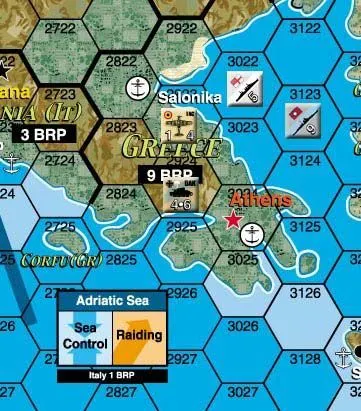
John Prados' Third Reich: Deluxe Map
- Complexity 3.0/5
- 2004
2001
Rules assistance for John Prados' Third Reich
Plain-language explanations of turns, card effects and disputed situations, with official source references and saved question history.
For 2 players
What would you like to know?
Answers come from the official rulebook, with the page to check.
John Prados' Third Reich is a board game released in 2001 for 2–5 players, 360 minutes per game, and ages 12 and up. It was designed by John Prados and Brian L. Knipple and its main mechanics are Dice Rolling, Hexagon Grid, and Simulation.






(from Avalanche Press website:) Third Reich interweaves not only the land, naval and air struggles, but also the equally important economic and political battles. Players must guide their nation to victory by capturing key objectives while making sure no one else — in particular their allies — gets there first. Players take on the leadership of Britain, France, Italy, Germany, the United States or the Soviet Union. Each of these major powers, in turn, can influence smaller countires like Turkey, Greece or Romania to join the war on their side. They can offer bribes or territory, and sometimes it’s more important to decrease someone else’s influence than to build up your own. The currency of the game is the Basic Resource Point, or BRP. This represents the financial, industrial and agricultural production needed to wage war. BRP’s are used to build new units, to pay for offensives, to replace losses suffered in battle, to bribe minor countries, and for a host of other purposes. Each country’s production can be affected by conquering or losing territory, or through strategic warfare (chiefly, attacks by submarines and bombers). Once activated (usually at a cost in BRP’s), land, naval and air units can move and attack enemy units. Combat is resolved by rolling dice, with a result of 6 usually equalling a hit. There are no Combat Results Tables; every factor counts and there are no “perfect numbers” of units to commit to battle as in some wargames. When a land unit is hit, BRP’s can be used to absorb some of the damage, but too many hits and it is reduced in strength or destroyed. Naval and air units pack a greater punch, but don’t bounce back from damage as easily. Scenarios, or game situations, begin the game in 1938, 1939, 1940, 1941, 1942, 1943, 1944 or 1945. Political markers are randomly chosen to determine what events might take place outside the players’ control: Poland might capitulate to Germany in 1939, Mussolini, Churchill or Hitler might unleash some stupid scheme the Italian, British or German player will have to execute, oil could be found in Libya, the French navy could rally to the Allies or the Axis, jets can be developed, good Germans might kill Hitler — dozens of such events are possible. As one of the most popular games of all time, our edition of Third Reich has also spawned a sequel, Great Pacific War. The two games can be played together or separately. (BGG description:)Avalanche Press' re-release of the original classic. This is a significant overhaul based on the Avalon Hill Third Reich, and has nothing to do with the later Advanced Third Reich. There has been dramatic simplification and streamlining, however. Gone is the CRT, replaced by a Columbia-esque "roll lots of dice" combat resolution system. The whole front/option system has been revised with an "HQ activation marker" system: each nation buys activation markers for HQs, land, and air units, and puts them in a cup. Turn order is then determined by draws. Naval and air systems have been overhauled and simplified: sea zones now regulate movement. Tactical air support is now limited to being equal to the strength of the attacker/defender, not three times. Also includes 1938 (Spanish Civil War boils over to a general European conflict) and 1945 scenarios (Western Allies and Russia fall out after collapse of Germany).
John Prados' Third Reich supports 2–5 players according to the catalogue. This range comes from the publisher’s listed player count, so the game can be set up for any group size within it. Some setups, rules and scoring details may still vary by player count, so check your edition’s rulebook for the exact configuration.
The listed playing time for John Prados' Third Reich is 360 minutes. This is the publisher’s estimate for a full game. The actual duration depends on the group, the player count and familiarity with the rules: first sessions usually run longer, while experienced groups often finish faster. Setup and teaching time are not included in this estimate.
The catalogue lists John Prados' Third Reich for ages 12 and up. This is the publisher’s recommendation and reflects reading demands, rule complexity and small components rather than theme alone. Younger players can often join with help from an adult, so check the age guidance on your edition and consider your group’s experience with board games.
John Prados' Third Reich has a complexity rating of 4.0 out of 5 from BoardGameGeek players, which makes it a heavy game. The rating reflects how much rules knowledge, planning and decision-making a typical game demands. Expect a longer first teach for heavier games, and use a preparation guide before game night.
John Prados' Third Reich belongs to these categories: Economic, Wargame, and World War II. Its main mechanics are Dice Rolling, Hexagon Grid, and Simulation. Categories describe the theme and setting of a game, while mechanics describe what players actually do on their turns. Each mechanic links to a catalogue hub with similar games, which helps when you want something comparable.
The credited designers of John Prados' Third Reich are: John Prados and Brian L. Knipple. These credits come from the published game data and name the people responsible for the game’s design, not its illustrators or publishers. Designer pages on MeepleRules collect other titles by the same designers, which helps when you enjoy a game and want to find similar ones.
The catalogue lists John Prados' Third Reich as a base game. It can be played on its own with the components in the box and does not require any other title. Expansions, if any exist, add new content or rules on top of it and are listed separately in the catalogue with a link back to this base game.