- BGG rank
- BGG #3,359
- BGG rating
- 7.0
Le Fantôme de l'Opéra
2013
Rules assistance for Le Fantôme de l'Opéra
Plain-language explanations of turns, card effects and disputed situations, with official source references and saved question history.
- 2 players
- 30 min
- 9+
- Complexity 2.2/5

For 2 players
Rules assistant for Le Fantôme de l'Opéra
What would you like to know?
Answers come from the official rulebook, with the page to check.
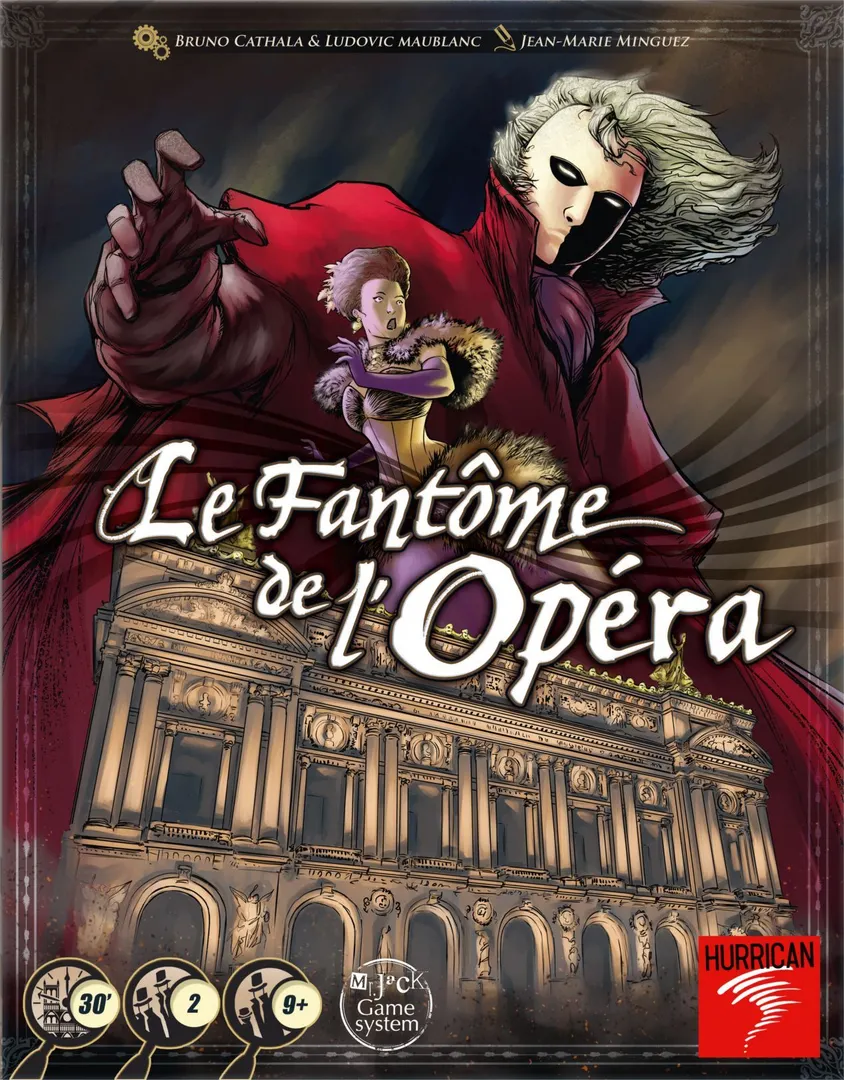
Le Fantôme de l'Opéra is a board game released in 2013 for 2 players, 30 minutes per game, and ages 9 and up. It was designed by Bruno Cathala and Ludovic Maublanc and its main mechanics are Variable Player Powers and Grid Movement.
About the game
Le Fantôme de l’Opéra is a two-player game based on the Mr. Jack game system – that is, the game is an asymmetric affair in which one player wants to reveal which suspect token on the game board represents the opponent, with both players taking turns moving all of the suspects to alternately reveal and hide information. That said, the game differs in a number of ways from Mr. Jack. In more detail... In Le Fantôme de l’Opéra, eight suspect tokens stand in the ten rooms of the Opéra Garnier. Each suspect has a reason to drive the opera singer La Carlotta away from the production, and at the start of the game one of the suspects is randomly determined to be the true identity of the Phantom player. The other player is the Investigator, and he wants to discover the Phantom's identity; if he does so before La Carlotta flees the Opéra Garnier, then he wins. Otherwise, he loses. (To balance play between newcomers and experienced players La Carlotta's starting position can changed.) At the start of each odd round, eight suspect cards are shuffled and four of them revealed. The Investigator moves one suspect and (likely) uses this suspect's unique ability, then the Phantom moves two of the remaining three suspects, then the Investigator moves the final suspect. The Phantom player then reveals whether he can or cannot cause a disturbance in the Opéra Garnier, thus scaring La Carlotta; he can cause a disturbance only if he's alone or if he's in the room with the blackout token. If he can cause a disturbance, the Investigator clears all suspects sharing a lit room; if not, the Investigator clears all suspects in the dark or on their own. After this, La Carlotta moves one step closer to fleeing for each suspect that hasn't been declared innocent (and an additional step if the Phantom did create a disturbance). For each even round, the remaining four suspect cards are revealed, and the players again move characters and use their special abilities, with the Phantom going first. The game continues until only a single suspect is not innocent or La Carlotta flees France for the safety of Milan. When a character moves, it can move up to as many spaces as the number of characters in the room from which it moves. Most characters can move only through open corridors, but Meg Giry can use secret passageways that connect many of the rooms. The players must use Meg's ability and the other characters' special abilities to hide or reveal information. One character, for example, moves a padlock that blocks one corridor, while another is responsible for the roaming blackout that allows the Phantom to operate in darkness (or at least provide cover for his activity elsewhere). One sweet character can draw everyone from adjacent rooms to her side, while an unpleasant fellow can drive everyone away. Still another reveals (or hides) an alibi card, clearing one suspect (or keeping his true nature unknown). Every character is useful in the right situation. You just have to learn what those situations are...
Categories
Mechanics
Designers
Publishers
- Hurrican
Questions and answers
Le Fantôme de l'Opéra supports 2 players according to the catalogue. This is the publisher’s listed player count, so the game is designed for exactly that number of participants. Variants for other group sizes, if any, are described in the rulebook of your edition, so check it before setting up a different configuration.
The listed playing time for Le Fantôme de l'Opéra is 30 minutes. This is the publisher’s estimate for a full game. The actual duration depends on the group, the player count and familiarity with the rules: first sessions usually run longer, while experienced groups often finish faster. Setup and teaching time are not included in this estimate.
The catalogue lists Le Fantôme de l'Opéra for ages 9 and up. This is the publisher’s recommendation and reflects reading demands, rule complexity and small components rather than theme alone. Younger players can often join with help from an adult, so check the age guidance on your edition and consider your group’s experience with board games.
Le Fantôme de l'Opéra has a complexity rating of 2.2 out of 5 from BoardGameGeek players, which makes it a medium-light game. The rating reflects how much rules knowledge, planning and decision-making a typical game demands. Expect a longer first teach for heavier games, and use a preparation guide before game night.
Le Fantôme de l'Opéra belongs to these categories: Deduction, Music, and Novel-based. Its main mechanics are Variable Player Powers and Grid Movement. Categories describe the theme and setting of a game, while mechanics describe what players actually do on their turns. Each mechanic links to a catalogue hub with similar games, which helps when you want something comparable.
The credited designers of Le Fantôme de l'Opéra are: Bruno Cathala and Ludovic Maublanc. These credits come from the published game data and name the people responsible for the game’s design, not its illustrators or publishers. Designer pages on MeepleRules collect other titles by the same designers, which helps when you enjoy a game and want to find similar ones.
The catalogue lists Le Fantôme de l'Opéra as a base game. It can be played on its own with the components in the box and does not require any other title. Expansions, if any exist, add new content or rules on top of it and are listed separately in the catalogue with a link back to this base game.