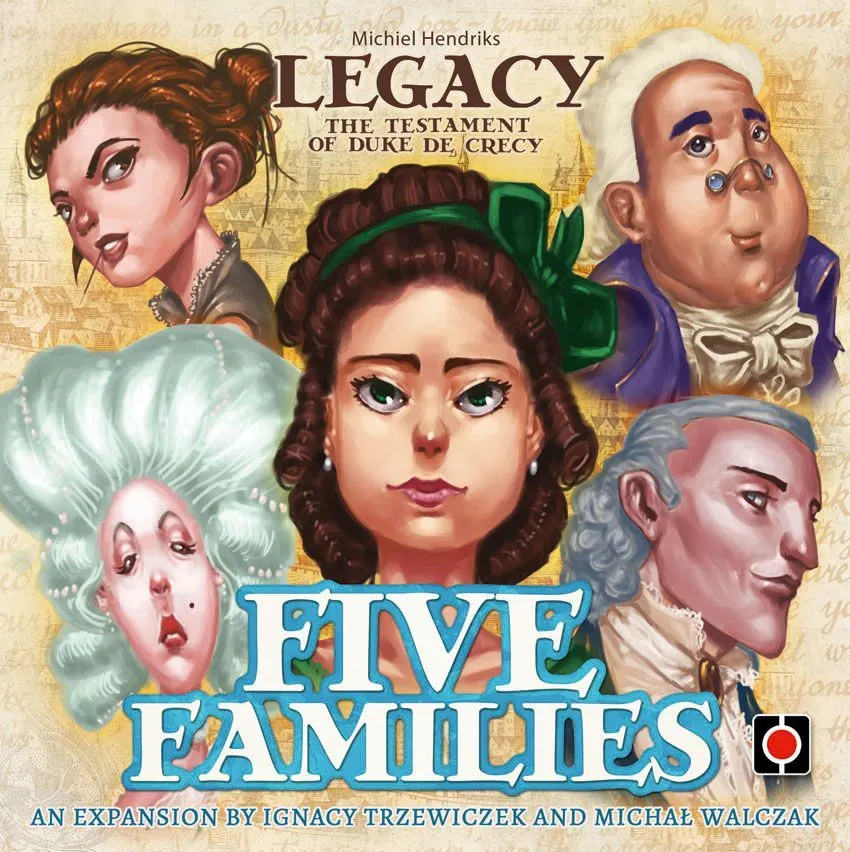
- BGG rating
- 6.7
Legacy: The Testament of Duke de Crecy – Extra Mansion Cards
- 1–4 players
- 60 min
- Complexity 2.4/5
- 2013
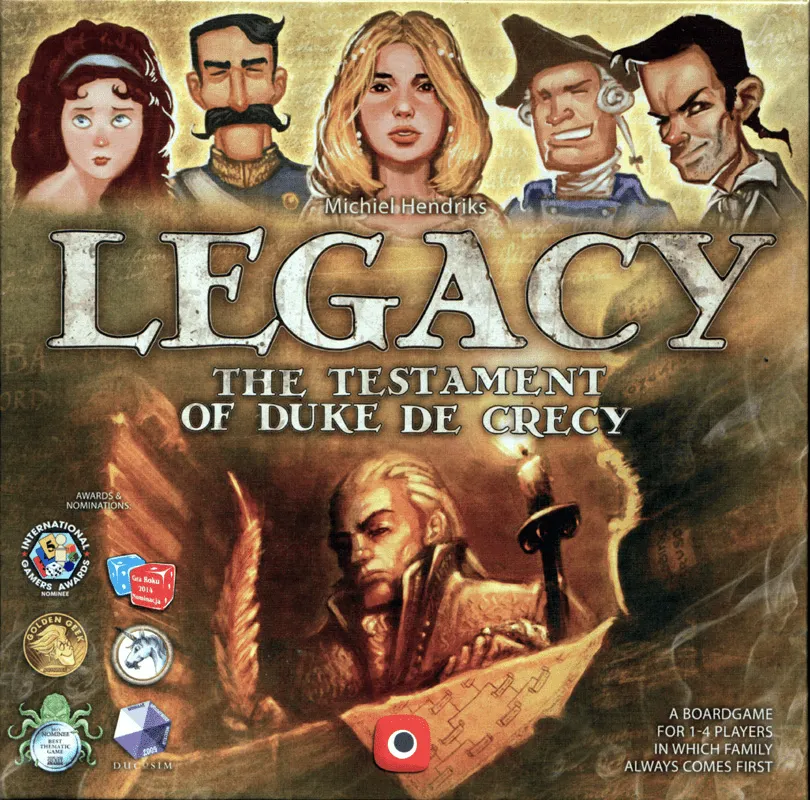
2013
Rules assistance for Legacy: The Testament of Duke de Crecy
Plain-language explanations of turns, card effects and disputed situations, with official source references and saved question history.
For 1 player
What would you like to know?
Answers come from the official rulebook, with the page to check.
Legacy: The Testament of Duke de Crecy is a board game released in 2013 for 1–4 players, 60 minutes per game, and ages 8 and up. It was designed by Michiel Justin Elliott Hendriks and its main mechanics are Hand Management, Set Collection, and End Game Bonuses.








It is 1729 in pre-revolution France, a time when the aristocracy has all the power and the means to rule the country. As a wealthy, well-educated aristocrat, you have travelled the world and had the fortune to enjoy your life to the fullest – but you see that history is about to change course and you know that in order to stay strong, your family must prepare well. You need to find new allies. You must absorb smaller families and use their potency to strengthen your kin. You have to arrange wise marriages, nurture strong connections at court, obtain titles, build mansions, and find the right spouses for your daughters and sons... Legacy: The Testament of Duke de Crecy enables you to build a powerful dynasty in 18th century France as you step into the shoes of a French noble and compete for lasting honor. Over three generations, you – a resourceful patriarch or matriarch – will attempt to create a lasting legacy by establishing a house with ties to many different wealthy and powerful families from France and abroad (Spain, Italy, Russia and other countries). This card game offers endless possibilities. Each time you build a family, you write a unique story, bringing to life the diverse relationships between parents and their children, between cousins, uncles, aunts, nephews and nieces. Whether you are looking for the best husband for your only daughter or a suitable wife for one of your two sons, whether you are looking to add new blood to your family by marrying into foreign nobility – you will be working to make your family rise in status through prestige and wealth, new skills and abilities. In Legacy: The Testament of Duke de Crecy – known previously as Nobles of Paris and winner of Ducosim Spelontwerp in 2009 – you will find 75 spouse cards with unique traits, more than twenty secret missions, nine titles, and nine "contribution to the family" cards. This all culminates in a highly thematic card game that will satisfy players who enjoy exploring many different paths to victory. Legacy is a worker placement game in which you take actions to improve the standing and/or wealth of your family. You will expand your family, creating an ever-growing tableau, the family tree. You will need to balance the three 'currencies' in the game, Prestige (converts to Honor points at the end of each generation, of which there are three), Income (your income which converts to hard cash at the end of each round, of which there are 9), and Friend cards (which are actual connections/friends, and are the only way to marry into wealthy/famous families, and can only be received through actions, such as marrying a woman who brings some of her social contacts with her). Prestige, Income and Friend cards can be gained and lost. You can, for example, lose some prestige by marrying someone infamous or lose some Honor points (i.e. reputation) by asking friends for money. There are also numerous actions you can take that will affect one of the three 'currencies' detrimentally, such as bribing someone to get a title (for which you need to pay, but also in the loss of friends who felt they deserved that title, and not you), or the maintenance of a beautiful new park you have built for the people (losing you income). Finally, you can also take actions that result in the loss of some of your social contacts (friends), due to jealousy, or people simply no longer wanting to be associated with you. These currencies are carefully balanced by the male and female friend cards in the game. Generally men will give you income and possibly prestige, but will cost you a dowry/wedding costs. Women, on the other hand, will give you connections (new friends you can choose from the current socialites (cards lying open on the table) and possibly prestige, and will sometimes even earn you a dowry! The card interactions allow for multiple different paths to success, but you must choose your road strategically, planning out where you want to be headed, else you will be left behind in the dust by those with greater and more successful plans than yours.
Legacy: The Testament of Duke de Crecy supports 1–4 players according to the catalogue. This range comes from the publisher’s listed player count, so the game can be set up for any group size within it. Some setups, rules and scoring details may still vary by player count, so check your edition’s rulebook for the exact configuration.
The listed playing time for Legacy: The Testament of Duke de Crecy is 60 minutes. This is the publisher’s estimate for a full game. The actual duration depends on the group, the player count and familiarity with the rules: first sessions usually run longer, while experienced groups often finish faster. Setup and teaching time are not included in this estimate.
The catalogue lists Legacy: The Testament of Duke de Crecy for ages 8 and up. This is the publisher’s recommendation and reflects reading demands, rule complexity and small components rather than theme alone. Younger players can often join with help from an adult, so check the age guidance on your edition and consider your group’s experience with board games.
Legacy: The Testament of Duke de Crecy has a complexity rating of 2.7 out of 5 from BoardGameGeek players, which makes it a medium-light game. The rating reflects how much rules knowledge, planning and decision-making a typical game demands. Expect a longer first teach for heavier games, and use a preparation guide before game night.
Legacy: The Testament of Duke de Crecy belongs to these categories: Card Game, Economic, and Age of Reason. Its main mechanics are Hand Management, Set Collection, and End Game Bonuses. Categories describe the theme and setting of a game, while mechanics describe what players actually do on their turns. Each mechanic links to a catalogue hub with similar games, which helps when you want something comparable.
The credited designers of Legacy: The Testament of Duke de Crecy are: Michiel Justin Elliott Hendriks. These credits come from the published game data and name the people responsible for the game’s design, not its illustrators or publishers. Designer pages on MeepleRules collect other titles by the same designers, which helps when you enjoy a game and want to find similar ones.
The catalogue lists Legacy: The Testament of Duke de Crecy as a base game. It can be played on its own with the components in the box and does not require any other title. Expansions, if any exist, add new content or rules on top of it and are listed separately in the catalogue with a link back to this base game.