
- BGG rank
- BGG #1,077
- BGG rating
- 7.9
Up Front
- 2 players
- 60 min
- Complexity 3.4/5
- 1983
1991
Rules assistance for Legends of Robin Hood
Plain-language explanations of turns, card effects and disputed situations, with official source references and saved question history.
For 2 players
What would you like to know?
Answers come from the official rulebook, with the page to check.
Legends of Robin Hood is a board game released in 1991 for 2–5 players, 60 minutes per game, and ages 10 and up. It was designed by Courtney F. Allen.
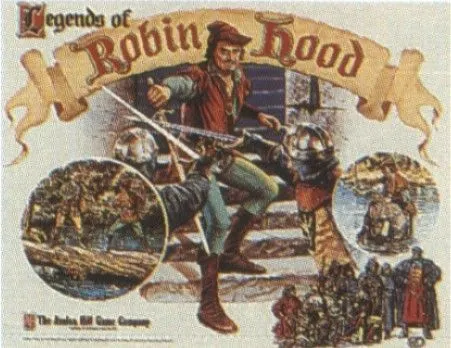
What red-blooded lad hasn't imagined himself fighting at the side of Robin Hood against the evil Prince John and the Sheriff of Nottingham? Cops and robbers, cowboys and Indians, Robin Hood and his Merry Men are all part of a young man's rite of passage from childhood flights of fancy. Long the stuff of screen legend, Robin Hood now lives again in a game format for the entire family. So come with us back to the greenwood in twelfth century England as our heroes Robin, Little john, Friar Tuck, Will Scarlet and Allan A’ Dale scour the countryside with quarter staff and long bow rob the rich and save the poor from the oppressions of nobles and clergy. Each player assumes the role of an outlaw clad in Lincoln green and tries to outdo his fellows in amassing the most gold by winning archery contests, recruiting stout yeomen, or robbing wealthy travelers. But beware; the woods are full of the Sheriff's men. Ambushes by Prince John or Sir Guy of Guisbourne could land you in irons in a castle dungeon. Play is extremely simple as each player maneuvers his band across the map using playing cards that both dictate the action and define the sequence of play with little or no reference to the rules. Yet, strategy is important. You can opt to stick to the relative safety of the woods and dine on the King's deer or don a disguise to sneak into Nottingham Castle to cudgel the Sheriff himself.
Legends of Robin Hood supports 2–5 players according to the catalogue. This range comes from the publisher’s listed player count, so the game can be set up for any group size within it. Some setups, rules and scoring details may still vary by player count, so check your edition’s rulebook for the exact configuration.
The listed playing time for Legends of Robin Hood is 60 minutes. This is the publisher’s estimate for a full game. The actual duration depends on the group, the player count and familiarity with the rules: first sessions usually run longer, while experienced groups often finish faster. Setup and teaching time are not included in this estimate.
The catalogue lists Legends of Robin Hood for ages 10 and up. This is the publisher’s recommendation and reflects reading demands, rule complexity and small components rather than theme alone. Younger players can often join with help from an adult, so check the age guidance on your edition and consider your group’s experience with board games.
Legends of Robin Hood has a complexity rating of 1.5 out of 5 from BoardGameGeek players, which makes it a light game. The rating reflects how much rules knowledge, planning and decision-making a typical game demands. Expect a longer first teach for heavier games, and use a preparation guide before game night.
Legends of Robin Hood belongs to these categories: Fighting and Adventure. Categories describe the theme, setting and style of a game rather than its rules. Filter the catalogue by the same category to find similar games when you enjoyed Legends of Robin Hood and want something comparable for your next game night.
The credited designers of Legends of Robin Hood are: Courtney F. Allen. These credits come from the published game data and name the people responsible for the game’s design, not its illustrators or publishers. Designer pages on MeepleRules collect other titles by the same designers, which helps when you enjoy a game and want to find similar ones.
The catalogue lists Legends of Robin Hood as a base game. It can be played on its own with the components in the box and does not require any other title. Expansions, if any exist, add new content or rules on top of it and are listed separately in the catalogue with a link back to this base game.