

- BGG rank
- BGG #7,962
- BGG rating
- 7.0
Bismarck (Second Edition)
- 2 players
- 150–240 min
- Complexity 3.2/5
- 1978
2011
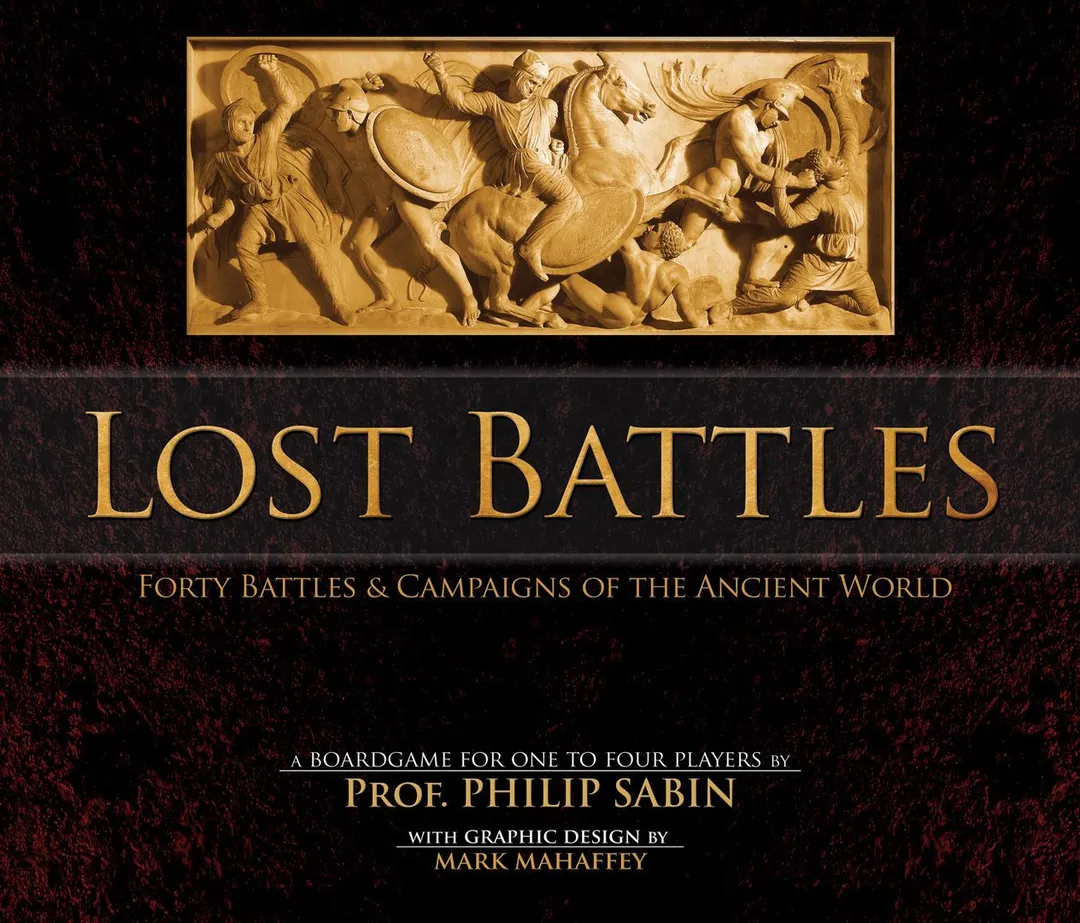
Rules assistance for Lost Battles: Forty Battles & Campaigns of the Ancient World
Plain-language explanations of turns, card effects and disputed situations, with official source references and saved question history.
For 1 player
What would you like to know?
Answers come from the official rulebook, with the page to check.
Lost Battles: Forty Battles & Campaigns of the Ancient World is a board game released in 2011 for 1–4 players, 140 minutes per game, and ages 12 and up. It was designed by Philip Sabin and its main mechanics are Dice Rolling, Grid Movement, and Modular Board.








"Lost Battles" is forty games in one. The game covers battles and campaigns in the Mediterranean and Near East from the Persian defeat at Marathon in 490 BC to Caesar's victory at Pharsalus in 48 BC. It has been exhaustively tested and refined over the past several years, and is based on Professor Philip Sabin's decades of research and simulation design on ancient warfare; and it includes an updated copy of his book, with extensive historical and design notes on every scenario. The game can be fought on three levels - the grand tactical, the grand strategic, or a combination of the two. At the grand tactical level, 1 or 2 players may refight any of 35 different land battles such as Leuctra, Gaugamela, Raphia, Cannae, Cynoscephalae or the Sambre - far more than in any other single boxed game. At the grand strategic level, 1 to 4 players may refight the epic duels of the two centuries from 350 to 150 BC, starting with the eclipse of Achaemenid Persia by Alexander of Macedon, and ending with Hannibal's campaigns and the conquest of Carthage and the Hellenistic states by the resurgent Roman republic. The most ambitious games combine these two levels, and see 1 to 4 players using tactical battles to resolve strategic campaigns across part or all of this two century period, or else refighting a series of historical battles to decide conflicts such as the three-cornered contest for dominance between Athens, Sparta and Thebes from the start of the Peloponnesian War to the death of Epaminondas. The accent throughout is on combining historical accuracy with speed and accessibility. The free-standing strategic game may be completed in just 30 minutes, while individual land battles may be re-fought in two hours or less. There is constant player interaction, and a series of tortuous dilemmas - how should the scarce command points be allocated across the battlefront, which troop types should be put in the lead against particular opponents, should units attack all-out at the cost of becoming exhausted themselves, and should generals join the fighting to rally their disheartened men at the risk of being killed and so making things far worse? The game includes all the many troop types from hoplites, legionaries, phalangites and archers to cataphracts, scythed chariots and war elephants, and it includes simple rules to reflect the huge differences in generalship and troop quality and to allow outclassed armies to win a handicapped 'game victory' even if they are defeated on the field, as long as they do better than they did historically. All aspects of the game are avowedly solitaire-friendly, and can be run by a single player swapping sides just as easily as by one or more players per side. Tactical battles are fought on a 5 x 4 grid of full-colour 5 inch square hard mounted terrain tiles, which dovetail to form any desired battlefield. The individually die-cut counters have rounded corners and are also in full-colour; they depict the various different troop types. The strategic game is fought on a hard mounted map showing the area from Spain to India.
Lost Battles: Forty Battles & Campaigns of the Ancient World supports 1–4 players according to the catalogue. This range comes from the publisher’s listed player count, so the game can be set up for any group size within it. Some setups, rules and scoring details may still vary by player count, so check your edition’s rulebook for the exact configuration.
The listed playing time for Lost Battles: Forty Battles & Campaigns of the Ancient World is 140 minutes. This is the publisher’s estimate for a full game. The actual duration depends on the group, the player count and familiarity with the rules: first sessions usually run longer, while experienced groups often finish faster. Setup and teaching time are not included in this estimate.
The catalogue lists Lost Battles: Forty Battles & Campaigns of the Ancient World for ages 12 and up. This is the publisher’s recommendation and reflects reading demands, rule complexity and small components rather than theme alone. Younger players can often join with help from an adult, so check the age guidance on your edition and consider your group’s experience with board games.
Lost Battles: Forty Battles & Campaigns of the Ancient World has a complexity rating of 3.1 out of 5 from BoardGameGeek players, which makes it a medium-weight game. The rating reflects how much rules knowledge, planning and decision-making a typical game demands. Expect a longer first teach for heavier games, and use a preparation guide before game night.
Lost Battles: Forty Battles & Campaigns of the Ancient World belongs to these categories: Wargame and Ancient. Its main mechanics are Dice Rolling, Grid Movement, and Modular Board. Categories describe the theme and setting of a game, while mechanics describe what players actually do on their turns. Each mechanic links to a catalogue hub with similar games, which helps when you want something comparable.
The credited designers of Lost Battles: Forty Battles & Campaigns of the Ancient World are: Philip Sabin. These credits come from the published game data and name the people responsible for the game’s design, not its illustrators or publishers. Designer pages on MeepleRules collect other titles by the same designers, which helps when you enjoy a game and want to find similar ones.
The catalogue lists Lost Battles: Forty Battles & Campaigns of the Ancient World as a base game. It can be played on its own with the components in the box and does not require any other title. Expansions, if any exist, add new content or rules on top of it and are listed separately in the catalogue with a link back to this base game.