
- BGG rank
- BGG #672
- BGG rating
- 7.9
1846: The Race for the Midwest
- 3–5 players
- 120–240 min
- Complexity 4.0/5
- 2005
2003
Rules assistance for Magna Grecia
Plain-language explanations of turns, card effects and disputed situations, with official source references and saved question history.
For 2 players
What would you like to know?
Answers come from the official rulebook, with the page to check.
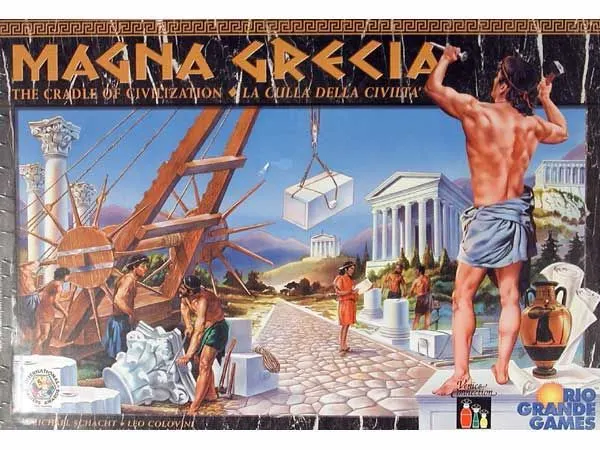
Magna Grecia is a board game released in 2003 for 2–4 players, 75 minutes per game, and ages 12 and up. It was designed by Michael Schacht and Leo Colovini and its main mechanics are Ownership, Tile Placement, and Network and Route Building.

From spielbox-online.de, translated via altavista babel fish (with a lot of manual tweaks): Magna Grecia (The cradle of the civilization) is the main attraction of the year with Clementoni. The game is a joint work of Leo Colovini and Michael Schacht. The southern region of Italy was called Magna Grecia and was settled 2,500 years ago by Greek merchants and adventurers. Before the arrival of the Greeks, the country was inhabited by only a few small tribes. Fruitful soil, navigable rivers, large forests, and bronze and silver mines offered enormous development possibilities. Larger cities developed, such as Tarantum, Syracuse, Katane, Locri, and Naxos. In addition, there were numerous villages of which no trace remains. A local road system promoted trade, and rich markets developed in the cities. More and more rivalries between the cities arose, particularly over control of the Oracle, which represented an important source for fame and wealth. Sufficient material for an evening of play. Each player must successfully settle and develop Magna Grecia. At favorable points, markets are built, villages are developed into cities and interconnected by a road system. Only thus may the interior be opened and the Oracle controlled. Constructing your own large city is often very expensive, and it is sometimes worthwhile to build instead in the neutral villages or opponents' cities. The board is covered with a hexagon grid on which pieces of road, towns, or markets are placed. A game is 12 rounds long. Each round is determined by an action map, which is set up at the beginning of play according to a certain pattern. The map specifies the player sequence and indicates to which extent the three basic actions (road construction, city building, and supply) may be used. There are also, of course, certain building rules to be considered. Additionally, markets can be established, the value of which depends on the number of connected locations. The Oracle is shown on the board. In order to control the Oracle, a player must connect one of his own cities to it by road. But if several cities are connected to an Oracle, the most important city takes precedence, determined by the number of locations connected to the city (not including Oracles). Markets and the Oracle determine when the game ends.
Magna Grecia supports 2–4 players according to the catalogue. This range comes from the publisher’s listed player count, so the game can be set up for any group size within it. Some setups, rules and scoring details may still vary by player count, so check your edition’s rulebook for the exact configuration.
The listed playing time for Magna Grecia is 75 minutes. This is the publisher’s estimate for a full game. The actual duration depends on the group, the player count and familiarity with the rules: first sessions usually run longer, while experienced groups often finish faster. Setup and teaching time are not included in this estimate.
The catalogue lists Magna Grecia for ages 12 and up. This is the publisher’s recommendation and reflects reading demands, rule complexity and small components rather than theme alone. Younger players can often join with help from an adult, so check the age guidance on your edition and consider your group’s experience with board games.
Magna Grecia has a complexity rating of 3.0 out of 5 from BoardGameGeek players, which makes it a medium-light game. The rating reflects how much rules knowledge, planning and decision-making a typical game demands. Expect a longer first teach for heavier games, and use a preparation guide before game night.
Magna Grecia belongs to these categories: Territory Building and Ancient. Its main mechanics are Ownership, Tile Placement, and Network and Route Building. Categories describe the theme and setting of a game, while mechanics describe what players actually do on their turns. Each mechanic links to a catalogue hub with similar games, which helps when you want something comparable.
The credited designers of Magna Grecia are: Michael Schacht and Leo Colovini. These credits come from the published game data and name the people responsible for the game’s design, not its illustrators or publishers. Designer pages on MeepleRules collect other titles by the same designers, which helps when you enjoy a game and want to find similar ones.
The catalogue lists Magna Grecia as a base game. It can be played on its own with the components in the box and does not require any other title. Expansions, if any exist, add new content or rules on top of it and are listed separately in the catalogue with a link back to this base game.