
- BGG rank
- BGG #25
- BGG rating
- 8.2
Nemesis
- 1–5 players
- 90–180 min
- Complexity 3.5/5
- 2018
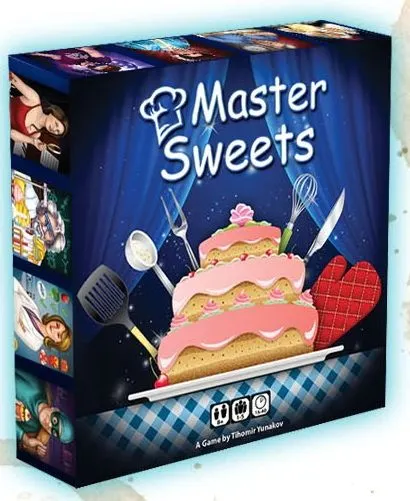
2019
Rules assistance for Master Sweets: Second Edition
Plain-language explanations of turns, card effects and disputed situations, with official source references and saved question history.
For 1 player
What would you like to know?
Answers come from the official rulebook, with the page to check.
Master Sweets: Second Edition is a board game released in 2019 for 1–5 players, 10–35 minutes per game, and ages 8 and up. It was designed by Tihomir Yunakov and its main mechanics are Variable Player Powers, Hand Management, and Set Collection.


MasterSweets: The Card Game is an easy to learn, fast to play, family-friendly game with great repeatability for 1 to 5 players. The second edition of the MasterSweets comes with 8 different game modes: ”MasterSweets” - competitive ”Clash of Sweets” - player elimination ”Sweets Workshop” - cooperative ”Lonely in The Kitchen” – solo ”Endless Cookbook” – competitive ”Team Sweets” – team competitive (2 vs 2) ”The Best Clue” – clue competitive ”Sweets Puzzle” - competitive MasterSweets - core competitive game In "MasterSweets" you will take up the role of one of the 16 fancier confectioners, competing to present the best confectionery delights. MasterSweets uses unique game mechanic based on the set collection mechanic. In the game, a set of ingredient cards are ordered on the table- they form the cookbook. Each row or column of the cookbook represents one recipe. The players will try to collect the full set of ingredient cards that a recipe contains in order to complete it. But each player may also exchange a card from his hand with a card from the cookbook. This way the player changes the set of cards in the collections that all players are trying to collect. Clash of Sweets - player elimination game In “Clash of Sweets” each player will create his own unique cookbook and will try to steal his opponents‘ recipes. This way, he reveals other players‘ culinary secrets and their unique cookbooks decrease. After the last recipe from a player’s cookbook is stolen, the player must leave the game. The last surviving player with recipes that have not been revealed is the winner. Sweets Workshop - cooperative game In "Sweets Workshop" a royalty has noticed our masters of the sweets. She wants them to make incredible sweets for her birthday. Now the players must combine their efforts and team up in order to precisely fulfil all the royalty’s requirements. But they have not worked together before and the players have communication problems. In “Sweets workshop” each player holds the cards in his hand facing the rest of the players. The other players should give him clues about his cards. Lonely in The Kitchen - solo game To be a true master of the sweets, you need a lot of workouts. The best workout is when you are confronted with your own best achievements. The solo game mode "Lonely in The Kitchen" has the same gameplay as the core game “MasterSweets” for two players. The goal in the “Lonely in the kitchen” game is to collect more victory points at the end of the game than your fictional opponent George “The cake” (a dummy player). Endless Cookbook – competitive game "Endless cookbook" game mode keeps all rules from the main game mode "MasterSweets" except the following. Regardless of the number of players create the initial cookbook with a specific form. When a recipe is completed fill the just emptied positions in the cookbook with new cards from the drawing deck. This way the cookbook keeps its initial form during the whole game. The first player that has at least 35 points in his completed sweets is the winner. Team Sweets – team competitive game "Team sweets" game mode allows you to play the game modes "MasterSweets", "Clash of sweets" and "Endless cookbook" in team competitive game - 2 players vs 2 players. Before the end of the active player turn, he may pass (only if he want) one card from his hand facedown to his teammate's hand. Before the active player choice of a cart to be transferred is made, his teammate may tell to all players exactly which kind of card he wants to receive. Or may use a code name for example "Please give me a tree" as "tree" is a code name for chocolate. The Best Clue - competitive game In “The Best Clue” each player holds the cards in his hand facing the rest of the players. The player’s goal is to guess 5 cards from his hand. On his turn, the active player may give a clue to one of his opponents in order to receive a special card. He may use this special card to request a clue (from a type that he wants) for his cards from the other players. (The clue types in “The Best Clue” are the same as in game mode “Sweets Workshop”). In this way, the player that gives the most useless clues to his opponents and requests the most useful clues about his cards will be the winner. Sweets Puzzle - competitive game In game mode “Sweets Puzzle” each payer tries to build his own cookbook that is an exact copy of a part of the main cookbook. A player receives victory points from inseparable cards in his cookbook that represent an exact copy of a part of the MAIN cookbook. If in a player’s cookbook there are two or more separate groups of cards representing a copy of the MAIN cookbook then the player takes the victory points only from the group that gives the most points. The game ends when any player collects at least 25 points. This player is the winner. —description from the designer
Master Sweets: Second Edition supports 1–5 players according to the catalogue. This range comes from the publisher’s listed player count, so the game can be set up for any group size within it. Some setups, rules and scoring details may still vary by player count, so check your edition’s rulebook for the exact configuration.
The listed playing time for Master Sweets: Second Edition is 10–35 minutes. This is the publisher’s estimate for a full game. The actual duration depends on the group, the player count and familiarity with the rules: first sessions usually run longer, while experienced groups often finish faster. Setup and teaching time are not included in this estimate.
The catalogue lists Master Sweets: Second Edition for ages 8 and up. This is the publisher’s recommendation and reflects reading demands, rule complexity and small components rather than theme alone. Younger players can often join with help from an adult, so check the age guidance on your edition and consider your group’s experience with board games.
Master Sweets: Second Edition has a complexity rating of 1.0 out of 5 from BoardGameGeek players, which makes it a light game. The rating reflects how much rules knowledge, planning and decision-making a typical game demands. Expect a longer first teach for heavier games, and use a preparation guide before game night.
Master Sweets: Second Edition belongs to these categories: Card Game. Its main mechanics are Variable Player Powers, Hand Management, and Set Collection. Categories describe the theme and setting of a game, while mechanics describe what players actually do on their turns. Each mechanic links to a catalogue hub with similar games, which helps when you want something comparable.
The credited designers of Master Sweets: Second Edition are: Tihomir Yunakov. These credits come from the published game data and name the people responsible for the game’s design, not its illustrators or publishers. Designer pages on MeepleRules collect other titles by the same designers, which helps when you enjoy a game and want to find similar ones.
The catalogue lists Master Sweets: Second Edition as a base game. It can be played on its own with the components in the box and does not require any other title. Expansions, if any exist, add new content or rules on top of it and are listed separately in the catalogue with a link back to this base game.