

- BGG rank
- BGG #31,455
- BGG rating
- 4.9
Guess Who?
- 2 players
- 20 min
- Complexity 1.1/5
- 1979
1979
Rules assistance for Movies and Money
Plain-language explanations of turns, card effects and disputed situations, with official source references and saved question history.
What would you like to know?
Answers come from the official rulebook, with the page to check.
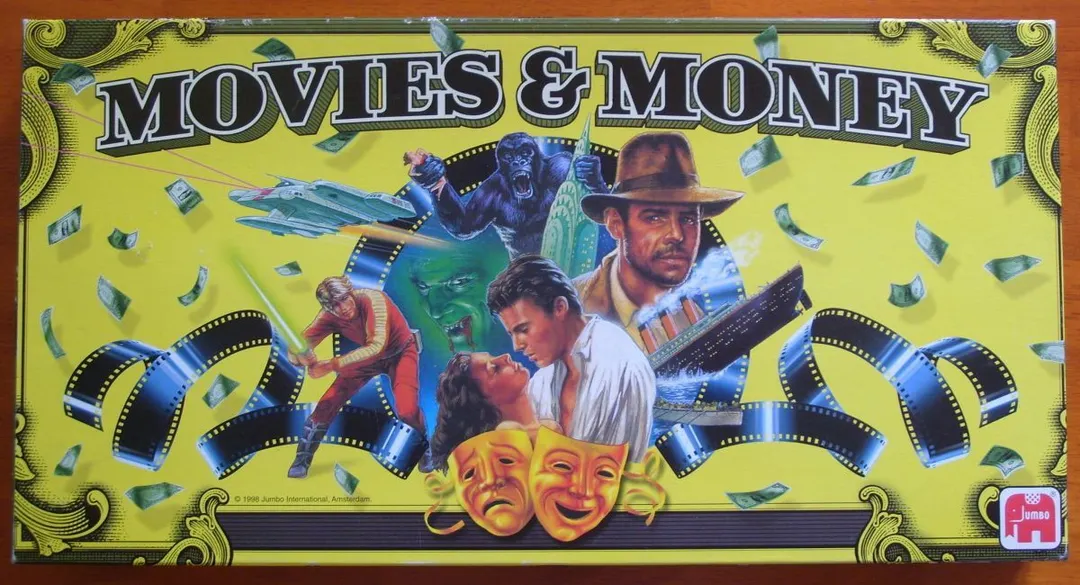
Movies and Money is a board game released in 1979 for 2–4 players, 45 minutes per game, and ages 8 and up. It was designed by Theo Coster, Ora Coster, and Theora Design.




extrapolated from rules: Movies & Money A game for 2 – 4 players Ages 8 and up Manufactured by Jumbo Game materials Game board 25 miniature screens 25 movie cards 6 Golden Suns 2 special dice Play money Preparation Place the board on the table. Each player sits on one side of the board. The red, green, yellow or blue strip at the board’s edge determines the color each player uses. A player is chosen to be banker. He distributes to each player 1 million dollars (5 x $10,000; 3 x $50,000; 3 x $100,000; 2 x $250,000). He puts the remaining money beside the board and administers it separately from his own money. The 25 movie cards are mixed thoroughly and a card is put face down on each board space. The 25 miniature screens and the 6 Golden Suns are put beside the board. Everyone throws the numbered die once. The player with the highest result (the star equals 6) begins. The game proceeds after him clockwise. Play, phase 1 On his turn, a player throws both dice. The intersection of the column (number-die) and row (letter-die) determines a board space. If the movie card on this space is face down, the player can and should buy this space with this card. He pays $10,000 to the bank and turns the card face up. Now, a miniature screen is put on this space. The player takes a screen from the reserve and puts it on the space so that his color appears through the two gaps in the framework of the screen. Finally, the acquired movie card is put into the screen, face up. Play, phase 2 As soon as all 25 movie cards are owned and face up in miniature screens on the board, the second game phase begins. Now movie cards can change hands. Debts and bankruptcy If a player must pay a sum and no longer has sufficient cash, he must sell his movie cards and/or Golden Suns. The player chooses what he would like to sell. The bank pays the sums printed on the cards, and Golden Suns fetch the same amount. Sold movie cards are turned face down again, and the screens and Golden Suns go back to the reserve. How-ever, the bank only takes back cards and Golden Suns if a player is insolvent. A player who cannot settle his debts must declare bankruptcy. He gives all his remaining cash, miniature screens and Golden Suns back to the bank. The movie cards are turned face down again. The player retires from the game. If movie cards are turned face down in the second game phase, the game returns to the first game phase. Therefore, takeovers of movie cards that belong to other players cannot take place. Negotiations All players are allowed to negotiate with other players anytime, even if it is not their turn. Movie cards may be bought, sold or traded. Players can also negotiate in order to pay debts. They need not necessarily sell to the bank if they receive better purchase offers from players. Players can also negotiate whether owed sums on opponents’ movie cards can be reduced or even free of charge. Ending the game The game is over when only one player remains. He is king of Hollywood!
Movies and Money supports 2–4 players according to the catalogue. This range comes from the publisher’s listed player count, so the game can be set up for any group size within it. Some setups, rules and scoring details may still vary by player count, so check your edition’s rulebook for the exact configuration.
The listed playing time for Movies and Money is 45 minutes. This is the publisher’s estimate for a full game. The actual duration depends on the group, the player count and familiarity with the rules: first sessions usually run longer, while experienced groups often finish faster. Setup and teaching time are not included in this estimate.
The catalogue lists Movies and Money for ages 8 and up. This is the publisher’s recommendation and reflects reading demands, rule complexity and small components rather than theme alone. Younger players can often join with help from an adult, so check the age guidance on your edition and consider your group’s experience with board games.
Movies and Money has a complexity rating of 1.0 out of 5 from BoardGameGeek players, which makes it a light game. The rating reflects how much rules knowledge, planning and decision-making a typical game demands. Expect a longer first teach for heavier games, and use a preparation guide before game night.
Movies and Money belongs to these categories: Movies / TV / Radio theme. Categories describe the theme, setting and style of a game rather than its rules. Filter the catalogue by the same category to find similar games when you enjoyed Movies and Money and want something comparable for your next game night.
The credited designers of Movies and Money are: Theo Coster, Ora Coster, and Theora Design. These credits come from the published game data and name the people responsible for the game’s design, not its illustrators or publishers. Designer pages on MeepleRules collect other titles by the same designers, which helps when you enjoy a game and want to find similar ones.
The catalogue lists Movies and Money as a base game. It can be played on its own with the components in the box and does not require any other title. Expansions, if any exist, add new content or rules on top of it and are listed separately in the catalogue with a link back to this base game.