

- BGG rank
- BGG #724
- BGG rating
- 7.3
Archipelago
- 2–5 players
- 30–240 min
- Complexity 3.7/5
- 2012
2015
Rules assistance for M.U.L.E. The Board Game
Plain-language explanations of turns, card effects and disputed situations, with official source references and saved question history.
For 3 players
What would you like to know?
Answers come from the official rulebook, with the page to check.
M.U.L.E. The Board Game is a board game released in 2015 for 3–4 players, 90–120 minutes per game, and ages 14 and up. It was designed by Heikki Harju and its main mechanics are Variable Player Powers, Trading, and Auction / Bidding.





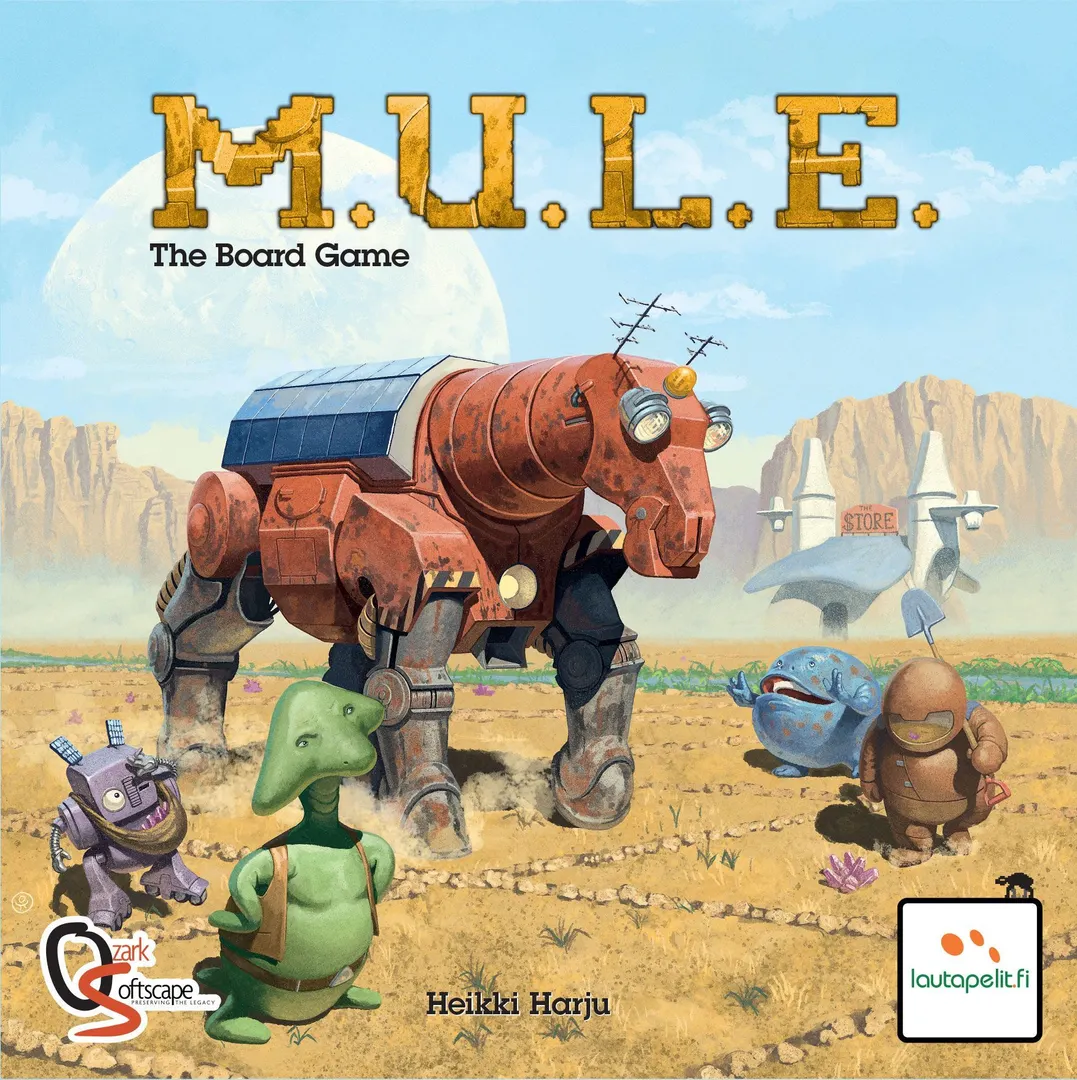
M.U.L.E. was first published as a computer game in 1983. Inspired by board games, it became a breakthrough, then a classic. Now this warm-hearted game of cut-throat capitalism is finally available as a board game! In M.U.L.E. The Board Game, you are one of the pioneering and industrious species of a Galactic Federation. Together with your fellow colonists, you attempt to settle the distant Planet Irata with the so-called help of a mule-like machine you all learn to hate. But for now, he's all you've got. Well, him and your fellow colonists. I wouldn't count on their help, though — not unless there's profit. Good luck. You'll need it. In M.U.L.E. (abbreviated from “Multiple Use Labor Element”), players claim plots of land and install mechanical robots (M.U.L.E.s) to work on them. M.U.L.E.s produce goods that colonists can use, sell for profit, or stockpile for (hopefully) even more profit: - Smithore is a metal that cannot be used by players directly, but can be sold to The Store. The Store uses Smithore to manufacture M.U.L.E.s. Since players need M.U.L.E.s to produce their Goods, they must sell Smithore to increase their production. - Crystite is a luxury mineral with a highly volatile price. It is not needed for anything on Planet Irata, but can be exported to other worlds for great profits (unless stolen by Pirates – you have been warned!) - Food is needed by players to take Development Actions, such as Assaying Lands or Installing/Refitting M.U.L.E.s. - Energy is needed to power M.U.L.E.s. You'll know the value of Energy when you lack it. There will be unexpected surpluses and shortages of different goods, causing market prices to fluctuate. Players must plan ahead while maintaining flexibility to change their plans as all kinds of ”fun” planetary disasters hit them. Interaction between colonists is highly opportunistic: they will gladly help you if there's profit in it for them. Or maybe not. You'll get to see the true colors of your friends by playing M.U.L.E. with them. The most cunning settler and trader receives fame, fortune, and the honorary title of First Founder! There is also an overall Colony Retirement score, describing how your colony succeeded (or failed) as a whole.
M.U.L.E. The Board Game supports 3–4 players according to the catalogue. This range comes from the publisher’s listed player count, so the game can be set up for any group size within it. Some setups, rules and scoring details may still vary by player count, so check your edition’s rulebook for the exact configuration.
The listed playing time for M.U.L.E. The Board Game is 90–120 minutes. This is the publisher’s estimate for a full game. The actual duration depends on the group, the player count and familiarity with the rules: first sessions usually run longer, while experienced groups often finish faster. Setup and teaching time are not included in this estimate.
The catalogue lists M.U.L.E. The Board Game for ages 14 and up. This is the publisher’s recommendation and reflects reading demands, rule complexity and small components rather than theme alone. Younger players can often join with help from an adult, so check the age guidance on your edition and consider your group’s experience with board games.
M.U.L.E. The Board Game has a complexity rating of 2.6 out of 5 from BoardGameGeek players, which makes it a medium-light game. The rating reflects how much rules knowledge, planning and decision-making a typical game demands. Expect a longer first teach for heavier games, and use a preparation guide before game night.
M.U.L.E. The Board Game belongs to these categories: Economic, Video Game Theme, and Exploration. Its main mechanics are Variable Player Powers, Trading, and Auction / Bidding. Categories describe the theme and setting of a game, while mechanics describe what players actually do on their turns. Each mechanic links to a catalogue hub with similar games, which helps when you want something comparable.
The credited designers of M.U.L.E. The Board Game are: Heikki Harju. These credits come from the published game data and name the people responsible for the game’s design, not its illustrators or publishers. Designer pages on MeepleRules collect other titles by the same designers, which helps when you enjoy a game and want to find similar ones.
The catalogue lists M.U.L.E. The Board Game as a base game. It can be played on its own with the components in the box and does not require any other title. Expansions, if any exist, add new content or rules on top of it and are listed separately in the catalogue with a link back to this base game.