

- BGG rank
- BGG #7,051
- BGG rating
- 8.3
Napoleon's Last Gamble: Battles of the Hundred Days
- 2–6 players
- 180–1200 min
- Complexity 2.8/5
- 2016
1979
Rules assistance for Napoleon at Leipzig
Plain-language explanations of turns, card effects and disputed situations, with official source references and saved question history.
For 2 players
What would you like to know?
Answers come from the official rulebook, with the page to check.
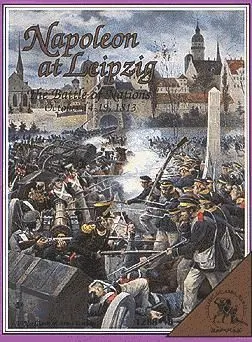
Napoleon at Leipzig is a board game released in 1979 for 2–3 players, 60–300 minutes per game, and ages 12 and up. It was designed by Kevin Zucker and its main mechanics are Dice Rolling, Hexagon Grid, and Simulation.
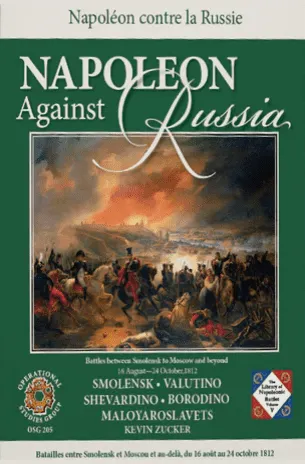




Napoleon at Leipzig, 1813 - His Grande Armée shattered on the Russian Steppes, Napoleon tries to regain the initiative in Germany. His former allies Prussia and Austria turn traitor and attack him. Tsarist Russia sends a massive army across the Vistula into Europe proper. Draining every reserve the French Empire has left, Napoleon gathers his loyal Rhinelanders, Italians, Saxons and Poles. Seizing the initiative in the Spring, he defeats the Allied Coalition at Lutzen, and then at Bautzen, and then again at Dresden. But these are not the complete victories his desperate situation demands. Small defeats of his Generals (Oudinot on August 23rd at Grossbeeren, Mcdonald on August 26th at Katzbach, Vandamme on August 29-30th at Kulm and Ney on September 6th at Dennewitz) brought the strength to decline... Now, with his strength sapped, Napoleon recoils to Leipzig. Like wolves, his enemies surround the place and converge. . . . Napoleon at Leipzig 3rd Edition retains its classic starting situation with only one wing of the French Army on the map. Later, Napoleon leads the main body of La Grande Armée, 175,000 strong, into a position which Marshal Marmont later described as lying "at the bottom of a funnel." As 300,000 Allied troops converge on Leipzig during the succeeding days, the French task is to crush one or more of the enemy armies, or successfully retire the cream of their army across the sole remaining bridge spanning the Elster. Scenarios and the Campaign Game can begin on the 14th, 16th, or 18th of October, 1813. The Standard, Campaign and Grand Tactical rules have been completely revised to reflect the latest findings in Napoleonic scholarship. A totally new map, based on fresh sources, accurately portrays the terrain around Leipzig, emphasizing the superb cavalry terrain to the south. A Study Folder with the classic narrative by noted author F. Lorraine Petrie, along with the Order of Battle and set-up for the three stages of the six-day battle, is also included. The game has 4 editions. The first one was produced by Kevin Zucker's own "Operational Studies Group" company. Later 3 more editions had been published, all by Clash of Arms (comments to the different editions had been made by Ed Wimble): - [2ed] 1988 - new counters. Map & box uses old negatives but with a different color scheme and paper. Rules pretty much the same with a flourish here and there (such as the added steps for the Guard counters). - [3ed] 1992 - this was certainly just a reprint, as there was no new copyright for it - [4ed] 1996 - new map and artwork based on Ed Wimble's visit of Leipzig. New box and artwork. New rules: Kevin Zucker redesigned them. Counters: The half sheet reworked. Thereafter GMT proclaimed a combined GMT-OSG 5ed for a P-500. In 2012 Kevin Zucker announced that the 5th Edition will now be a sole OSG product and should see publication in 2012/ 2013. Note: the 5th Edition can be found here: Napoleon at Leipzig (Fifth Edition) GAME SYSTEM: Series: The Library of Napoleonic Battles (OSG) - formerly known as the "Napoleon's Last Battles (NLB-)Series" - scale = 480m/hex, - time = 1hour/GT, - strength = 500-800 men/SP. Game Scale: Turn: 1-3 hours Hex: 525 yards / 480 meters Units: Battery to Division Game Inventory (Operational Studies Group version): Two 22 x 34" 6-color mapsheets One dual-side printed countersheet (400 1/2" counters - 90 of which are blanks) One 8-page Napoleon at Leipzig rules booklet One 32-page Napoleon at Leipzig study folder booklet One side-printed errata card One 6-sided die Complexity: Medium Solitaire Suitability: Medium Players: 1 or more Playing Time: 1-6 Hours
Napoleon at Leipzig supports 2–3 players according to the catalogue. This range comes from the publisher’s listed player count, so the game can be set up for any group size within it. Some setups, rules and scoring details may still vary by player count, so check your edition’s rulebook for the exact configuration.
The listed playing time for Napoleon at Leipzig is 60–300 minutes. This is the publisher’s estimate for a full game. The actual duration depends on the group, the player count and familiarity with the rules: first sessions usually run longer, while experienced groups often finish faster. Setup and teaching time are not included in this estimate.
The catalogue lists Napoleon at Leipzig for ages 12 and up. This is the publisher’s recommendation and reflects reading demands, rule complexity and small components rather than theme alone. Younger players can often join with help from an adult, so check the age guidance on your edition and consider your group’s experience with board games.
Napoleon at Leipzig has a complexity rating of 2.9 out of 5 from BoardGameGeek players, which makes it a medium-light game. The rating reflects how much rules knowledge, planning and decision-making a typical game demands. Expect a longer first teach for heavier games, and use a preparation guide before game night.
Napoleon at Leipzig belongs to these categories: Wargame and Napoleonic. Its main mechanics are Dice Rolling, Hexagon Grid, and Simulation. Categories describe the theme and setting of a game, while mechanics describe what players actually do on their turns. Each mechanic links to a catalogue hub with similar games, which helps when you want something comparable.
The credited designers of Napoleon at Leipzig are: Kevin Zucker. These credits come from the published game data and name the people responsible for the game’s design, not its illustrators or publishers. Designer pages on MeepleRules collect other titles by the same designers, which helps when you enjoy a game and want to find similar ones.
The catalogue lists Napoleon at Leipzig as a base game. It can be played on its own with the components in the box and does not require any other title. Expansions, if any exist, add new content or rules on top of it and are listed separately in the catalogue with a link back to this base game.