

- BGG rank
- BGG #32
- BGG rating
- 8.1
Sky Team
- 2 players
- 20 min
- Complexity 2.0/5
- 2023
Rules assistance for Pietjesbak
Plain-language explanations of turns, card effects and disputed situations, with official source references and saved question history.
For 2 players
What would you like to know?
Answers come from the official rulebook, with the page to check.
Pietjesbak is a board game for 2–8 players and 30 minutes per game. Its main mechanics are Dice Rolling.


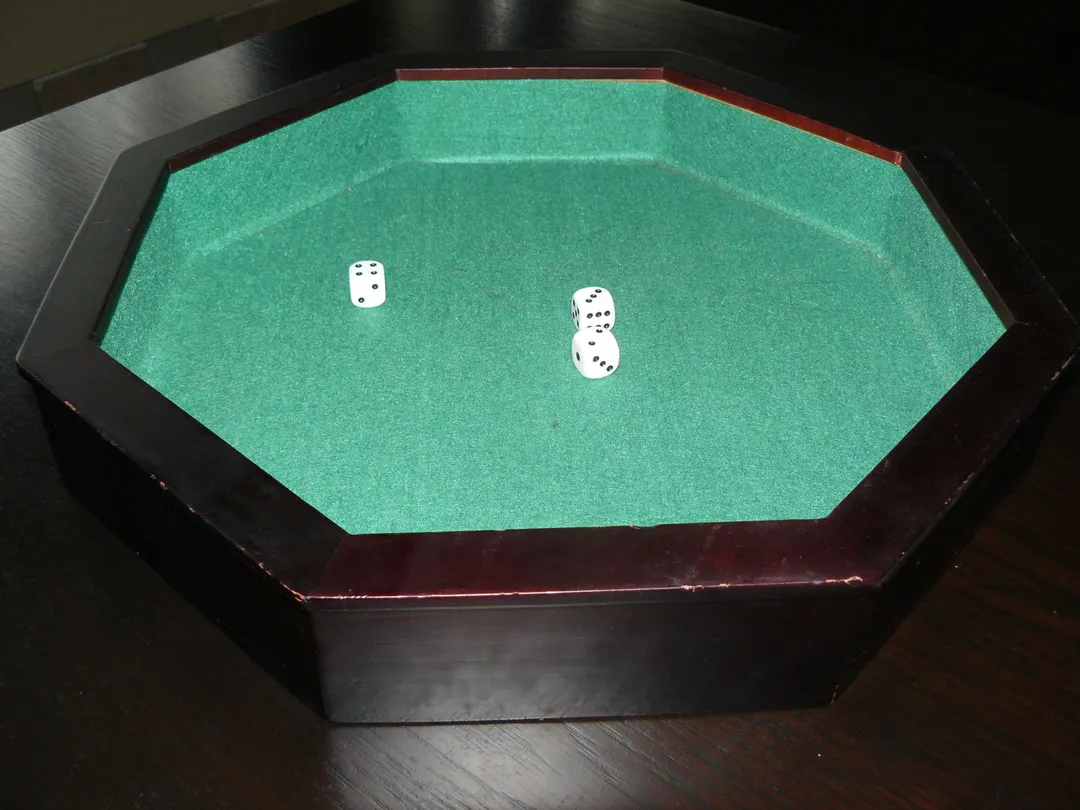
A Pietjesbak (or Pitjesbak, translated: Seedsbox) is an 8 sided wooden box covered with felt. It has a diameter of approximately 38 cm. The game is played in the box using 3 regular D6 dice. You also need a piece of chalk for scoring. There are different playing versions of this game. Special houserules/pubrules are common. The most common rules: Each player gets 15 points to start with (or 9 for a short game), marked with chalk on their side of the Pietjesbak. The purpose is to get the highest score within 3 rolls and with that lose all his points. The starting player can roll any/all three dice up to 3 times. Each other player gets as many rolls as the first player, and tries to get a higher score. One counts as 100, 6 counts as 60, the other numbers count as their face value. Special combinations have a higher score. The highest score wins the round and the player can reduce their score by 1, 2 or 3. The different scores (from lowest to highest): 3 numbers that are not one of the special combinations below. The dice are added together. Example: 1,2,6 = 100+2+60 = 162. The winner reduces their score by 1. Zand/Sand, 3 identical numbers. Example: 3,3,3. The higher the better (except: 1,1,1 aka Drie Apen). The winner reduces their score by 2. Soixante-Neuf/Sixty-Nine (4,5,6 = 4+5+60 = 69). The winner reduces their score by 3. Drie Apen/Three Apes (1,1,1 = 100+100+100 = 300, which is unbeatable). With this score you instantly win the game. To summarize (with out-of-sequence ranks in bold-italics): 300 > 69 > triple-six 180 > triple-five 15 > triple-four 12 > triple-three 9 > triple-two 6 > 260 > 220 > 205 > 204 > 203 > 202 > 165 > 164 > 163 > 162 > 125 > ...> 122 > 110 >...> 104 > 70 > 68 >...> 64 > 14 >...> 7 (lowest 2,2,3)
Pietjesbak supports 2–8 players according to the catalogue. This range comes from the publisher’s listed player count, so the game can be set up for any group size within it. Some setups, rules and scoring details may still vary by player count, so check your edition’s rulebook for the exact configuration.
The listed playing time for Pietjesbak is 30 minutes. This is the publisher’s estimate for a full game. The actual duration depends on the group, the player count and familiarity with the rules: first sessions usually run longer, while experienced groups often finish faster. Setup and teaching time are not included in this estimate.
Pietjesbak has a complexity rating of 1.0 out of 5 from BoardGameGeek players, which makes it a light game. The rating reflects how much rules knowledge, planning and decision-making a typical game demands. Expect a longer first teach for heavier games, and use a preparation guide before game night.
Pietjesbak belongs to these categories: Dice. Its main mechanics are Dice Rolling. Categories describe the theme and setting of a game, while mechanics describe what players actually do on their turns. Each mechanic links to a catalogue hub with similar games, which helps when you want something comparable.
The catalogue lists Pietjesbak as a base game. It can be played on its own with the components in the box and does not require any other title. Expansions, if any exist, add new content or rules on top of it and are listed separately in the catalogue with a link back to this base game.