
- BGG rank
- BGG #1,986
- BGG rating
- 7.2
Cosmic Frog
- 2–6 players
- 45–90 min
- Complexity 3.0/5
- 2020
2005
Rules assistance for Rat Hot
Plain-language explanations of turns, card effects and disputed situations, with official source references and saved question history.
For 2 players
What would you like to know?
Answers come from the official rulebook, with the page to check.
Rat Hot is a board game released in 2005 for 2 players, 30 minutes per game, and ages 8 and up. It was designed by Michael Schacht and its main mechanics are Take That, Tile Placement, and Layering.



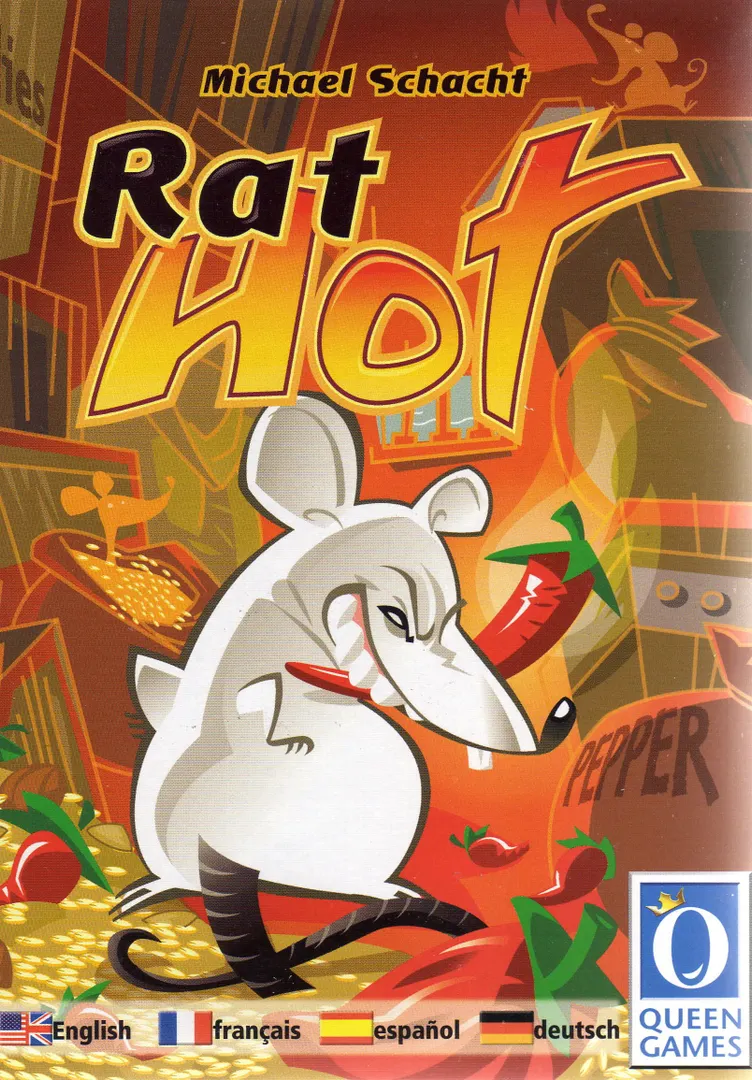
Two spice dealers share a storehouse with a number of hungry rats, who want to put them out of business. The two dealers want to store spices so that they know where everything is, but they also have to keep the rats at bay. Stack your crates, keep your spices together, and cover up the rats. Rat Hot is a two-player game developed from Michael Schacht's Dschunke: Das Legespiel on his own label Spiel aus Timbuktu, which in turn was developed from his game Dschunke, also published by Queen. The Rat Hot tile distribution differs slightly from Dschunke: das Legespiel but you can very nearly use the Dschunke: das Legespiel rules with a Rat Hot set. All the games use the clever mechanism of stacking long 3x1 tiles so that the upper tiles obscure some parts of the tiles underneath. In Rat Hot, the two players simply take turns to draw 2 tiles from a face down pile, and add them to the existing layout. The tiles are all 1x3 and show a combination of rats, spices or empty crates. Each player has four different types of spice in their player colour which they are trying to form into large groups. Many of the tiles have spices of both colours. The game is scored with grey and yellow chips which represent 1 and 2 points. Each time you place a tile, you and your opponent can score points from groups created or changed by that tile. Whenever a group of two of the same spice is formed, the owning player receives one point, or two points for groups of three or more. Beware! If there are three rats of your own colour visible at the end of your turn, you instantly lose. When the draw pile is exhausted and the tiles all placed, the board is scored once more for all players, so trying to preserve existing groups also counts. The real trick in the game comes in the tile placement. Tiles must be adjacent by at least one square. Tiles can placed on top of other tiles, so that stacks build up. But a tile can not sit exactly on top of another, so there must always be some offset, and all three squares of a tile must be supported by other tiles, or the table. Rat Hot can be very tricky. You want to keep your opponent's rats exposed in awkward places, so they have to spend both their moves trying to keep the rats covered. But you also want to set up scoring positions, and cover your own rats, and avoid giving your opponent points as well. There's a good mental challenge here, as you puzzle over the best use and arrangement of your tiles. Do you dare leave two of your rats open, because your opponent may draw more of your rats and make it impossible for you to finish your next turn with less than three showing. Can you get a good group of spices going and also break up your opponent's groups? Tricky problems for tricky minds. Rat Hot is a quick, fun game and is a good addition to Queen's line of small 2-player games. The wood chips make it easy to see who is leading, the tiles are nicely made, the graphics are fun, and the game plays quickly and fairly. You can be stuffed by unlucky tile draws, but perhaps your low score is more to do with your choices, or maybe the other player is just smarter than you. Fast play, easy rules, and the risk of sudden death give Rat Hot a high replay value.
Rat Hot supports 2 players according to the catalogue. This is the publisher’s listed player count, so the game is designed for exactly that number of participants. Variants for other group sizes, if any, are described in the rulebook of your edition, so check it before setting up a different configuration.
The listed playing time for Rat Hot is 30 minutes. This is the publisher’s estimate for a full game. The actual duration depends on the group, the player count and familiarity with the rules: first sessions usually run longer, while experienced groups often finish faster. Setup and teaching time are not included in this estimate.
The catalogue lists Rat Hot for ages 8 and up. This is the publisher’s recommendation and reflects reading demands, rule complexity and small components rather than theme alone. Younger players can often join with help from an adult, so check the age guidance on your edition and consider your group’s experience with board games.
Rat Hot has a complexity rating of 1.5 out of 5 from BoardGameGeek players, which makes it a light game. The rating reflects how much rules knowledge, planning and decision-making a typical game demands. Expect a longer first teach for heavier games, and use a preparation guide before game night.
Rat Hot belongs to these categories: Print & Play and Abstract Strategy. Its main mechanics are Take That, Tile Placement, and Layering. Categories describe the theme and setting of a game, while mechanics describe what players actually do on their turns. Each mechanic links to a catalogue hub with similar games, which helps when you want something comparable.
The credited designers of Rat Hot are: Michael Schacht. These credits come from the published game data and name the people responsible for the game’s design, not its illustrators or publishers. Designer pages on MeepleRules collect other titles by the same designers, which helps when you enjoy a game and want to find similar ones.
The catalogue lists Rat Hot as a base game. It can be played on its own with the components in the box and does not require any other title. Expansions, if any exist, add new content or rules on top of it and are listed separately in the catalogue with a link back to this base game.