- BGG rank
- BGG #1,729
- BGG rating
- 7.1
Salem 1692
2015
Rules assistance for Salem 1692
Plain-language explanations of turns, card effects and disputed situations, with official source references and saved question history.
- 4–12 players
- 25–35 min
- 12+
- Complexity 2.0/5

For 4 players
Rules assistant for Salem 1692
What would you like to know?
Answers come from the official rulebook, with the page to check.
Salem 1692 is a board game released in 2015 for 4–12 players, 25–35 minutes per game, and ages 12 and up. It was designed by Travis Hancock and its main mechanics are Hand Management, Player Elimination, and Hidden Roles.
About the game
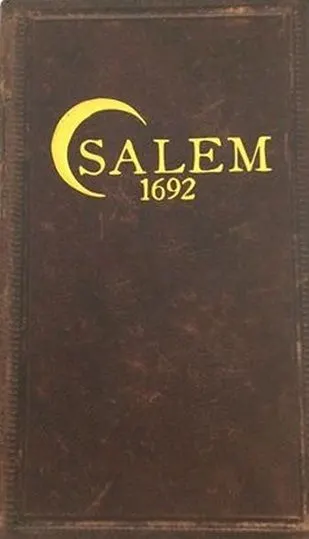
Accuse and defend your fellow townsfolk as you hunt down the witches of Salem. Act fast, before conspiracy turns you against your own. The year is 1692, and it is a perilous time to live in the town of Salem, Massachusetts. One wrong step, or one misplaced accusation, and you could be the next witch to hang. "Salem" takes players into this perilous world and lets them re-live the tension, politics, and religious extremism that still has people talking about it 300 years later. The game is packaged in a faux book box that closes magnetically. The game, disguised as a worn out leather book, can easily hide on your bookshelf and masquerade as an antique. Players can play as prominent villagers from the old Salem town, and even read their bios in the instruction manual. The servant girl Mary Warren, pastor Samuel Parris, farmer John Proctor, storyteller Tituba, and beggar Sarah Good are some of the 12 characters featured in the game. Players, each acting as one of these unique characters, are given 3-5 Tryal cards (depending on the number of players). These Tryal cards reveal the true identity of each player, "Witch" or "Not a Witch." During gameplay, players gather cards that they use to accuse, or defend, other players. Deciding who to trust is key to survival, since you can never play a card on yourself. When you suspect someone to be a witch, you can begin accusing them with red accusation cards. When enough accusations have been placed on one of the players, the player who lays the final accusation chooses one of that player's Tryal cards to reveal. Once all "Witch" Tryal cards have been found, the villagers of Salem win. Players can also use green and blue cards such as "Alibi", "Stocks", "Matchmaker", "Asylum", and "Scapegoat" to help or hurt their allies or enemies. As players draw cards, they will eventually draw black cards that take immediate effect. One black card, "Night", forces all players to close their eyes while the Witches choose someone to eliminate and the Constable chooses someone to potentially save. The other black card, "Conspiracy," forces all players to take a face-down Tryal card from the player to their left. Killing witches quickly is essential, otherwise "Conspiracy" may soon have the whole town turned evil. Before long, accusations will be flying, and screams of "She's a WITCH!" will wake the neighbours. Will you be the hero who purges your town of witches, or will you be wrongly accused and hung for witchcraft? Or perhaps you will be a witch yourself, escape conviction, and bring Salem to the ground. Volume 1 in the Dark Cities Series by Facade Games.
Designers
Publishers
- Siam Board Games
- (Web published)
- Ігромаг
- Meanbook Games
- Lucky Duck Games
- Facade Games
Questions and answers
Salem 1692 supports 4–12 players according to the catalogue. This range comes from the publisher’s listed player count, so the game can be set up for any group size within it. Some setups, rules and scoring details may still vary by player count, so check your edition’s rulebook for the exact configuration.
The listed playing time for Salem 1692 is 25–35 minutes. This is the publisher’s estimate for a full game. The actual duration depends on the group, the player count and familiarity with the rules: first sessions usually run longer, while experienced groups often finish faster. Setup and teaching time are not included in this estimate.
The catalogue lists Salem 1692 for ages 12 and up. This is the publisher’s recommendation and reflects reading demands, rule complexity and small components rather than theme alone. Younger players can often join with help from an adult, so check the age guidance on your edition and consider your group’s experience with board games.
Salem 1692 has a complexity rating of 2.0 out of 5 from BoardGameGeek players, which makes it a medium-light game. The rating reflects how much rules knowledge, planning and decision-making a typical game demands. Expect a longer first teach for heavier games, and use a preparation guide before game night.
Salem 1692 belongs to these categories: Card Game, Party Game, and Print & Play. Its main mechanics are Hand Management, Player Elimination, and Hidden Roles. Categories describe the theme and setting of a game, while mechanics describe what players actually do on their turns. Each mechanic links to a catalogue hub with similar games, which helps when you want something comparable.
The credited designers of Salem 1692 are: Travis Hancock. These credits come from the published game data and name the people responsible for the game’s design, not its illustrators or publishers. Designer pages on MeepleRules collect other titles by the same designers, which helps when you enjoy a game and want to find similar ones.
The catalogue lists Salem 1692 as a base game. It can be played on its own with the components in the box and does not require any other title. Expansions, if any exist, add new content or rules on top of it and are listed separately in the catalogue with a link back to this base game.