
- BGG rank
- BGG #17,228
- BGG rating
- 6.8
Stargate Trading Card Game
- 2 players
- 20 min
- Complexity 2.4/5
- 2007
2002
Rules assistance for Star Trek Customizable Card Game (Second Edition)
Plain-language explanations of turns, card effects and disputed situations, with official source references and saved question history.
For 2 players
What would you like to know?
Answers come from the official rulebook, with the page to check.
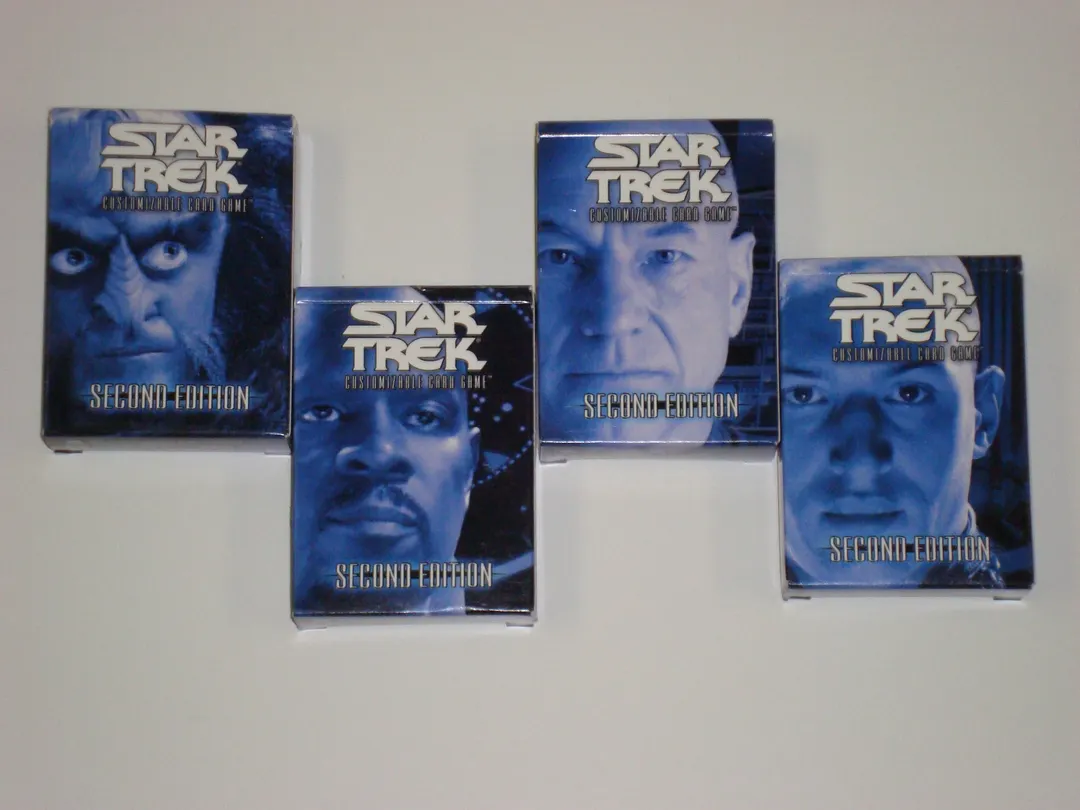
Star Trek Customizable Card Game (Second Edition) is a board game released in 2002 for 2 players and 45 minutes per game. It was designed by Evan Lorentz and Brad Defruiter and its main mechanics are Set Collection, Secret Unit Deployment, and Interrupts.
Star Trek CCG 2nd edition is a reinvention of the original star trek customizable card game. One major difference in Second Edition was the addition of a cost system to equipment, events, personnel, and ships. A card's cost is listed in the top left-hand corner of a card, directly preceding the card's title as a single digit number (currently anywhere from 0 to 9). A player receives seven 'counters' at the beginning of each turn; to play a card, the player must spend a number of counters equal to the cost of the card. Only interrupts (of the card types in a player's deck) do not have a cost and are treated as 0-cost.Another major change in the gameplay of Second Edition was the new method of handling dilemmas. Instead of using First Edition's lengthy procedure of a 'seed phase', which could last upwards of 15 minutes, Second Edition employs an 'on-the-fly' method for constructing dilemma combinations. While First Edition attempted to sometimes literally represent instances from the Star Trek universe in the game, Second Edition has focused more on a consistency of gameplay as a priority over design consideration with regard to remaining faithful to the source material. Effects on cards sometimes lack the "Trek sense" that First Edition cards contained and can be purely conceptual, but are generally much more equitable when compared with other similarly costed effects.
Star Trek Customizable Card Game (Second Edition) supports 2 players according to the catalogue. This is the publisher’s listed player count, so the game is designed for exactly that number of participants. Variants for other group sizes, if any, are described in the rulebook of your edition, so check it before setting up a different configuration.
The listed playing time for Star Trek Customizable Card Game (Second Edition) is 45 minutes. This is the publisher’s estimate for a full game. The actual duration depends on the group, the player count and familiarity with the rules: first sessions usually run longer, while experienced groups often finish faster. Setup and teaching time are not included in this estimate.
Star Trek Customizable Card Game (Second Edition) has a complexity rating of 3.2 out of 5 from BoardGameGeek players, which makes it a medium-weight game. The rating reflects how much rules knowledge, planning and decision-making a typical game demands. Expect a longer first teach for heavier games, and use a preparation guide before game night.
Star Trek Customizable Card Game (Second Edition) belongs to these categories: Card Game, Movies / TV / Radio theme, and Science Fiction. Its main mechanics are Set Collection, Secret Unit Deployment, and Interrupts. Categories describe the theme and setting of a game, while mechanics describe what players actually do on their turns. Each mechanic links to a catalogue hub with similar games, which helps when you want something comparable.
The credited designers of Star Trek Customizable Card Game (Second Edition) are: Evan Lorentz and Brad Defruiter. These credits come from the published game data and name the people responsible for the game’s design, not its illustrators or publishers. Designer pages on MeepleRules collect other titles by the same designers, which helps when you enjoy a game and want to find similar ones.
The catalogue lists Star Trek Customizable Card Game (Second Edition) as a base game. It can be played on its own with the components in the box and does not require any other title. Expansions, if any exist, add new content or rules on top of it and are listed separately in the catalogue with a link back to this base game.