- BGG rank
- BGG #3,385
- BGG rating
- 7.5
Strike of the Eagle
2011
Rules assistance for Strike of the Eagle
Plain-language explanations of turns, card effects and disputed situations, with official source references and saved question history.
- 2–4 players
- 60–240 min
- 13+
- Complexity 3.1/5

For 2 players
Rules assistant for Strike of the Eagle
What would you like to know?
Answers come from the official rulebook, with the page to check.
Strike of the Eagle is a board game released in 2011 for 2–4 players, 60–240 minutes per game, and ages 13 and up. It was designed by Uwe Eickert, Robert Żak, and Brian Bennett and its main mechanics are Area Movement, Area Majority / Influence, and Simulation.
About the game
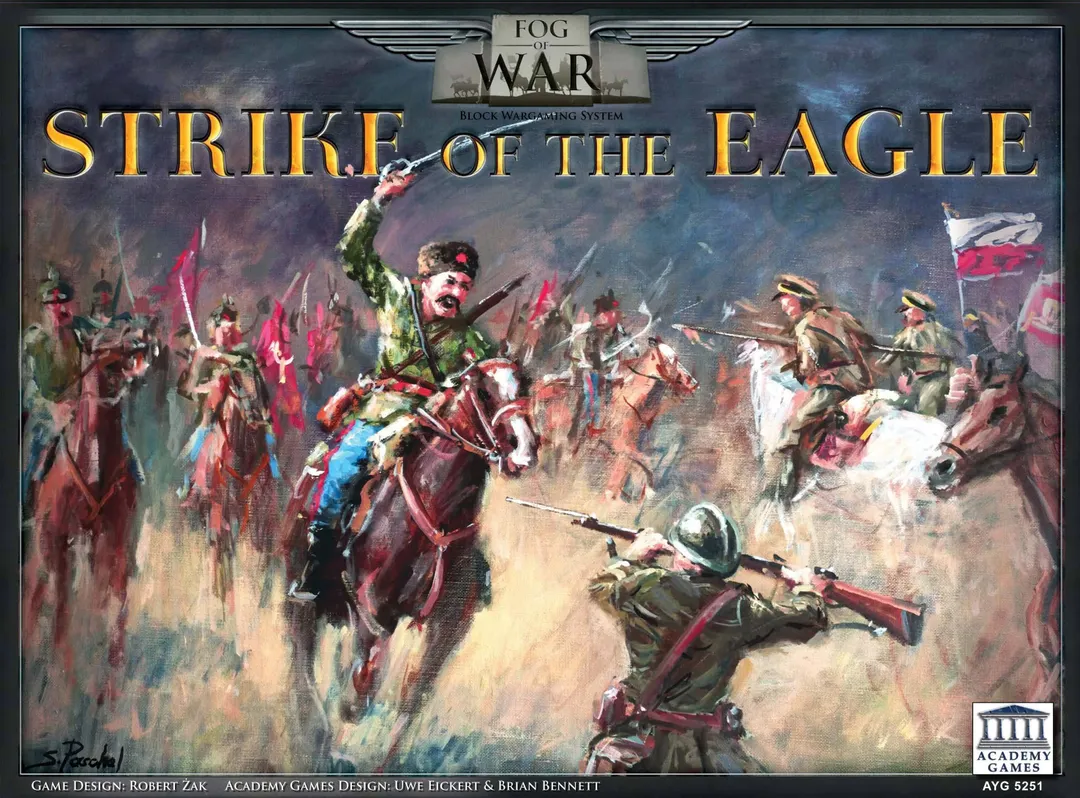
WWI has ended, but the battle for democracy has just begun. Communist movements have sprung up throughout Europe. Trotsky, Lenin and Stalin plan to blast through Poland in order to support the red revolutions in Germany, France and England. Only the armies of Poland stand in the way of the Bolshevik tide. Strike of the Eagle models the battles and historical events of the Polish-Soviet War of 1919-1920. To simulate the tension of the era from the fog of war, players alternate placing secret orders on their armies in order to bluff, mislead and misdirect their opponents. These concealed orders make it difficult to deduce an opponent's plans and are used to hide a player's true intentions and objectives. Players then reveal and resolve the issued orders. They can then disrupt their opponent's moves, cut off supply and much more. Once orders are resolved the next turn begins. Units are represented by wooden blocks. Battles are fought with no dice, but with a simple and quick combat system. Action cards are pivotal to the game in that they allow players to either modify how many orders they may issue, add army reinforcements or modify a battle's resolution.[...] Strike of the Eagle includes several scenarios for 2-4 players. Some are short games that can be played in an hour, up to the full campaign that can last several hours. The map portrays a portion of Eastern Europe in 1920. It is divided into areas that are named after local cities to simplify scenario setups. Along the outer edge of the map is a grid to help find areas during game setup. Each area name is followed by its grid location. The map is divided into two fronts; the northern and the southern. The front line is designated by a yellow line that runs from east to west. In 4 player scenarios, each allied player commands blocks on one front only. If a block of one player crosses the line between fronts, it moves to the control of his ally at the beginning of the next Operation Phase. The Fog of War series is a card driven game where Divisions and Brigades are represented as blocks. These blocks stand upright during the game to prevent opponents from knowing their strength or unit type and can only be revealed during combat or through Recon Area orders given during each Operation Phase. Strike of the Eagle is divided into a number of Rounds, each Round being subdivided into a number of identical phases. The Round Phase Track marks the game's progression. Each round is divided into the Replenish Cards Phase, five identical Operation Phases, and a Reinforcement Phase. Each side has a pool of order counters to draw from. These order counters represent the various types of orders each unit or group may be given. These orders, which range from Forced Marches to Reconnaissance actions, allow the player to strategically manouver his Divisions and Brigades. Orders are placed face down, leading to guesswork and strategic anticipation on the part of your opponent! The sequence of placing and executing orders is determined by the player(s) with the higher initiative. Each front has its own initiative track. Initiative is gained and lost as the game progresses. Whether to place first or second is an important strategic element of the game! Strike of the Eagle is a card driven game. Each card is broken up into a number of different parts and each card can be played for either its event as listed in the body of the card, to increase the number of orders available in a phase (uppermost left), for the combat value on the card (uppermost right), or for reinforcements (lowermost left). Supply is important in Stike of the Eagle. If units are out of supply they will fight less well, take much greater losses, and lose the advantage of any Garrison which might be located at their city. (from Academy Games website)
Mechanics
Designers
Publishers
- Academy Games, Inc.
Questions and answers
Strike of the Eagle supports 2–4 players according to the catalogue. This range comes from the publisher’s listed player count, so the game can be set up for any group size within it. Some setups, rules and scoring details may still vary by player count, so check your edition’s rulebook for the exact configuration.
The listed playing time for Strike of the Eagle is 60–240 minutes. This is the publisher’s estimate for a full game. The actual duration depends on the group, the player count and familiarity with the rules: first sessions usually run longer, while experienced groups often finish faster. Setup and teaching time are not included in this estimate.
The catalogue lists Strike of the Eagle for ages 13 and up. This is the publisher’s recommendation and reflects reading demands, rule complexity and small components rather than theme alone. Younger players can often join with help from an adult, so check the age guidance on your edition and consider your group’s experience with board games.
Strike of the Eagle has a complexity rating of 3.1 out of 5 from BoardGameGeek players, which makes it a medium-weight game. The rating reflects how much rules knowledge, planning and decision-making a typical game demands. Expect a longer first teach for heavier games, and use a preparation guide before game night.
Strike of the Eagle belongs to these categories: Wargame, Bluffing, and Civil War. Its main mechanics are Area Movement, Area Majority / Influence, and Simulation. Categories describe the theme and setting of a game, while mechanics describe what players actually do on their turns. Each mechanic links to a catalogue hub with similar games, which helps when you want something comparable.
The credited designers of Strike of the Eagle are: Uwe Eickert, Robert Żak, and Brian Bennett. These credits come from the published game data and name the people responsible for the game’s design, not its illustrators or publishers. Designer pages on MeepleRules collect other titles by the same designers, which helps when you enjoy a game and want to find similar ones.
The catalogue lists Strike of the Eagle as a base game. It can be played on its own with the components in the box and does not require any other title. Expansions, if any exist, add new content or rules on top of it and are listed separately in the catalogue with a link back to this base game.