
- BGG rank
- BGG #1,714
- BGG rating
- 6.8
Lost Cities: The Board Game
- 2–4 players
- 30–60 min
- Complexity 1.7/5
- 2008
2020
Rules assistance for Sumatra
Plain-language explanations of turns, card effects and disputed situations, with official source references and saved question history.
For 2 players
What would you like to know?
Answers come from the official rulebook, with the page to check.
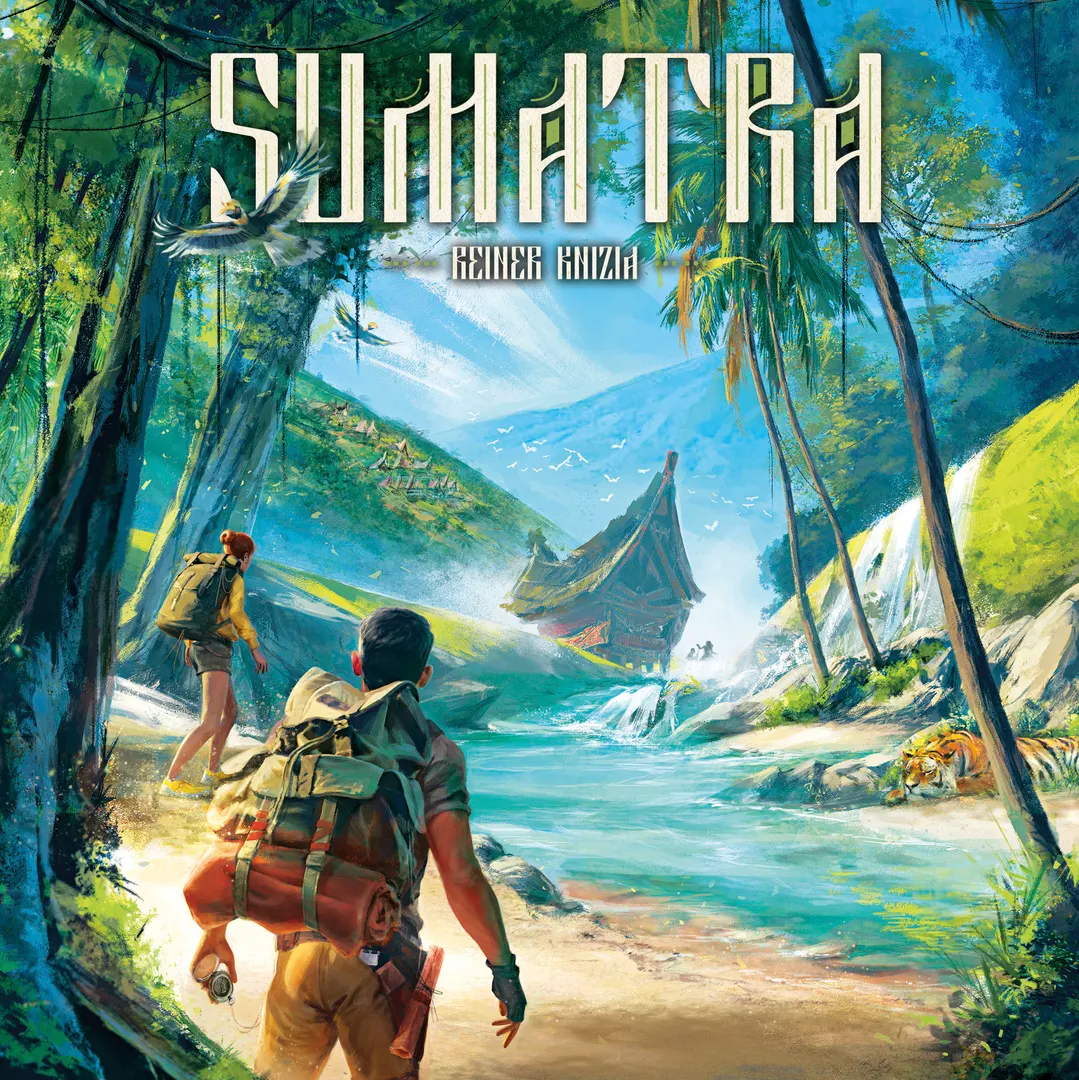
Sumatra is a board game released in 2020 for 2–5 players, 45 minutes per game, and ages 8 and up. It was designed by Reiner Knizia and its main mechanics are Set Collection and Open Drafting.



Join this expedition, and you will have the unforgettable opportunity to explore Sumatra, from the top of its majestic volcanoes to the depths of its tropical rainforest. Find the most exotic animals and the most exuberant flowers, and discover the endless variety of cultures that coexist on the largest island in Indonesia. Your expedition sets out with the mission of writing a travel notebook that will help raise awareness of one of the richest ecosystems in the world. Whoever makes the best contribution to this exciting mission will win. In Sumatra, players move around the island to explore its multiple landscapes. On a turn, your possible actions depend on where you're located in relation to the travel notebook token that starts the game in base camp with all the players: If you're one space behind the token, you move to the notebook's space and end your turn. If you're on the same location as the token, either you move ahead one space or you stay put, take a tile from the pool of "available information" tiles, and add it to your personal notebook. If you're one space ahead of the token, you move the token to your space, move all the "available information" tiles to the "known information" pool, draw tiles from the bag equal to the number shown at your location, add those tiles to the pool of "available information", then take one of these new tiles and add it to your notebook. Thus, you're catching up with the group, researching with the group to add info to your notebook, moving ahead, or digging into new tiles ahead of everyone else. Tiles score and have effects in various ways, for example, with players gaining or losing points for meeting the most or fewest inhabitants. Flora and fauna tiles score only if you have a pair in a column, but only the highest-valued of this pair scores. Villages score only if you have more pairs of reception and GPS tiles than the number of villages, while the reception and GPS pairs net you no points, but allow you to get a tile from the pool of "known information". Equipment makes it safe to explore volcanoes on the island, and if you don't have enough equipment, you might lose other tiles you've collected. Sumatra also includes badges that players can collect. Be the first to collect, say, three flora tiles or a combination of two inhabitant and two craft tiles, and you can claim the badge for this, which is worth 3 points at game's end. You can also claim one diversity badge for having at least one tile in at least six rows of your notebook. The more rows you have a presence in, the higher the value of the diversity badge, but you can claim at most one during the game — and if someone else claims the six-row badge, then you'll need to have a tile in at least seven rows for the next one... ••• Únete a esta expedición y descubre Sumatra desde la cima de sus majestuosos volcanes hasta las profundidades de su selva. Encuentra los animales más exóticos, las flores más exuberantes y conoce la interminable variedad de culturas que conviven en la isla más grande de Indonesia. La expedición parte con la misión de escribir un cuaderno de viaje que ayude a dar a conocer uno de los ecosistemas más ricos del mundo. Aquel que contribuya en mayor medida a esta apasionante misión se alzará con la victoria. En Sumatra, los jugadores se irán desplazando por la isla para explorar sus múltiples parajes. En cada uno de ellos encontrarán información útil, representada por losetas, que deberán registrar en sus cuadernos de viaje colocándolas en su fila correspondiente. El jugador con el cuaderno de viaje e insignias de más valor al final de la partida se alzará con la victoria. —description from the publisher (Spanish)
Sumatra supports 2–5 players according to the catalogue. This range comes from the publisher’s listed player count, so the game can be set up for any group size within it. Some setups, rules and scoring details may still vary by player count, so check your edition’s rulebook for the exact configuration.
The listed playing time for Sumatra is 45 minutes. This is the publisher’s estimate for a full game. The actual duration depends on the group, the player count and familiarity with the rules: first sessions usually run longer, while experienced groups often finish faster. Setup and teaching time are not included in this estimate.
The catalogue lists Sumatra for ages 8 and up. This is the publisher’s recommendation and reflects reading demands, rule complexity and small components rather than theme alone. Younger players can often join with help from an adult, so check the age guidance on your edition and consider your group’s experience with board games.
Sumatra has a complexity rating of 2.0 out of 5 from BoardGameGeek players, which makes it a medium-light game. The rating reflects how much rules knowledge, planning and decision-making a typical game demands. Expect a longer first teach for heavier games, and use a preparation guide before game night.
Sumatra belongs to these categories: Travel, Exploration, and Adventure. Its main mechanics are Set Collection and Open Drafting. Categories describe the theme and setting of a game, while mechanics describe what players actually do on their turns. Each mechanic links to a catalogue hub with similar games, which helps when you want something comparable.
The credited designers of Sumatra are: Reiner Knizia. These credits come from the published game data and name the people responsible for the game’s design, not its illustrators or publishers. Designer pages on MeepleRules collect other titles by the same designers, which helps when you enjoy a game and want to find similar ones.
The catalogue lists Sumatra as a base game. It can be played on its own with the components in the box and does not require any other title. Expansions, if any exist, add new content or rules on top of it and are listed separately in the catalogue with a link back to this base game.