- BGG rank
- BGG #17,010
- BGG rating
- 6.7
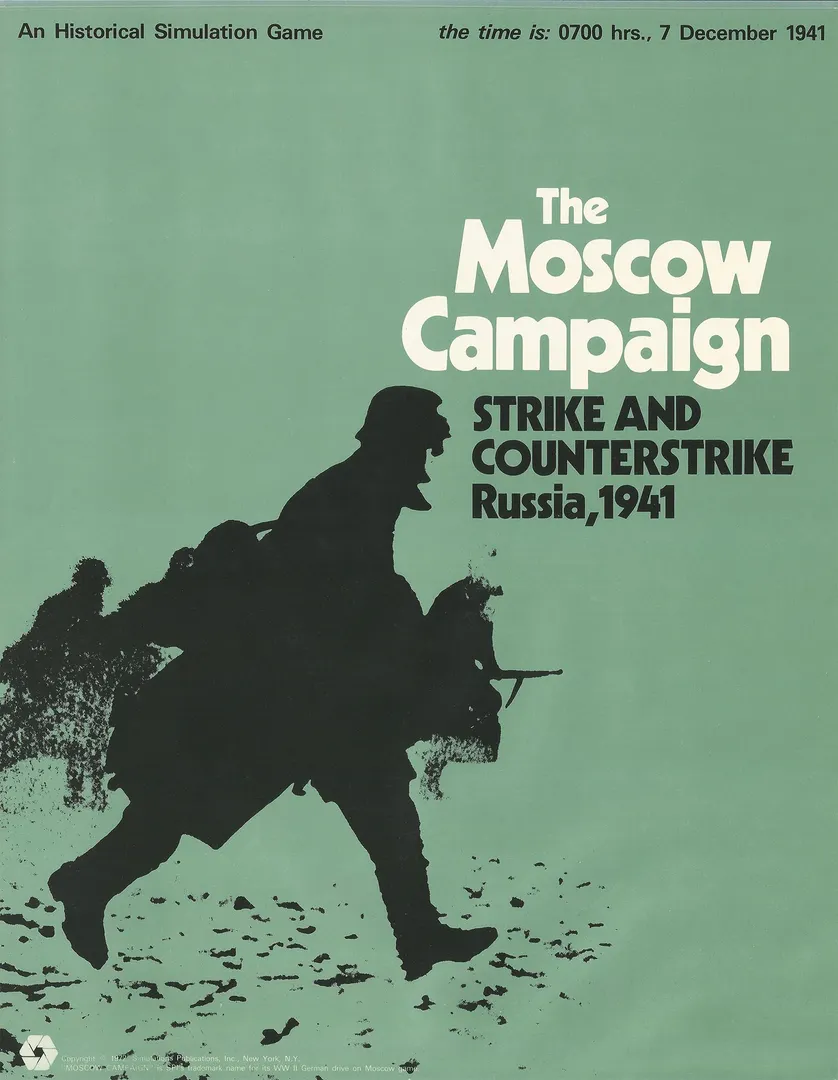
The Moscow Campaign: Strike and Counterstrike Russia, 1941
1972
Rules assistance for The Moscow Campaign: Strike and Counterstrike Russia, 1941
Plain-language explanations of turns, card effects and disputed situations, with official source references and saved question history.
- 2 players
- 120 min
- 12+
- Complexity 2.1/5

For 2 players
Rules assistant for The Moscow Campaign: Strike and Counterstrike Russia, 1941
What would you like to know?
Answers come from the official rulebook, with the page to check.
The Moscow Campaign: Strike and Counterstrike Russia, 1941 is a board game released in 1972 for 2 players, 120 minutes per game, and ages 12 and up. It was designed by Jim Dunnigan and its main mechanics are Dice Rolling, Grid Movement, and Hexagon Grid.
About the game
The Moscow Campaign; Strike and Counterstrike Russia, 1941, is the successor to SPI's earlier treatment of roughly the same events, The Battle of Moscow (originally published in Strategy & Tactics magazine #24). The Moscow Campaign covers the final German drives on the Russian capital and the first Soviet counteroffensive. The scale is 6 miles per hex and three days per turn. Units (blue Germans and brown Soviets) are predominantly divisions. The Soviets have a few corps, and some German mechanized divisions are replaced by kampfgruppen if eliminated in combat. Though they have "historical" designations, the formations are pretty generic. They display combat factors, movement allowances and NATO symbols. Most formidable are the German 6-8 panzer divisions; most common are the lowly Soviet 1-4 infantry. Games can begin as early as September 30, 1941, and end as late as December 31st. A variety of starting points, ending points and German orders of battle produce 24 scenarios, four lasting all 31 turns, the rest - centered on the German offensives in early October and late November and the Soviet riposte at the end of the year - 8 turns each. The four-color map is functional though not an aesthetic gem. It shows cities, rivers, railroads, forests, swamps, lakes, Soviet fortifications and scenario start lines. Players alternate turns, each having a movement phase, combat phase and second movement phase for mechanized units. Zones of control are "semi-active" (requiring extra movement points to enter or leave but not mandating combat between adjacent enemies). The stacking limit is three units of any size per hex. The Combat Results Table has the classic Eliminate, Exchange, Retreat outcomes. Overruns during movement are also possible, though they require 11 to 1 odds. Germans must trace supply lines to railroads that have been converted by Eisenbahn Bautruppen, Soviets to unconverted rail lines that run to the north, south or east of the map. Lack of supply halves movement and combat factors but doesn't, by itself, result in elimination. Weather changes historically. Rain, mud and full winter successively erode movement allowances and combat strengths. There are no air or command rules. Victory points are awarded for destroying enemy units and for geographical objectives (possession of Moscow for either side, proximity to Moscow for the Germans, pushing units west of the start line for the Soviets). When published, this was one of SPI's largest and most sophisticated games. Game Scale: Game Turn: 2 days Hex: 6 miles / 9.6 kilometers Units: Brigade to Corps Game Inventory: One 22 x 34" four-color mapsheet One single-side printed countersheet (400 1/2" counters) One 10-page foldout Moscow Campaign folder One 6-sided die Solitaire Suitability: Medium Complexity Level: Medium Players: 2 or more Playing Time: 2-4 hours
Categories
Mechanics
Designers
Publishers
- SPI (Simulations Publications, Inc.)
Questions and answers
The Moscow Campaign: Strike and Counterstrike Russia, 1941 supports 2 players according to the catalogue. This is the publisher’s listed player count, so the game is designed for exactly that number of participants. Variants for other group sizes, if any, are described in the rulebook of your edition, so check it before setting up a different configuration.
The listed playing time for The Moscow Campaign: Strike and Counterstrike Russia, 1941 is 120 minutes. This is the publisher’s estimate for a full game. The actual duration depends on the group, the player count and familiarity with the rules: first sessions usually run longer, while experienced groups often finish faster. Setup and teaching time are not included in this estimate.
The catalogue lists The Moscow Campaign: Strike and Counterstrike Russia, 1941 for ages 12 and up. This is the publisher’s recommendation and reflects reading demands, rule complexity and small components rather than theme alone. Younger players can often join with help from an adult, so check the age guidance on your edition and consider your group’s experience with board games.
The Moscow Campaign: Strike and Counterstrike Russia, 1941 has a complexity rating of 2.1 out of 5 from BoardGameGeek players, which makes it a medium-light game. The rating reflects how much rules knowledge, planning and decision-making a typical game demands. Expect a longer first teach for heavier games, and use a preparation guide before game night.
The Moscow Campaign: Strike and Counterstrike Russia, 1941 belongs to these categories: Wargame and World War II. Its main mechanics are Dice Rolling, Grid Movement, and Hexagon Grid. Categories describe the theme and setting of a game, while mechanics describe what players actually do on their turns. Each mechanic links to a catalogue hub with similar games, which helps when you want something comparable.
The credited designers of The Moscow Campaign: Strike and Counterstrike Russia, 1941 are: Jim Dunnigan. These credits come from the published game data and name the people responsible for the game’s design, not its illustrators or publishers. Designer pages on MeepleRules collect other titles by the same designers, which helps when you enjoy a game and want to find similar ones.
The catalogue lists The Moscow Campaign: Strike and Counterstrike Russia, 1941 as a base game. It can be played on its own with the components in the box and does not require any other title. Expansions, if any exist, add new content or rules on top of it and are listed separately in the catalogue with a link back to this base game.