- BGG rank
- BGG #2,276
- BGG rating
- 8.0
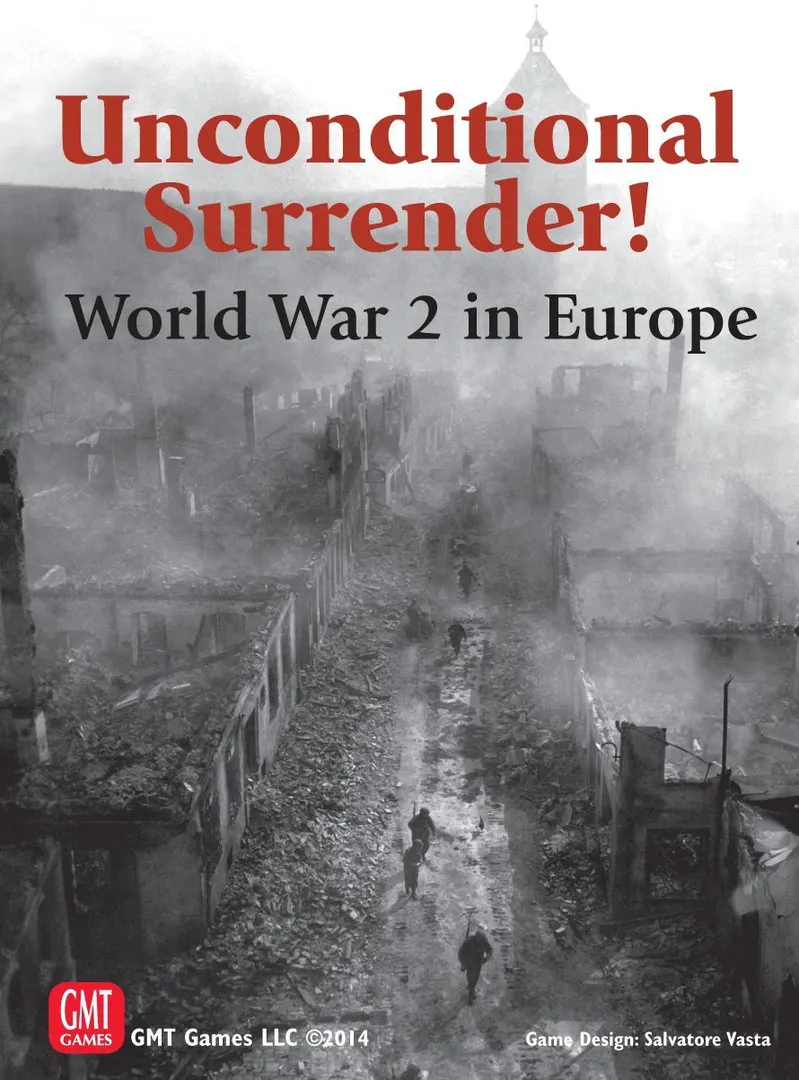
Unconditional Surrender! World War 2 in Europe
2014
Rules assistance for Unconditional Surrender! World War 2 in Europe
Plain-language explanations of turns, card effects and disputed situations, with official source references and saved question history.
- 2–4 players
- 60–3000 min
- 14+
- Complexity 3.8/5

For 2 players
Rules assistant for Unconditional Surrender! World War 2 in Europe
What would you like to know?
Answers come from the official rulebook, with the page to check.
Unconditional Surrender! World War 2 in Europe is a board game released in 2014 for 2–4 players, 60–3000 minutes per game, and ages 14 and up. It was designed by Salvatore Vasta and its main mechanics are Dice Rolling, Hexagon Grid, and Simulation.
About the game
Unconditional Surrender! World War 2 in Europe (USE) is a strategic level game covering the World War II European Theater. Players make the political decisions and control the military forces of the three major factions that struggled for European dominance and survival. With its emphasis on force projection and decision making, players remain focused on the big picture of managing their front lines and political opportunities. Through simple mechanics and low on-map counter density, players easily handle the strategic action without a myriad of complicated subsystems or tall stacks of counters. As one gamer put it, "It is a delight to be spending my limited brain power on making (or agonizing over) operational decisions that are as dependent upon guts as they are gray matter. This game is not a series of arithmetic exercises, and the only variable in these algorithms is nerve." Though the focus is on the big picture, Unconditional Surrender! still delivers historical detail. Each country has an historical army level order of battle, and its relative economic strength and national will to fight are effectively and simply modeled. Also represented are such World War II events as airdrops, Free Forces, jets, naval evacuation, partisans, radar, railroad artillery guns, and ULTRA; all neatly woven into the game's core mechanics for ease of play The game has many scenarios ranging from quick playing individual campaigns to longer ones covering up to the entire war. Design Highlights Scale: army, fleet, or air wing level units; 30-60 miles per hex; monthly turns Players: 2-4 Playing Time: 30 minutes to 50 hours, depending on the scenario Low On-Map Counter Density: The number of counters on the map is relatively low. Simple Stacking: No more than one air, ground, convoy, or warship unit per hex. No Factors on Counters: There are no combat or movement factors on counters. Single Combat System: One combat resolution sequence and Combat Results Table covers all types of combat, yet the results differ for air/naval, ground, or strategic combat. Integrated Movement/Combat System: Units move and fight in a combined activation. "Use it or Lose it" Economic System: Simple math with minimal record keeping Historical or Variable Entry: Units and events can enter play using an historical or variable time line. Variable Politics: Most countries’ belligerence and faction alliance is not predetermined. Solitaire Friendly: Though not designed with solitaire rules, the mechanics easily allow one player to play the game. PBEM Capable: The game can be played using PBEM software, but its mechanics require frequent exchanges. COMPONENTS: 840 counters on 3 countersheets Two 22"x34" maps Three 11"x17" Player Aid Sheets Three 8.5"x11" Faction cards Two 8.5"x11" Flowchart cards Rulebook Playbook Three six-sided dice TIME SCALE: Monthly Turns MAP SCALE: 30 to 40 miles per hex UNIT SCALE: Army, Fleet or Wing DESIGNER: Salvatore Vasta DEVELOPER: Mark Dey MAP ART: Salvatore Vasta & Mark Simonitch COUNTER ART: Charlie Kibler (from the designer and GMT Games website)
Categories
Mechanics
Designers
Publishers
- GMT Games
Questions and answers
Unconditional Surrender! World War 2 in Europe supports 2–4 players according to the catalogue. This range comes from the publisher’s listed player count, so the game can be set up for any group size within it. Some setups, rules and scoring details may still vary by player count, so check your edition’s rulebook for the exact configuration.
The listed playing time for Unconditional Surrender! World War 2 in Europe is 60–3000 minutes. This is the publisher’s estimate for a full game. The actual duration depends on the group, the player count and familiarity with the rules: first sessions usually run longer, while experienced groups often finish faster. Setup and teaching time are not included in this estimate.
The catalogue lists Unconditional Surrender! World War 2 in Europe for ages 14 and up. This is the publisher’s recommendation and reflects reading demands, rule complexity and small components rather than theme alone. Younger players can often join with help from an adult, so check the age guidance on your edition and consider your group’s experience with board games.
Unconditional Surrender! World War 2 in Europe has a complexity rating of 3.8 out of 5 from BoardGameGeek players, which makes it a heavy game. The rating reflects how much rules knowledge, planning and decision-making a typical game demands. Expect a longer first teach for heavier games, and use a preparation guide before game night.
Unconditional Surrender! World War 2 in Europe belongs to these categories: Wargame and World War II. Its main mechanics are Dice Rolling, Hexagon Grid, and Simulation. Categories describe the theme and setting of a game, while mechanics describe what players actually do on their turns. Each mechanic links to a catalogue hub with similar games, which helps when you want something comparable.
The credited designers of Unconditional Surrender! World War 2 in Europe are: Salvatore Vasta. These credits come from the published game data and name the people responsible for the game’s design, not its illustrators or publishers. Designer pages on MeepleRules collect other titles by the same designers, which helps when you enjoy a game and want to find similar ones.
The catalogue lists Unconditional Surrender! World War 2 in Europe as a base game. It can be played on its own with the components in the box and does not require any other title. Expansions, if any exist, add new content or rules on top of it and are listed separately in the catalogue with a link back to this base game.