- BGG rank
- BGG #3,155
- BGG rating
- 8.0
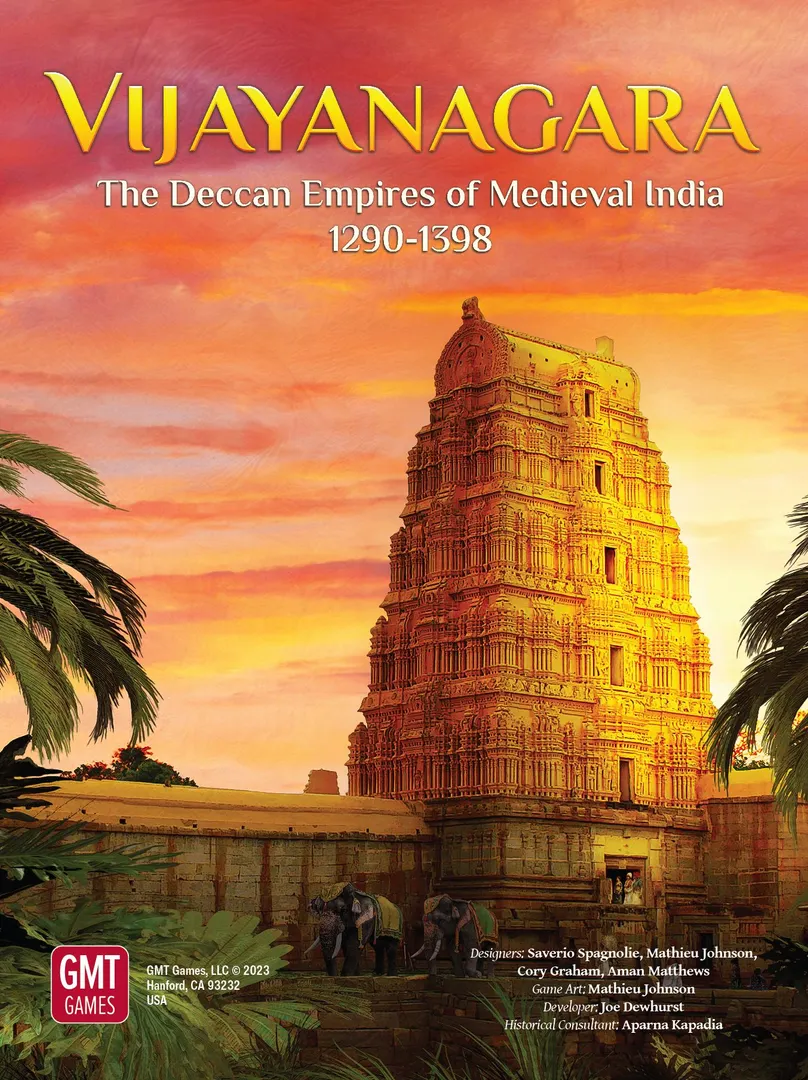
Vijayanagara: The Deccan Empires of Medieval India, 1290-1398
2024
Rules assistance for Vijayanagara: The Deccan Empires of Medieval India, 1290-1398
Plain-language explanations of turns, card effects and disputed situations, with official source references and saved question history.
- 1–3 players
- 60–120 min
- 13+
- Complexity 3.1/5

For 1 player
Rules assistant for Vijayanagara: The Deccan Empires of Medieval India, 1290-1398
What would you like to know?
Answers come from the official rulebook, with the page to check.
Vijayanagara: The Deccan Empires of Medieval India, 1290-1398 is a board game released in 2024 for 1–3 players, 60–120 minutes per game, and ages 13 and up. It was designed by Saverio Spagnolie, Mathieu Johnson, Cory Graham, and Aman Matthews and its main mechanics are Variable Player Powers, Area Majority / Influence, and Simulation.
About the game
Vijayanagara: The Deccan Empires of Medieval India, 1290-1398 depicts the epic, century-long rise and fall of medieval kingdoms in India over two dynastic periods, for 1-3 players. Vijayanagara is the first game in the new Irregular Conflicts Series (ICS). With gameplay inspired by GMT’s COIN system, players will take on the asymmetric roles of the Delhi Sultanate, the Bahmani Kingdom, and the Vijayanagara Empire, navigating event cards and unique action menus as they contest to write themselves into medieval Indian history. Players will rally local amirs and rajas to their cause, construct epic temples, forts, and qasbahs, and battle for supremacy over the Deccan Plateau. Highlights 1. A sweeping, century-long narrative and numerous epic events. 2. Playtime ~90 minutes. 3. Three asymmetric Factions with different strengths and abilities. 4. A fourth non-player Faction (Mongols) operated by the Bahmani and Vijayanagara players. 5. A new battle-resolution system with strength-dependent risk mitigation. Vijayanagara is intended for players new to asymmetric wargames and veteran COIN players alike. The factions have distinct capabilities and each is faced with different strategic decisions, offering a very high degree of replayability. The game is streamlined: all player actions and most rules are visible on the table on player aids and cards. Gameplay and turn order is organized around a deck of unique event cards. With each new card, factions have the option to carry out the event or to select from faction-specific Commands and special Decrees; Commands such as the Conscription of new troops, Governing in Tributary Provinces, and Migration to begin life anew, and Decrees ranging from Demanding Tribute, Conspiring with Delhi’s Governors to betray the Sultan, and forming new Alliances with minor regional powers. -description from publisher's website
Mechanics
Publishers
- GMT Games
Questions and answers
Vijayanagara: The Deccan Empires of Medieval India, 1290-1398 supports 1–3 players according to the catalogue. This range comes from the publisher’s listed player count, so the game can be set up for any group size within it. Some setups, rules and scoring details may still vary by player count, so check your edition’s rulebook for the exact configuration.
The listed playing time for Vijayanagara: The Deccan Empires of Medieval India, 1290-1398 is 60–120 minutes. This is the publisher’s estimate for a full game. The actual duration depends on the group, the player count and familiarity with the rules: first sessions usually run longer, while experienced groups often finish faster. Setup and teaching time are not included in this estimate.
The catalogue lists Vijayanagara: The Deccan Empires of Medieval India, 1290-1398 for ages 13 and up. This is the publisher’s recommendation and reflects reading demands, rule complexity and small components rather than theme alone. Younger players can often join with help from an adult, so check the age guidance on your edition and consider your group’s experience with board games.
Vijayanagara: The Deccan Empires of Medieval India, 1290-1398 has a complexity rating of 3.1 out of 5 from BoardGameGeek players, which makes it a medium-weight game. The rating reflects how much rules knowledge, planning and decision-making a typical game demands. Expect a longer first teach for heavier games, and use a preparation guide before game night.
Vijayanagara: The Deccan Empires of Medieval India, 1290-1398 belongs to these categories: Wargame and Medieval. Its main mechanics are Variable Player Powers, Area Majority / Influence, and Simulation. Categories describe the theme and setting of a game, while mechanics describe what players actually do on their turns. Each mechanic links to a catalogue hub with similar games, which helps when you want something comparable.
The credited designers of Vijayanagara: The Deccan Empires of Medieval India, 1290-1398 are: Saverio Spagnolie, Mathieu Johnson, Cory Graham, and Aman Matthews. These credits come from the published game data and name the people responsible for the game’s design, not its illustrators or publishers. Designer pages on MeepleRules collect other titles by the same designers, which helps when you enjoy a game and want to find similar ones.
The catalogue lists Vijayanagara: The Deccan Empires of Medieval India, 1290-1398 as a base game. It can be played on its own with the components in the box and does not require any other title. Expansions, if any exist, add new content or rules on top of it and are listed separately in the catalogue with a link back to this base game.