- BGG rank
- BGG #2,225
- BGG rating
- 7.3
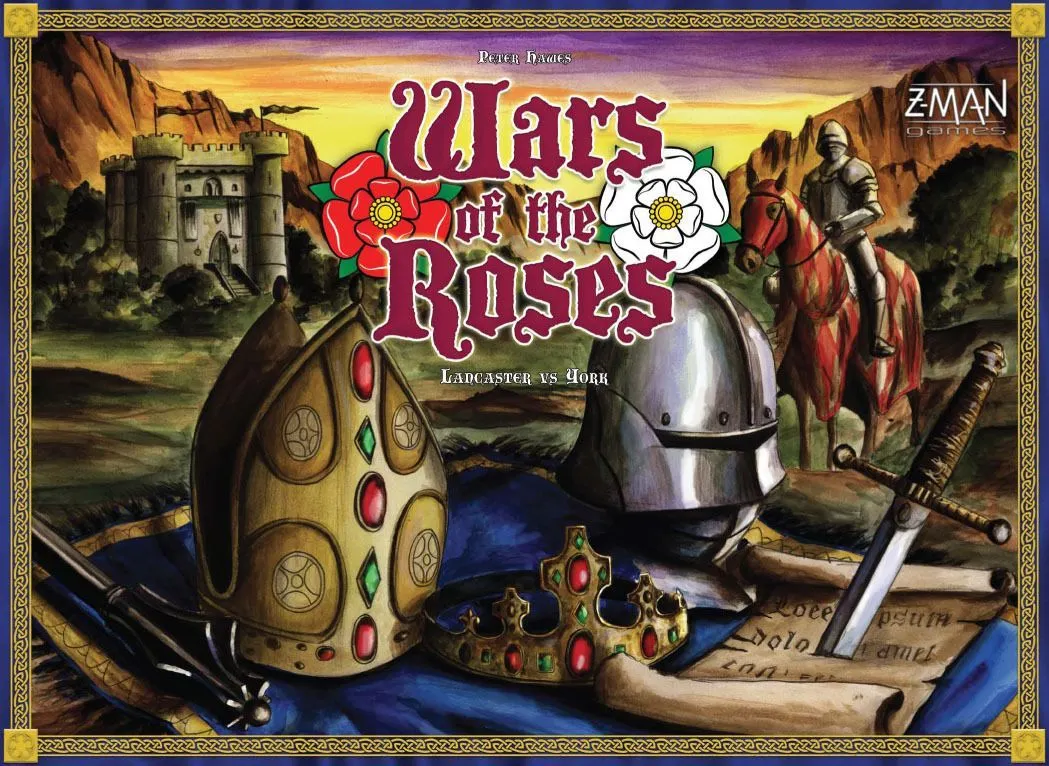
Wars of the Roses: Lancaster vs. York
2010
Rules assistance for Wars of the Roses: Lancaster vs. York
Plain-language explanations of turns, card effects and disputed situations, with official source references and saved question history.
- 2–4 players
- 180 min
- 13+
- Complexity 3.2/5

For 2 players
Rules assistant for Wars of the Roses: Lancaster vs. York
What would you like to know?
Answers come from the official rulebook, with the page to check.
Wars of the Roses: Lancaster vs. York is a board game released in 2010 for 2–4 players, 180 minutes per game, and ages 13 and up. It was designed by Peter Hawes and its main mechanics are Area Movement, Area Majority / Influence, and Simultaneous Action Selection.
About the game
Two Lancastrians and two Yorkists draft cards that give them control of major towns, nobles, bishops and royal castles. Income generated by these enables them to raise armies and to bribe nobles, bishops and ship captains to change allegiance. Players then use secret planning and simultaneous deployment to gain control of the six areas in England and Wales and, hopefully, enough votes in parliament to crown their royal heir as king. From the back of the box: Journey back to England, 1450, just prior to the outbreak of the bitter civil war between the Royal Houses of Lancaster and York. Henry VI, a Lancastrian, was proving to be a weak ruler, so the wealthy and ambitious Richard, Duke of York, looked to put things right. The powerful noble families had to choose sides and over the next 40 years, kings, royal heirs, and great nobles were to die, in what was to become known as the Wars of the Roses. Players take on the role of Lancastrians and Yorkists, who must gather support from the major towns and powerful noble families and attempt to control the royal castles throughout the country. Ports, the shipping trade, and financial aid from the Church and France are also needed. As their faction grows in strength, players vie for the King’s favor and look to earn the prestigious titles of Captain of Calais, Archbishop of Canterbury, Warden of the Cinque Ports, Lord High Admiral and Constable of the Tower of London. Money means power, because loyalty can be bought, so players should be prepared for the inevitable treachery as nobles change allegiance at crucial times, affecting the balance of power. When Parliament is called, each region in England will support one or other of the two Royal Houses and the crown will go to the one with the greater power base. Nobles loyal to this House will be rewarded by a grateful King. Eventually, only one Royal House will boast the King, but the player who has gathered the most money and prestige will win, regardless of his allegiance.
Mechanics
Designers
Publishers
- 999 Games
- Z-Man Games
Questions and answers
Wars of the Roses: Lancaster vs. York supports 2–4 players according to the catalogue. This range comes from the publisher’s listed player count, so the game can be set up for any group size within it. Some setups, rules and scoring details may still vary by player count, so check your edition’s rulebook for the exact configuration.
The listed playing time for Wars of the Roses: Lancaster vs. York is 180 minutes. This is the publisher’s estimate for a full game. The actual duration depends on the group, the player count and familiarity with the rules: first sessions usually run longer, while experienced groups often finish faster. Setup and teaching time are not included in this estimate.
The catalogue lists Wars of the Roses: Lancaster vs. York for ages 13 and up. This is the publisher’s recommendation and reflects reading demands, rule complexity and small components rather than theme alone. Younger players can often join with help from an adult, so check the age guidance on your edition and consider your group’s experience with board games.
Wars of the Roses: Lancaster vs. York has a complexity rating of 3.2 out of 5 from BoardGameGeek players, which makes it a medium-weight game. The rating reflects how much rules knowledge, planning and decision-making a typical game demands. Expect a longer first teach for heavier games, and use a preparation guide before game night.
Wars of the Roses: Lancaster vs. York belongs to these categories: Wargame, Medieval, and Political. Its main mechanics are Area Movement, Area Majority / Influence, and Simultaneous Action Selection. Categories describe the theme and setting of a game, while mechanics describe what players actually do on their turns. Each mechanic links to a catalogue hub with similar games, which helps when you want something comparable.
The credited designers of Wars of the Roses: Lancaster vs. York are: Peter Hawes. These credits come from the published game data and name the people responsible for the game’s design, not its illustrators or publishers. Designer pages on MeepleRules collect other titles by the same designers, which helps when you enjoy a game and want to find similar ones.
The catalogue lists Wars of the Roses: Lancaster vs. York as a base game. It can be played on its own with the components in the box and does not require any other title. Expansions, if any exist, add new content or rules on top of it and are listed separately in the catalogue with a link back to this base game.