- BGG rank
- BGG #1,736
- BGG rating
- 7.3
Warsaw: City of Ruins
2016
Rules assistance for Warsaw: City of Ruins
Plain-language explanations of turns, card effects and disputed situations, with official source references and saved question history.
- 2–4 players
- 60 min
- 10+
- Complexity 2.2/5

For 2 players
Rules assistant for Warsaw: City of Ruins
What would you like to know?
Answers come from the official rulebook, with the page to check.
Warsaw: City of Ruins is a board game released in 2016 for 2–4 players, 60 minutes per game, and ages 10 and up. It was designed by Filip Miłuński and its main mechanics are Tile Placement, Simultaneous Action Selection, and Pattern Building.
About the game
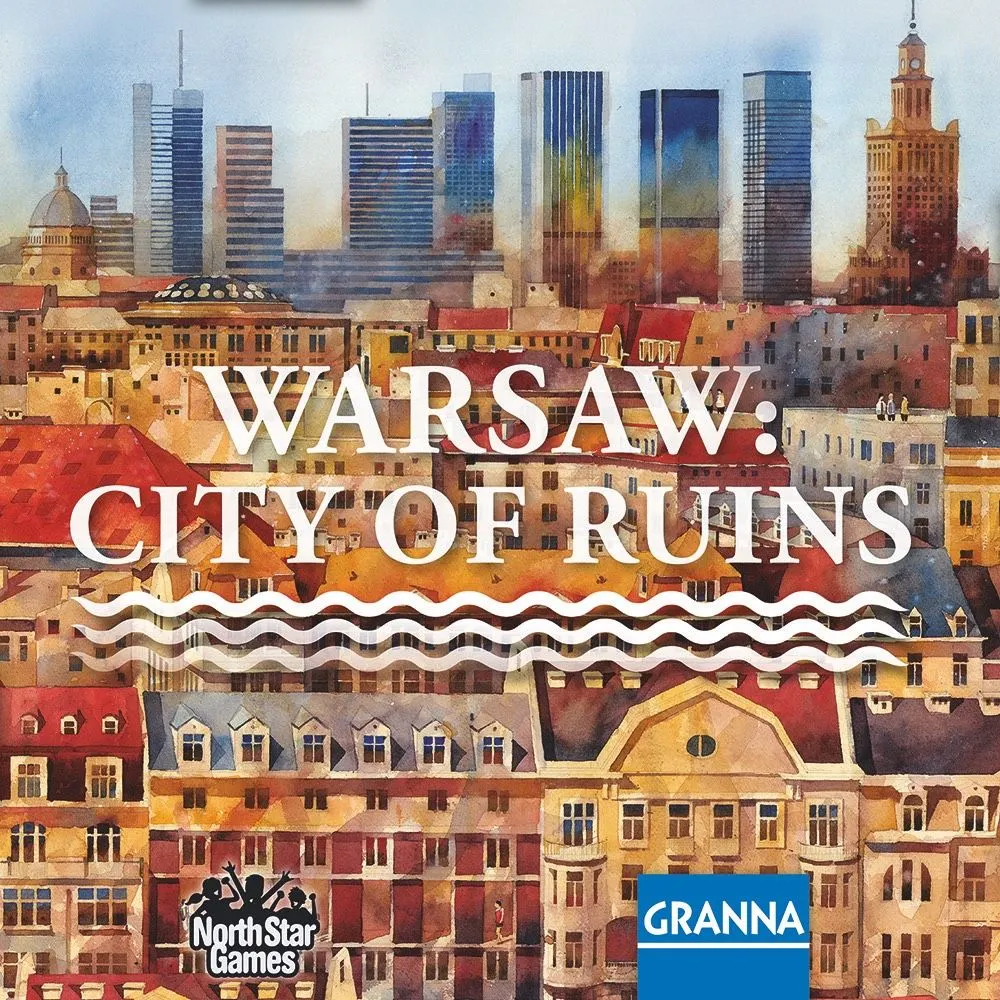
Warsaw is a unique city. It is said that it "survived its own death", and there is truth in this. Poland's capital was largely destroyed during the Second World War, and its reconstruction was an exceptional urban development process. Warsaw is a combination of elegant buildings from Saxon times, architecture from between the World Wars, socialist blocks, and modern buildings. Walking through the streets of Warsaw's Wola district, one can see this diversity at a glance. Modern glass office buildings stand next to pre-war automotive garages, and concrete block buildings touch elegant older houses, which show the signs of time's decay. Some call it a spatial mess, while others see in it the residents' determination. Both views are right because that's how Warsaw is. Maybe not the most beautiful, but strong and determined. Nothing reflects the city's character more than its diverse buildings. In Warsaw: City of Ruins, players jointly build Warsaw over six epochs, from when Warsaw first became the capital at the end of the 16th century through modern times. Each player creates their own district of the city. At the end of each of the six epochs, districts give income and victory points to their owners. After six rounds, whoever has the most points wins. In more detail, each epoch consists of a construction phase and an income phase, with wars at the end of the third and fourth epochs. During the construction phase of an epoch, players shuffle the city tiles with the current epoch's number, then deal several tiles to each player. Each player chooses one of the tiles, then places it face down onto the table. All players simultaneously reveal their selected tiles, and each player chooses one of two possible actions: Discard their tile to the box and take three coins from the bank. Pay the tile's cost in coins and build the tile in their district. Instead of placing a tile on an empty space, a player may choose to build on top of an existing tile. Simply place the new tile directly onto an existing tile, covering it completely. As a result, the new tile's price is reduced by the price of the older tile that it covers. A player's district can never be larger than a 3×4 or 4×3 rectangle of tiles. Each city tile is divided into four quarters, and each quarter has its own type of building, so a tile can have 1-4 different kinds of buildings. Public buildings and milestones are always separate individual areas, even if they are adjacent to each other. They also occupy an entire tile. During the income phase, milestones are placed, and players receive coins and victory points.
Categories
Designers
Publishers
- Granna
- North Star Games, LLC
- GeGe Co. Ltd.
- Hemz Universal Games Co. Ltd.
Questions and answers
Warsaw: City of Ruins supports 2–4 players according to the catalogue. This range comes from the publisher’s listed player count, so the game can be set up for any group size within it. Some setups, rules and scoring details may still vary by player count, so check your edition’s rulebook for the exact configuration.
The listed playing time for Warsaw: City of Ruins is 60 minutes. This is the publisher’s estimate for a full game. The actual duration depends on the group, the player count and familiarity with the rules: first sessions usually run longer, while experienced groups often finish faster. Setup and teaching time are not included in this estimate.
The catalogue lists Warsaw: City of Ruins for ages 10 and up. This is the publisher’s recommendation and reflects reading demands, rule complexity and small components rather than theme alone. Younger players can often join with help from an adult, so check the age guidance on your edition and consider your group’s experience with board games.
Warsaw: City of Ruins has a complexity rating of 2.2 out of 5 from BoardGameGeek players, which makes it a medium-light game. The rating reflects how much rules knowledge, planning and decision-making a typical game demands. Expect a longer first teach for heavier games, and use a preparation guide before game night.
Warsaw: City of Ruins belongs to these categories: Economic and City Building. Its main mechanics are Tile Placement, Simultaneous Action Selection, and Pattern Building. Categories describe the theme and setting of a game, while mechanics describe what players actually do on their turns. Each mechanic links to a catalogue hub with similar games, which helps when you want something comparable.
The credited designers of Warsaw: City of Ruins are: Filip Miłuński. These credits come from the published game data and name the people responsible for the game’s design, not its illustrators or publishers. Designer pages on MeepleRules collect other titles by the same designers, which helps when you enjoy a game and want to find similar ones.
The catalogue lists Warsaw: City of Ruins as a base game. It can be played on its own with the components in the box and does not require any other title. Expansions, if any exist, add new content or rules on top of it and are listed separately in the catalogue with a link back to this base game.