
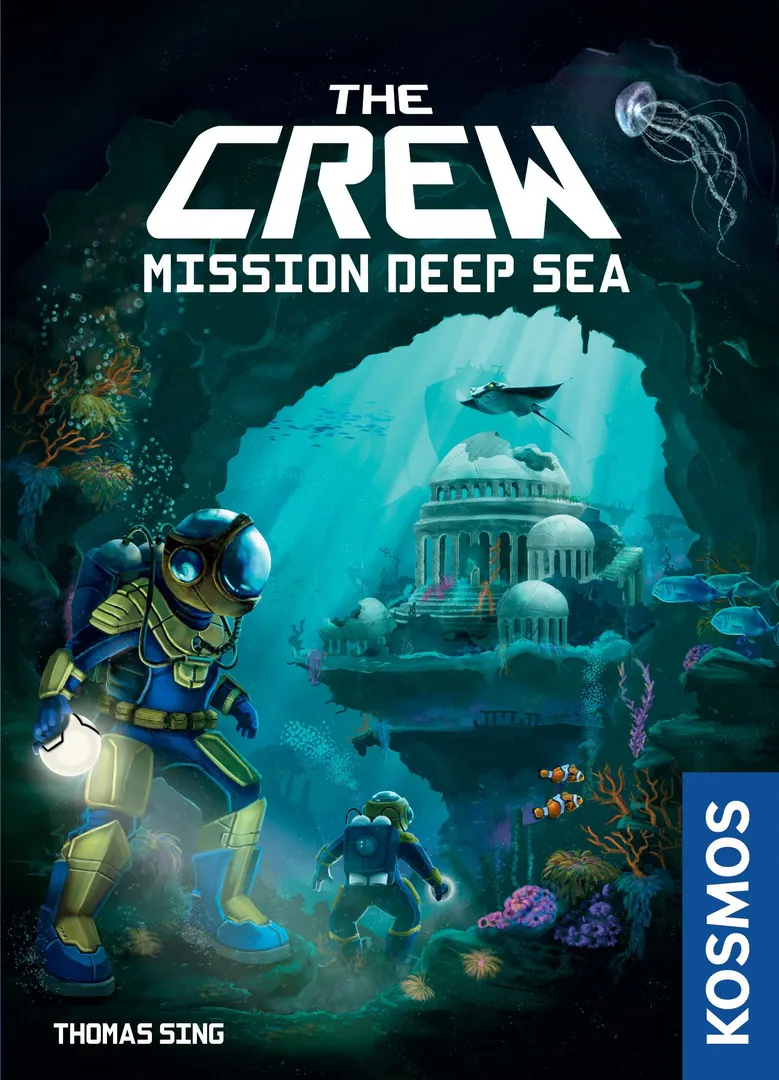
- BGG rank
- BGG #45
- BGG rating
- 8.0
The Crew: Mission Deep Sea
- 2–5 players
- 20 min
- Complexity 2.1/5
- 2021
Rules assistance for Whist 22
Plain-language explanations of turns, card effects and disputed situations, with official source references and saved question history.
For 3 players
What would you like to know?
Answers come from the official rulebook, with the page to check.
Whist 22 is a board game for 3–5 players and 20 minutes per game. Its main mechanics are Trick-taking.
This is a trick-taking playing card game played using 22 cards. The game is similar in mechanism to Oh Hell, but simpler to grasp because there is no suit. It is usually played using a tarot deck, keeping only the 21 trumps and the fool. If a tarot deck is not available, then it can be played using two suits (one suit for values 1 to 10, the other one for values 11 to 21) and the fool. Summary of the rules: If played in partnerships, partners sit across the table from each other. Players begin the game with 14 points. The game ends when one player reaches 0. The player scoring the most points wins. The dealer deals the cards so that the lowest number of cards remains undealt: for example with four players, five cards are dealt to each player and two cards are put aside. The player to his left announces how many tricks he thinks he will win, then the player on his left, etc... This is the contract. The dealer is the last to announce, but the sum of announced tricks must not equal the number of cards dealt to each player. Let us follow the same example, where 5 cards were dealt to each player: player A announces 2 tricks, players B and C each announce 1 trick. Then the dealer cannot announce 1 trick because the total would be 5 tricks and each player could fulfill his contract. The player to the left of the dealer starts. The winner of a trick is the one who will start the next trick. The owner of the fool must assign its value (0 or 22) when he plays it. At the end of the round, each player counts the number of tricks he has won and compare it to the number of tricks he has announced. No point is awarded for fulfilling the contract, but 1 point is deducted for each missed trick, either over or under the number of tricks the player initially announced. The next round takes place in the same way, but with one less card per player. After several rounds where one less card is dealt in each round, there is a round where each player only receives one card. Each player then places the card on its forehead without looking at it, so that all players except him can see the card. Each player then announces if he will win the trick or not. As was the case in previous rounds, the sum of announced tricks cannot equal the number of cards dealt to each player (i.e. one). After this round, in each round the number of cards dealt to each player is increased by one, until the number of cards is the same as in the first round. If we follow the same example as above (with 4 players), here are the numbers of cards dealt to each player in each round: 5-4-3-2-1-2-3-4-5-4-3...
Whist 22 supports 3–5 players according to the catalogue. This range comes from the publisher’s listed player count, so the game can be set up for any group size within it. Some setups, rules and scoring details may still vary by player count, so check your edition’s rulebook for the exact configuration.
The listed playing time for Whist 22 is 20 minutes. This is the publisher’s estimate for a full game. The actual duration depends on the group, the player count and familiarity with the rules: first sessions usually run longer, while experienced groups often finish faster. Setup and teaching time are not included in this estimate.
Whist 22 has a complexity rating of 1.3 out of 5 from BoardGameGeek players, which makes it a light game. The rating reflects how much rules knowledge, planning and decision-making a typical game demands. Expect a longer first teach for heavier games, and use a preparation guide before game night.
Whist 22 belongs to these categories: Card Game. Its main mechanics are Trick-taking. Categories describe the theme and setting of a game, while mechanics describe what players actually do on their turns. Each mechanic links to a catalogue hub with similar games, which helps when you want something comparable.
The catalogue lists Whist 22 as a base game. It can be played on its own with the components in the box and does not require any other title. Expansions, if any exist, add new content or rules on top of it and are listed separately in the catalogue with a link back to this base game.