- BGG rating
- 8.1
Rules assistance for Wings of Glory: World War 1 – Albatros D.III
Plain-language explanations of turns, card effects and disputed situations, with official source references and saved question history.
- 2 players
- 30 min
- 13+

Rules assistant for Wings of Glory: World War 1 – Albatros D.III
What would you like to know?
Answers come from the official rulebook, with the page to check.
Wings of Glory: World War 1 – Albatros D.III is an expansion for Wings of Glory: WW1 Airplane Packs released in 2017 for 2 players, 30 minutes per game, and ages 13 and up. Its main mechanics are Simultaneous Action Selection and Simulation.
About the game
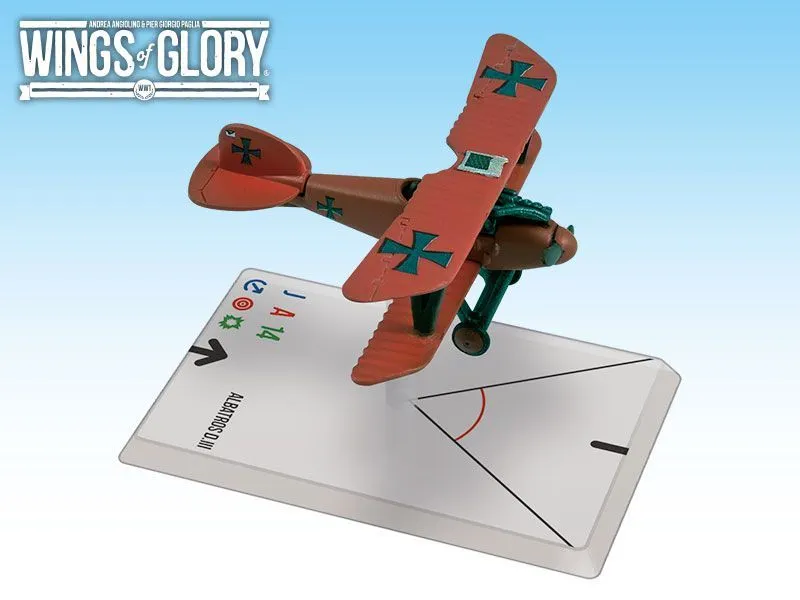
The Albatros D.III was the continuation of the line of “shark shaped” fighters that began with the D.I in the fall of 1916. Among the improvements was adopting the “sesquiplane” design from the Nieuport fighters, gaining climb and visibility, but weakening the structure. Still, the D.III dominated the skies and was the main killer during “Bloody April.” The Austrians built the D.III under license and actually managed to improve on the original. There were still some in combat at the Armistice. Albatros D.III (Frommherz) Hermann Frommherz went from 2-seater pilot to the famous Jasta 2, where his first fighter was the “Blau Maus.” He survived World War I with 32 victories. Albatros D.III (Gruber) Kurt Gruber’s first victory came with the Austro–Hungarian ace Godwin Brumowski manning the guns in his Albatros 2–seater, and they fought together again in this D.III in Flik 41J. Albatros D.III (Von Richthofen) Manfred von Richthofen, to flaunt his prowess in front of the enemy, painted this airplane completely bright red, partly obscuring its markings. For this reason, he became universally known as the “Red Baron.”
Publishers
- Ares Games
Questions and answers
Wings of Glory: World War 1 – Albatros D.III supports 2 players according to the catalogue. This is the publisher’s listed player count, so the game is designed for exactly that number of participants. Variants for other group sizes, if any, are described in the rulebook of your edition, so check it before setting up a different configuration.
The listed playing time for Wings of Glory: World War 1 – Albatros D.III is 30 minutes. This is the publisher’s estimate for a full game. The actual duration depends on the group, the player count and familiarity with the rules: first sessions usually run longer, while experienced groups often finish faster. Setup and teaching time are not included in this estimate.
The catalogue lists Wings of Glory: World War 1 – Albatros D.III for ages 13 and up. This is the publisher’s recommendation and reflects reading demands, rule complexity and small components rather than theme alone. Younger players can often join with help from an adult, so check the age guidance on your edition and consider your group’s experience with board games.
Wings of Glory: World War 1 – Albatros D.III belongs to these categories: Fighting, Wargame, and Miniatures. Its main mechanics are Simultaneous Action Selection and Simulation. Categories describe the theme and setting of a game, while mechanics describe what players actually do on their turns. Each mechanic links to a catalogue hub with similar games, which helps when you want something comparable.
The catalogue lists Wings of Glory: World War 1 – Albatros D.III as an expansion for Wings of Glory: WW1 Airplane Packs. Expansions add new content, rules or scenarios to the base game and usually cannot be played on their own, so you need Wings of Glory: WW1 Airplane Packs to use it. Check that your edition of Wings of Glory: WW1 Airplane Packs is compatible, as some expansions were revised between editions.