

- Puesto en BGG
- BGG #5035
- Puntuación BGG
- 6,2
504
- 2–4 jugadores
- 30–120 min
- Complejidad 3,5/5
- 2015
2020
Ayuda con las reglas de 18DO: Dortmund
Explicaciones claras de turnos, efectos de cartas y situaciones dudosas, con referencias a fuentes oficiales e historial de preguntas guardado.
Para 2 jugadores
¿Qué quieres saber?
Las respuestas salen del reglamento oficial, con la página para comprobarlo.
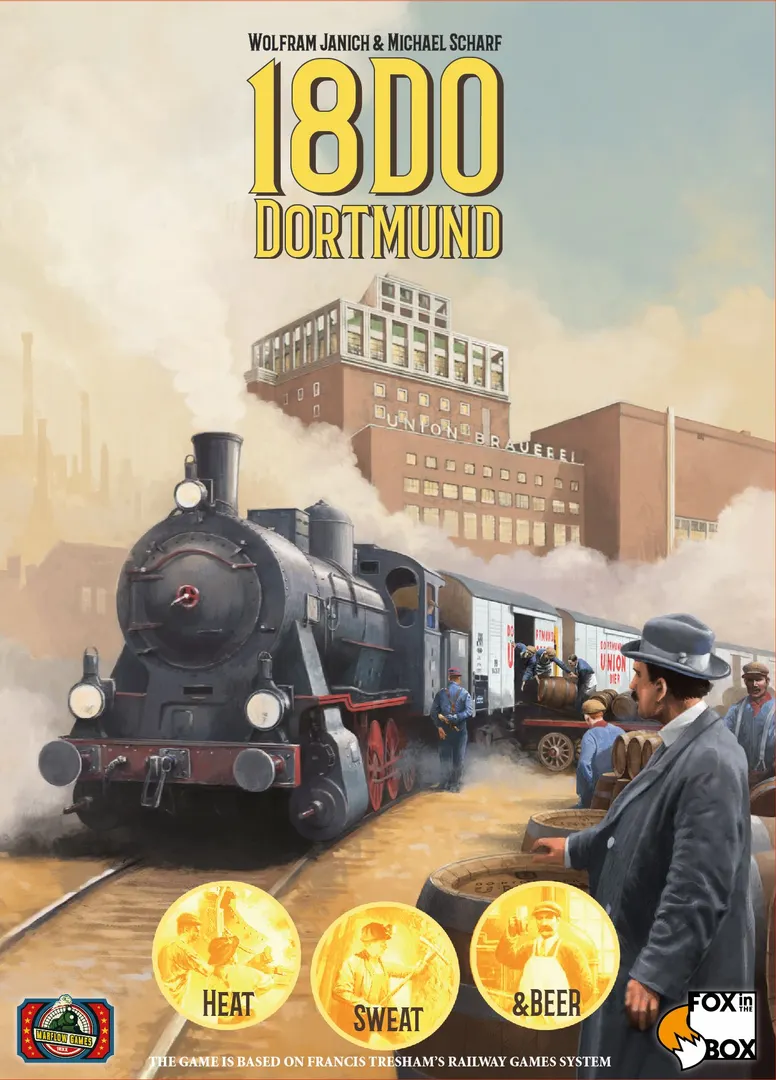
18DO: Dortmund es un juego de mesa publicado en 2020 para 2–5 jugadores, con partidas de 180 a 360 minutos y a partir de 12 años. Fue diseñado por Wolfram Janich y Michael Scharf y sus mecánicas principales son Auction / Bidding, Tile Placement y Commodity Speculation.
En inglés
18DO-Dortmund is a strategic economy game, which reflects the development of the most important industries in Dortmund during the 19th century. Dortmund has been a town of beer brewers since the medieval age. About 1840 the first underground mining started and the first steel mill has been built. The connection with the German railway net pushed the industrial development of Dortmund furthermore. The expansion of coal mines and steel mills led to a population increase. From the latter the Dortmund breweries benefited as the demand for beer boosted. At the end of the 19th century the Dortmund breweries used conditioned cars to transport the Dortmund Export beer by railway to distant regions. In 18DO-Dortmund the players are investors who invest in both, breweries and railway corporations. Each player starts with a private brewery. In addition every player may found a railway corporation. Coal mines and steel mills have a passive role only, but their locations have an impact on the game’s development. All breweries are located in the hex “Dortmund City”. They produce and supply beer and during the course of the game they improve their brewery equipment in order to scope with the increasing requirements of the beer market which a separate element of the game. The railway corporations are more dynamic. From their starting field at the border of the map they lay tracks to the coal mines and steel mills. On this tracks they run their trains virtually and achieve income according to the value of the hexes which are part of their trains’ routes. When connecting the locations of coal mines and steel mills with the railway network the demand for beer will be increased. This reflects that the coal mines/steels mills with a railway link are able to increase their capacities and the consequently needed higher workforce will trigger an increase of beer consumption. Later in the game the breweries start shipping beer by using the transport capacity of the railway corporations. In order to do so the train of a railway corporation must run a route that leads from the “Dortmund City” hex to one of the red off-board destination hexes. While the railway companies start the game as corporations the brewery corporations will be founded later during the game. For this purpose private breweries may be converted into brewery corporations. In order to give an owner/director of a brewery more room for decisions there are special function tokens which will give each brewery specific advantages. When a corporation pays dividends the owner of its shares receive the due payment by the bank. In addition the stock value of these shares will be increased. At the end of games all players accumulated their possessions’ which consists of their private cash plus the value of their share portfolio. This richest player will win! Description by the author
Según el catálogo, 18DO: Dortmund admite de 2 a 5 jugadores. Este intervalo corresponde al número de jugadores indicado por la editorial, así que el juego puede prepararse para cualquier grupo dentro de ese margen. La preparación, algunas reglas y la puntuación pueden variar según el número de jugadores; consulta la configuración exacta en el reglamento de tu edición.
La duración indicada para 18DO: Dortmund es de 180 a 360 minutos, la estimación de la editorial para una partida completa. El tiempo real depende del grupo, del número de jugadores y del conocimiento de las reglas: las primeras partidas suelen alargarse y los grupos con experiencia terminan antes. La preparación y la explicación de las reglas no están incluidas.
El catálogo indica 18DO: Dortmund a partir de 12 años. Es la recomendación de la editorial y refleja la lectura necesaria, la complejidad de las reglas y las piezas pequeñas, no solo el tema. Los más pequeños a menudo pueden jugar con ayuda de un adulto: comprueba la edad recomendada en tu edición y la experiencia de tu grupo.
18DO: Dortmund tiene una puntuación de complejidad de 4,0 sobre 5 según los jugadores de BoardGameGeek, lo que lo convierte en un juego exigente. La puntuación refleja cuánto conocimiento de reglas, planificación y toma de decisiones exige una partida típica. Los juegos exigentes requieren una explicación inicial más larga, así que conviene usar una guía de preparación.
18DO: Dortmund pertenece a estas categorías: Economic y Trains. Sus mecánicas principales son Auction / Bidding, Tile Placement y Commodity Speculation. Las categorías describen el tema y la ambientación de un juego, mientras que las mecánicas describen lo que los jugadores hacen realmente en su turno. Cada mecánica lleva a una página del catálogo con juegos similares.
Los autores acreditados de 18DO: Dortmund son: Wolfram Janich y Michael Scharf. Estos créditos proceden de los datos publicados del juego y nombran a las personas responsables de su diseño, no a ilustradores ni editoriales. Las páginas de autor de MeepleRules reúnen otros títulos de los mismos autores, algo útil cuando un juego te gusta y buscas otros parecidos.
El catálogo clasifica 18DO: Dortmund como juego base. Se juega por sí solo con los componentes de la caja y no requiere ningún otro título. Las expansiones, si existen, añaden contenido o reglas nuevas y aparecen por separado en el catálogo con un enlace a este juego base.