
- Puesto en BGG
- BGG #6169
- Puntuación BGG
- 6,9
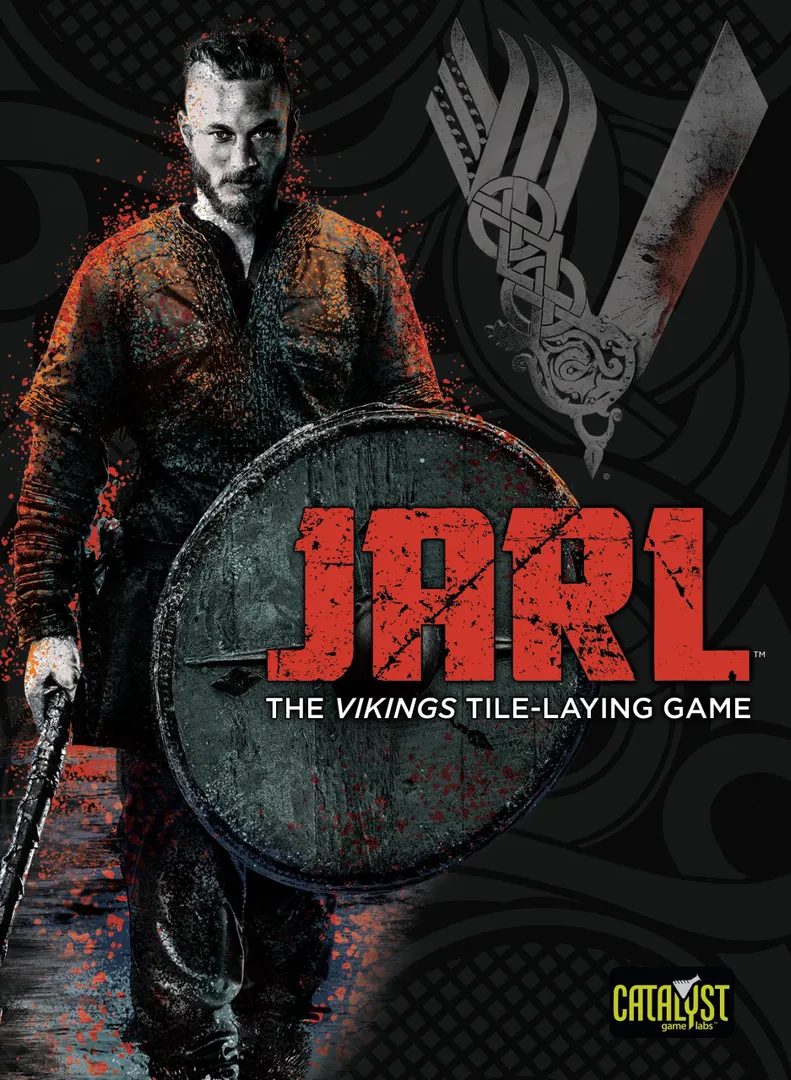
Jarl: The Vikings Tile-Laying Game
- 2 jugadores
- 15–25 min
- Complejidad 2,7/5
- 2015
1851
Ayuda con las reglas de 3-D Chess
Explicaciones claras de turnos, efectos de cartas y situaciones dudosas, con referencias a fuentes oficiales e historial de preguntas guardado.
Para 2 jugadores
¿Qué quieres saber?
Las respuestas salen del reglamento oficial, con la página para comprobarlo.
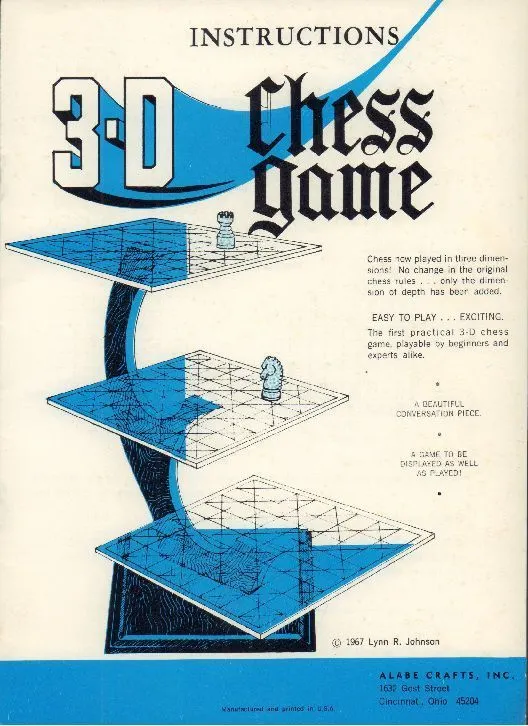
3-D Chess es un juego de mesa publicado en 1851 para 2 jugadores y con partidas de 90 minutos. Fue diseñado por Lionel Adalbert Bagration Felix Kieseritzky y sus mecánicas principales son Grid Movement.






En inglés
There are many forms of 3D Chess, the earliest being Kubicschach, which is German for Cubic Chess and was designed by the French Chess master Lionel Adalbert Bagration Felix Kieseritzky, in 1851. Kubicschach, as the name suggests, is eight standard Chess boards stacked up to for an 8x8x8 cube, it never became a popular game. Kubicschach was reduced by Doctor Ferdinand Maack in 1907, to five 5x5 boards and renamed Raumschach, which is German for Space Chess. It was played a lot in Germany during the beginning of the 20th century. Dimensional Games, Inc launched "The Original 3D Chess" in 1967, designed by NASA engineer Lynn R. Johnson. It includes three 8x8 boards and was sold until the late 90's. It was reproduced and relaunched in 2025, using the original design. The Dynamic Games company first produced a three 8x8 board in 1973 and sold it under the name Strato Chess. The game has been copied by many companies since and is the most widely available of all 3D Chess boards. The most famous variant of 3D Chess appeared in the Star Trek television show in 1966, in which it was referred to as 'Three Dimensional Chess'. The original stage property was designed by Irving A Feinberg and consisted of three 4x4 boards and four movable 2x2 boards. It was developed into a real game by the technical designer Franz Joseph Schnaubelt in his 1975 book, the Star Fleet Technical Manual and improved by a fan and chess player Andrew Bartmess, whose rules are some of the most popular. Fans of Star Trek still call it 'Three Dimensional Chess' but players of the game call it by the title Schnaubelt popularised 'Tri Dimensional Chess'. In 1985, the game design Gary Gygax published rules for Dragon Chess in Dragon magazine. A Dragon Chess board is three 8x12 boards stacked up and includes the extra pieces: Sylph, Griffon, Dragon, Warrior, Oliphant, Unicorn, Hero, Thief, Cleric, Mage, Paladin, Dwarf, Basilisk and Elemental. Max Chappell started designing Hyperchess in the early '70s but didn't produce and sell the first commercial set until 1996. Although it was influenced by the tri dimensional chess board, it has been described as more helical in design. In 2001 William d'Agostino recreated the Strato Chess board and called it Millenium Chess, with the idea of extending Classic Chess, without distorting the game.
Según el catálogo, 3-D Chess admite 2 jugadores. Es el número de jugadores indicado por la editorial, así que el juego está diseñado exactamente para esa cantidad de participantes. Las variantes para otros tamaños de grupo, si existen, se describen en el reglamento de tu edición; consúltalo antes de preparar otra configuración.
La duración indicada para 3-D Chess es de 90 minutos, la estimación de la editorial para una partida completa. El tiempo real depende del grupo, del número de jugadores y del conocimiento de las reglas: las primeras partidas suelen alargarse y los grupos con experiencia terminan antes. La preparación y la explicación de las reglas no están incluidas.
3-D Chess tiene una puntuación de complejidad de 4,1 sobre 5 según los jugadores de BoardGameGeek, lo que lo convierte en un juego exigente. La puntuación refleja cuánto conocimiento de reglas, planificación y toma de decisiones exige una partida típica. Los juegos exigentes requieren una explicación inicial más larga, así que conviene usar una guía de preparación.
3-D Chess pertenece a estas categorías: Movies / TV / Radio theme y Abstract Strategy. Sus mecánicas principales son Grid Movement. Las categorías describen el tema y la ambientación de un juego, mientras que las mecánicas describen lo que los jugadores hacen realmente en su turno. Cada mecánica lleva a una página del catálogo con juegos similares.
Los autores acreditados de 3-D Chess son: Lionel Adalbert Bagration Felix Kieseritzky. Estos créditos proceden de los datos publicados del juego y nombran a las personas responsables de su diseño, no a ilustradores ni editoriales. Las páginas de autor de MeepleRules reúnen otros títulos de los mismos autores, algo útil cuando un juego te gusta y buscas otros parecidos.
El catálogo clasifica 3-D Chess como juego base. Se juega por sí solo con los componentes de la caja y no requiere ningún otro título. Las expansiones, si existen, añaden contenido o reglas nuevas y aparecen por separado en el catálogo con un enlace a este juego base.