

- Puesto en BGG
- BGG #352
- Puntuación BGG
- 7,5
Raíles: Millonarios del Vapor
- 3–6 jugadores
- 90 min
- Complejidad 3,5/5
- 2009
Ayuda con las reglas de Age of Steam Expansion: Portugal
Explicaciones claras de turnos, efectos de cartas y situaciones dudosas, con referencias a fuentes oficiales e historial de preguntas guardado.
¿Qué quieres saber?
Las respuestas salen del reglamento oficial, con la página para comprobarlo.
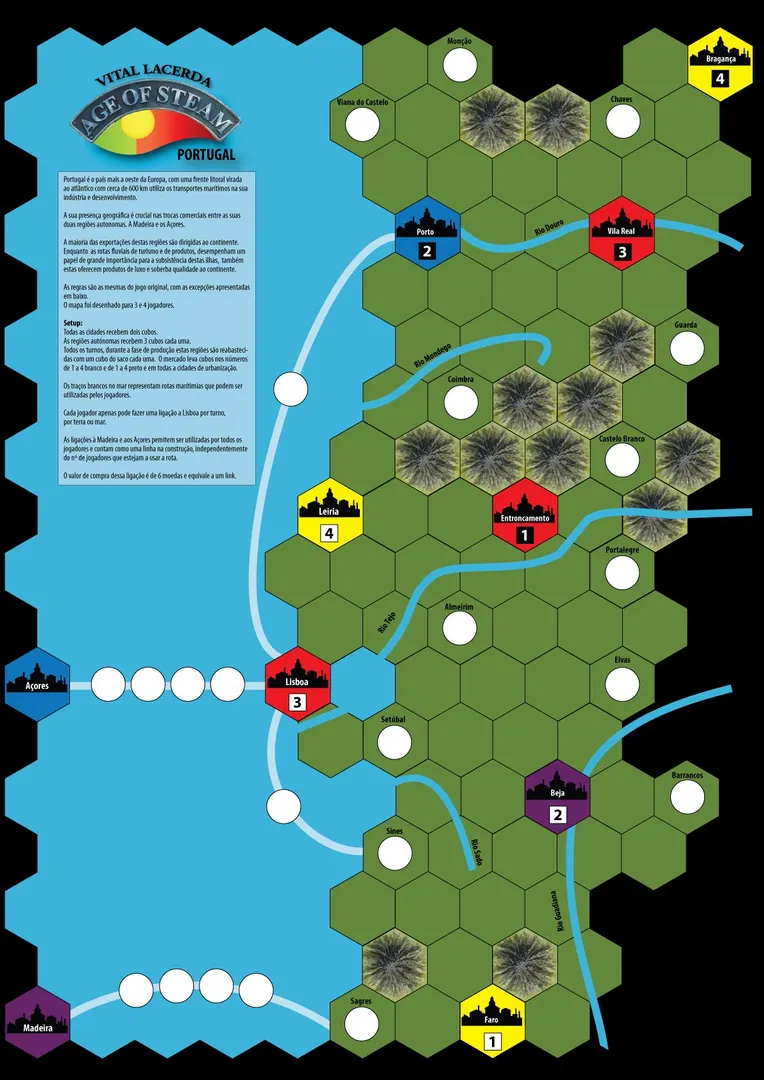
Age of Steam Expansion: Portugal es una expansión de Age of Steam publicada en 2008 para 3–4 jugadores. Fue diseñado por Vital Lacerda y sus mecánicas principales son Auction / Bidding, Tile Placement y Network and Route Building.





En inglés
Portugal is the most Western country in Europe. With a coast that spreads over 600km facing the Atlantic Ocean, Portugal uses the shipping routes in order to develop its industry. Portugal mainland is a crucial geographical presence for the two autonomous regions, the islands of Madeira and the Azores. Most of the exports from these regions are directed to the mainland. While the sea routes for tourism and goods play a role of great importance to the livelihood of these islands, they also offer luxury products and superb quality to the continent. The rules are the same as the original game, with the exceptions presented below. The map was designed for 3 and 4 players. The real hook of this map is the importance of Lisbon on the map center. The game usually grows from Lisbon since the companies can link to almost all cities on the map from there. The twist is that each player can only make one connection to Lisbon per turn, be it by land or by sea. In fact, Lisbon and Oporto are the most important links in his map. This expansion works very well with Steam rules too.
Según el catálogo, Age of Steam Expansion: Portugal admite de 3 a 4 jugadores. Este intervalo corresponde al número de jugadores indicado por la editorial, así que el juego puede prepararse para cualquier grupo dentro de ese margen. La preparación, algunas reglas y la puntuación pueden variar según el número de jugadores; consulta la configuración exacta en el reglamento de tu edición.
Age of Steam Expansion: Portugal tiene una puntuación de complejidad de 3,3 sobre 5 según los jugadores de BoardGameGeek, lo que lo convierte en un juego de complejidad media. La puntuación refleja cuánto conocimiento de reglas, planificación y toma de decisiones exige una partida típica. Los juegos exigentes requieren una explicación inicial más larga, así que conviene usar una guía de preparación.
Age of Steam Expansion: Portugal pertenece a estas categorías: Trains, Transportation y Expansion for Base-game. Sus mecánicas principales son Auction / Bidding, Tile Placement y Network and Route Building. Las categorías describen el tema y la ambientación de un juego, mientras que las mecánicas describen lo que los jugadores hacen realmente en su turno. Cada mecánica lleva a una página del catálogo con juegos similares.
Los autores acreditados de Age of Steam Expansion: Portugal son: Vital Lacerda. Estos créditos proceden de los datos publicados del juego y nombran a las personas responsables de su diseño, no a ilustradores ni editoriales. Las páginas de autor de MeepleRules reúnen otros títulos de los mismos autores, algo útil cuando un juego te gusta y buscas otros parecidos.
El catálogo clasifica Age of Steam Expansion: Portugal como expansión de Age of Steam. Las expansiones añaden contenido, reglas o escenarios al juego base y normalmente no se pueden jugar solas, así que necesitas Age of Steam para usarla. Comprueba que tu edición de Age of Steam sea compatible, porque algunas expansiones se revisaron entre ediciones.
