
- Puesto en BGG
- BGG #6622
- Puntuación BGG
- 8,1
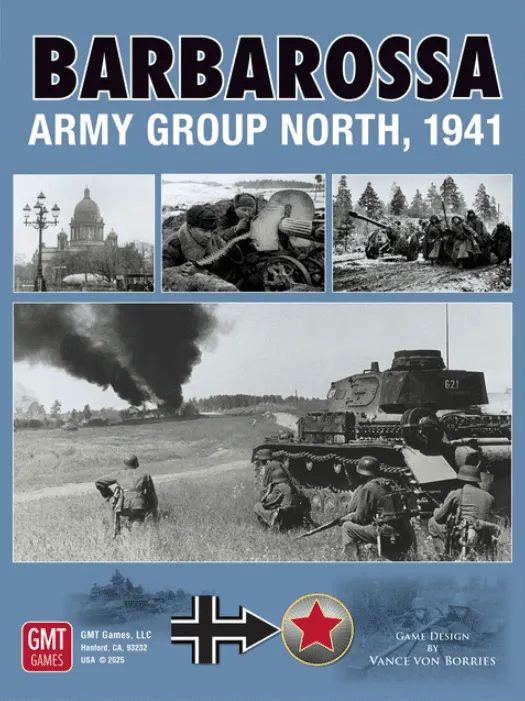
Barbarossa: Army Group North, 1941
- 1–4 jugadores
- 300 min
- Complejidad 4,2/5
- 2000
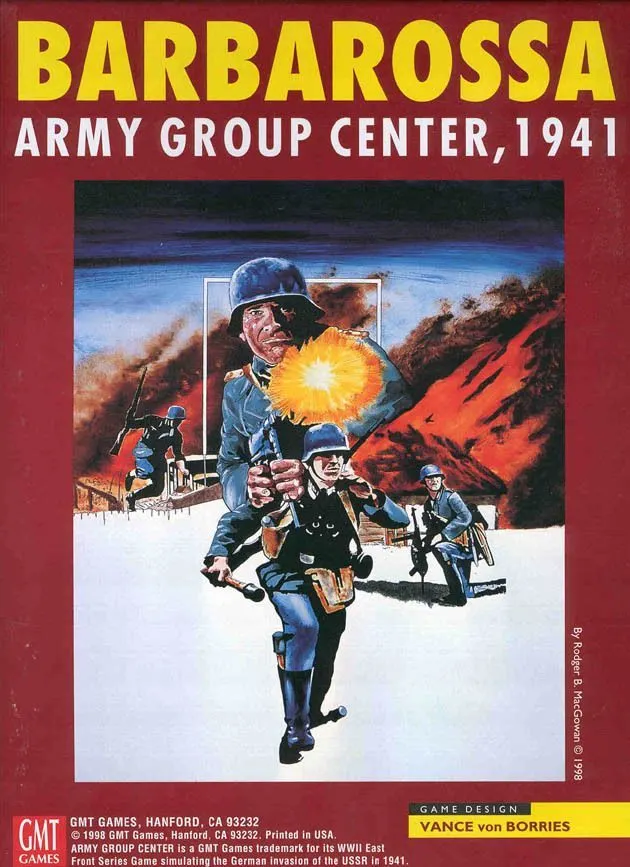
1998
Ayuda con las reglas de Barbarossa: Army Group Center, 1941
Explicaciones claras de turnos, efectos de cartas y situaciones dudosas, con referencias a fuentes oficiales e historial de preguntas guardado.
Para 1 jugador
¿Qué quieres saber?
Las respuestas salen del reglamento oficial, con la página para comprobarlo.
Barbarossa: Army Group Center, 1941 es un juego de mesa publicado en 1998 para 1–4 jugadores, con partidas de 120 minutos y a partir de 12 años. Fue diseñado por Vance von Borries y Tony Curtis y sus mecánicas principales son Hexagon Grid.
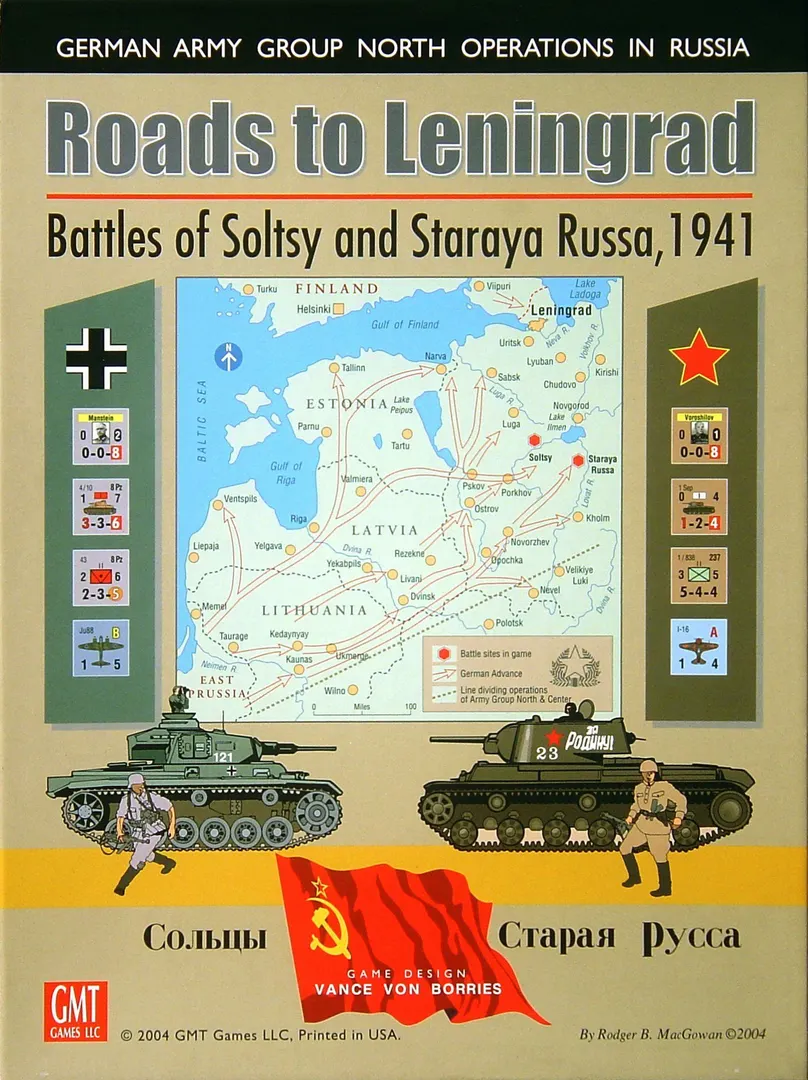



En inglés
Historical Setting June 1941 -- Army Group Center hurls itself through the Soviet border defenses, and its two Panzer groups race headlong toward Minsk. Behind them lie the remnants of the Soviet Western Front -- almost a million men in four armies. The Soviets are stunned by the German Blitzkrieg. Their responses are slow, confused, and governed by pre-war contingency plans made obsolete by the speed of the German advance. In little more than a week, the German panzer spearheads meet east of Minsk. Though isolated units continue to fight, the entire Soviet Western Front has ceased to exist! The Germans' next target is Smolensk, but the Soviets resist more effectively. Entire armies are dispatched from other parts of the Soviet Union as the true scope of the Minsk pocket disaster and the magnitude of the German threat become known. Soviet counterattacks, especially around Lepel, are thrown back with horrific losses. Once again the Panzer Groups charge eastward, creating yet another huge Soviet pocket west of Smolensk. The Soviets resist savagely. Smolensk falls on July 13th, but the pocket does not close. Many Soviet units escape to fight another day. Hitler now makes a fateful decision and overrides his generals. Over half of Army Group Center's armored and air formations are diverted south to take Kiev or north to isolate Leningrad. No longer under heavy pressure, the Soviets gain time to form solid fronts around Vyazma and Bryansk. Did Hitler's decision cost the Germans the war? Play Barbarossa: Army Group Center and find out for yourself Game Features Eight scenarios allow players to vary their level of involvement, complexity, and starting point, from introductory to full campaign An asymmetrical sequence of play that highlights Axis armored breakthroughs and Soviet difficulties in combined arms warfare. This includes a “non-op” Soviet HQ system to simulate the rigid, yet fragile, Soviet Command structure Detailed air rules which integrate with land combat and weather rules Incredibly detailed Order of Battle, including special coverage of artillery, rocket artillery, engineers, bridge units, armored trains, and much more Modifications to the proven “EFS” include many revised rules and procedures, as well as new Order of Battle information Extensive bibliography and design/historical notes COMPONENTS • Four 22" × 34" inch maps (Maps C, D, H, and I) • One 25½" × 11½" inch map (Map WA) • 1400 die-cut ½" counters in five full counter sheets • One Rule Book • One Playbook • One 11" × 17" Map Card (with Scenario 3 and 6 Maps either side) • Three double-sided Soviet Set Up Cards (with backside of one card containing a Game Card displaying all Scenario 3 and 6 units) • Two double-sided Axis Set Up Cards (with CRT on one) • One single-sided 8½" × 11" combined Axis and Soviet Step Reduction Organization Card • Two double-sided 11" × 17" inch folded Chart Cards with Combat Results Table, Terrain Effects Chart, Overrun, AA, Air Combat, CAB, etc. charts • One double-sided 11" × 17" inch folded Chart Card with Units and their Symbols, Movement Phase, Effects on Movement Chart, Artillery, etc. charts • One double-sided 8½" × 11" chart card front side Axis/Soviet Set Up Card for Scenario 1 and backside with Super-Heavy Artillery Effects Table • Two single-sided 8½" × 11" Air Unit Status/Unit Rebuilding Cards (one Soviet and one Axis) • One double-sided 11" × 17" inch folded Chart Card containing Scenario Victory Conditions, Replacement Table, Fuel, ASPs, RR Conversion • One single-sided 8½" × 11" Chart Card with Turn Record Track, Weather Table, and various scenario information summaries • Two 11" × 17" Expanded Sequences of Play Cards • One ten-sided die TIME SCALE 2 days per turn MAP SCALE 5 miles per hex GROUND UNIT SCALE Division/Regiment AIR UNIT SCALE 40-80 aircraft per counter NUMBER OF PLAYERS One to four (2nd edition description, from GMT website and components from Playbook) This is one of a very popular series of games from GMT covering the first months of the invasion of the USSR; units are battalions through divisions, hexes are about 5 miles, and turns are two days. The system encompasses (as of 6/2001) Barbarossa: Army Group North (2000), Barbarossa: Army Group Center (1998), and Barbarossa: Army Group South (1996). Typhoon! (1995) is the progenitor of these games, and its system is quite similar, but it is unfortunately subtly incompatible with the later games. While not simple, these games are also not overly complex and present an excellent simulation of the early war. Most of the details of the campaigns are covered in a playable manner. Perhaps the most obviously interesting detail is the sequence of play, which is asymmetrical to account for the difficulties the Soviets labored under. Make no mistake, the Soviets are going to take a lot of abuse, but this is no walkover for the Germans and both sides are interesting to play. (BGG user description) 1st edition errata counters contained in Barbarossa: Crimea, 1941-42.
Según el catálogo, Barbarossa: Army Group Center, 1941 admite de 1 a 4 jugadores. Este intervalo corresponde al número de jugadores indicado por la editorial, así que el juego puede prepararse para cualquier grupo dentro de ese margen. La preparación, algunas reglas y la puntuación pueden variar según el número de jugadores; consulta la configuración exacta en el reglamento de tu edición.
La duración indicada para Barbarossa: Army Group Center, 1941 es de 120 minutos, la estimación de la editorial para una partida completa. El tiempo real depende del grupo, del número de jugadores y del conocimiento de las reglas: las primeras partidas suelen alargarse y los grupos con experiencia terminan antes. La preparación y la explicación de las reglas no están incluidas.
El catálogo indica Barbarossa: Army Group Center, 1941 a partir de 12 años. Es la recomendación de la editorial y refleja la lectura necesaria, la complejidad de las reglas y las piezas pequeñas, no solo el tema. Los más pequeños a menudo pueden jugar con ayuda de un adulto: comprueba la edad recomendada en tu edición y la experiencia de tu grupo.
Barbarossa: Army Group Center, 1941 tiene una puntuación de complejidad de 4,0 sobre 5 según los jugadores de BoardGameGeek, lo que lo convierte en un juego exigente. La puntuación refleja cuánto conocimiento de reglas, planificación y toma de decisiones exige una partida típica. Los juegos exigentes requieren una explicación inicial más larga, así que conviene usar una guía de preparación.
Barbarossa: Army Group Center, 1941 pertenece a estas categorías: Wargame y World War II. Sus mecánicas principales son Hexagon Grid. Las categorías describen el tema y la ambientación de un juego, mientras que las mecánicas describen lo que los jugadores hacen realmente en su turno. Cada mecánica lleva a una página del catálogo con juegos similares.
Los autores acreditados de Barbarossa: Army Group Center, 1941 son: Vance von Borries y Tony Curtis. Estos créditos proceden de los datos publicados del juego y nombran a las personas responsables de su diseño, no a ilustradores ni editoriales. Las páginas de autor de MeepleRules reúnen otros títulos de los mismos autores, algo útil cuando un juego te gusta y buscas otros parecidos.
El catálogo clasifica Barbarossa: Army Group Center, 1941 como juego base. Se juega por sí solo con los componentes de la caja y no requiere ningún otro título. Las expansiones, si existen, añaden contenido o reglas nuevas y aparecen por separado en el catálogo con un enlace a este juego base.