

- Puesto en BGG
- BGG #5300
- Puntuación BGG
- 8,1
UND1C1
- 2–4 jugadores
- 45–60 min
- Complejidad 2,7/5
- 2022
2025
Ayuda con las reglas de Baseball Card GM
Explicaciones claras de turnos, efectos de cartas y situaciones dudosas, con referencias a fuentes oficiales e historial de preguntas guardado.
¿Qué quieres saber?
Las respuestas salen del reglamento oficial, con la página para comprobarlo.
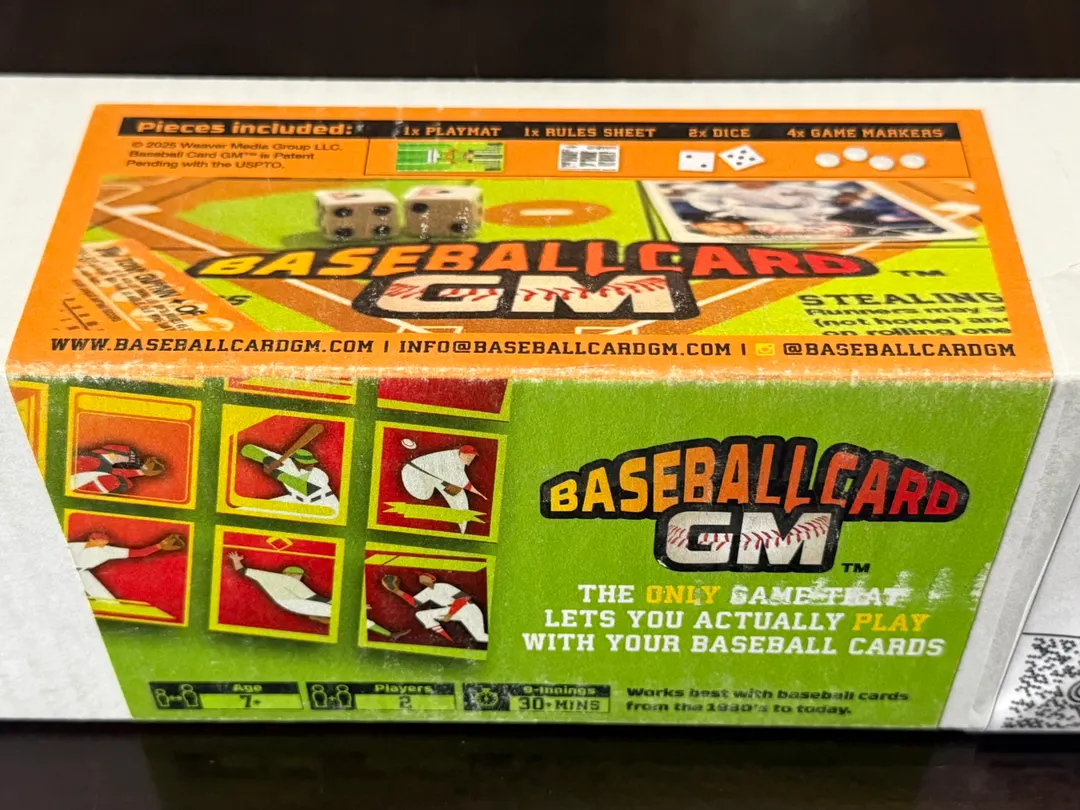
Baseball Card GM es un juego de mesa publicado en 2025 para 1–2 jugadores, con partidas de 30 a 45 minutos y a partir de 7 años. Sus mecánicas principales son Dice Rolling, Simulation y Deck Construction.





En inglés
It all started in 2024, when Garrett Weaver (then just seven) asked a simple question: “How can I actually play with my baseball cards?” When no games existed, he and his younger brother Simon invented a set of rules at their dining-room table, which today after play-testing with their friends, schoolmates, and baseball teammates has become Baseball Card GM. The game is a sturdy 36"x18" neoprene playmat (which can be rolled for easy storage/travel) with all rules on the playmat itself. A 9-inning game takes about 30 minutes to play, good for ages 7+. It's easy as 1-2-3: 1. Draft your team from your own baseball cards. You are the GM, so you can create any team you want, any way you want, with whatever cards you have! You can make your ultimate Dream Team, recreate an actual historic team, build along a specific theme (ex: MVP’s and CY’s of the 2000’s), do an actual draft alternating picks with your competitor, or crack some new packs and play with whatever you get. The possibilities are endless, and even a random stack of cards can be hours of fun. The game works best with baseball cards from the 1980’s to today (ie most likely to have all the stats needed for the game: HR, 3B, 2B, Avg, BBs, Hits, RBIs, SBs), but you can use older cards as well because the stats used in the game are nearly universal to all cards. Once you have your team, you will build your line-up, choose your starting pitcher, and fill out your bench and bullpen. Then you are ready to play ball! 2. Use the stats on the back of the cards. A good GM knows player analytics, and for you that means diving into the stats on the back of the cards! Your batter getting a single, double, triple, homerun, walk, strikeout, ground-out (G/O), fly-out (F/O) or pop-out (P/O) is all based on a combination of whichever single year of their major league stats you choose from the back of their card, the stats of the pitcher they are facing, whether the pitcher/batter are righty or lefty, and the outcome of rolling two dice. The odds are all worked out right on the playmat so potential batting outcomes are just like how it COULD have happened historically in real life. Better batters will have better chances to roll better outcomes with the same frequency as their stats dictate. Remember not all players excel at every stat, so build your line-up accordingly! 3. Play a real game that is true to the stats. A GM has to know all the nuances of baseball, and here all the normal baseball rules apply! Run through your line-up in order, alternating between Visitors and Home teams, placing cards as they move around the bases. Substitute batters, pitchers, or base runners just as the pro’s would in a real game. Track Outs, Runs, and the Top-Bottom of the nine inning game with the markers placed in the appropriate squares on the playmat. Special circumstances when runners are already on base are described on the playmat too: double plays, sac flies, scoring from second on a single, and stealing bases can and will happen! —description from the designer
Según el catálogo, Baseball Card GM admite de 1 a 2 jugadores. Este intervalo corresponde al número de jugadores indicado por la editorial, así que el juego puede prepararse para cualquier grupo dentro de ese margen. La preparación, algunas reglas y la puntuación pueden variar según el número de jugadores; consulta la configuración exacta en el reglamento de tu edición.
La duración indicada para Baseball Card GM es de 30 a 45 minutos, la estimación de la editorial para una partida completa. El tiempo real depende del grupo, del número de jugadores y del conocimiento de las reglas: las primeras partidas suelen alargarse y los grupos con experiencia terminan antes. La preparación y la explicación de las reglas no están incluidas.
El catálogo indica Baseball Card GM a partir de 7 años. Es la recomendación de la editorial y refleja la lectura necesaria, la complejidad de las reglas y las piezas pequeñas, no solo el tema. Los más pequeños a menudo pueden jugar con ayuda de un adulto: comprueba la edad recomendada en tu edición y la experiencia de tu grupo.
Baseball Card GM tiene una puntuación de complejidad de 1,3 sobre 5 según los jugadores de BoardGameGeek, lo que lo convierte en un juego ligero. La puntuación refleja cuánto conocimiento de reglas, planificación y toma de decisiones exige una partida típica. Los juegos exigentes requieren una explicación inicial más larga, así que conviene usar una guía de preparación.
Baseball Card GM pertenece a estas categorías: Dice y Sports. Sus mecánicas principales son Dice Rolling, Simulation y Deck Construction. Las categorías describen el tema y la ambientación de un juego, mientras que las mecánicas describen lo que los jugadores hacen realmente en su turno. Cada mecánica lleva a una página del catálogo con juegos similares.
El catálogo clasifica Baseball Card GM como juego base. Se juega por sí solo con los componentes de la caja y no requiere ningún otro título. Las expansiones, si existen, añaden contenido o reglas nuevas y aparecen por separado en el catálogo con un enlace a este juego base.