
- Puntuación BGG
- 7,3
Blitzkrieg Module System
- 2 jugadores
- 240 min
- Complejidad 3,6/5
- 1969
1965
Ayuda con las reglas de Blitzkrieg
Explicaciones claras de turnos, efectos de cartas y situaciones dudosas, con referencias a fuentes oficiales e historial de preguntas guardado.
Para 2 jugadores
¿Qué quieres saber?
Las respuestas salen del reglamento oficial, con la página para comprobarlo.
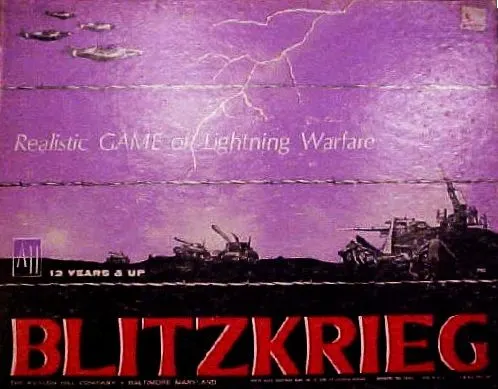
Blitzkrieg es un juego de mesa publicado en 1965 para 2 jugadores, con partidas de 90 minutos y a partir de 12 años. Fue diseñado por Larry Pinsky y Thomas N. Shaw y sus mecánicas principales son Dice Rolling, Grid Movement y Hexagon Grid.







En inglés
Blitzkrieg is one of Avalon Hill's earlier releases, and is a classic hex and counter board game. The game is a fictional representation of the breakout of World War II. Five minor countries become engulfed in a tremendous conflict for territory waged by Great Blue and Big Red, the major antagonists. Units represented are infantry, airborne, rangers, armor, artillery, fighters and bombers. Naval action is included but abstracted. Rules are introduced at three levels: the basic game, the advanced game, and a tournament game, as well as optional rules players can include as they choose. The advanced game adds special unit abilities, supply restrictions, air war and strategic bombing, naval invasions, commando raids, special desert supply restrictions, etc. Tournament play was intended for play at game conventions such as the annual world board-gaming convention in Harrisburg, Pa. The nice thing about Blitzkrieg is that it uses a system that is similar to most other hex and counter games, so once one learns one game, the learning curve of a similar game is not as steep. Such is the case with many of the old Avalon Hill Classics. Once you learned one game all of the others played the same way with some minor variation, only the campaign is different. The basic play used unit types and combat ratings. As expected, infantry would have different abilities from armor or artillery. Each unit had ratings printed in large print on the piece, ("chits" or counters as they are called). For example, take a 1-4 infantry brigade. The "4" is the movement factor per turn, so the unit can move four hexes in clear terrain per turn. Movement along a road is 1/3, so a 1-4 infantry can move 12 hexes if moved solely along a road. Each side is permitted to move all of their units up to their full movement allowance. The first rating, the "1" in this case, is the combat factor. Combat is worked out in odds, so that if one moves his 1-4 infantry next to the enemies’ 1-4 infantry, the combat odds are 1-1 (not very good in combat). There is nothing preventing one from ganging up on an enemy unit, and in fact this is the general tactic even in real life. So if one brought up another brigade into the attack there would be two 1-4 infantry brigades against the enemy's single brigade for 2-1 odds. For example, if the enemy had a 4-4 infantry division sitting on a clear hex and on their turn a player brings up three 4-4 infantry divisions adjacent to have combat, this would be at 12-4 odds, which reduce to 3-1. Then one would consult the combat results table under the 3-1 column and roll the die. The results would resolve the combat and tell what losses there were, and who had to retreat. Obviously, higher odds will favor that side. Also in combat, terrain affects combat. A defender in a city or mountain would have their defense rating doubled. For example, a 1-4 infantry in the mountains would defend as a combat rating of 2. Odds are rounded in favor of the defender. From the example above if that 4-4 infantry was defending in a city against those three 4-4 infantry, the odds would now be 12-8, only 1-1 odds (better bring up more attacking troops). When Blitzkrieg came out this type of map wargame was relatively new, so this game was very novel in its time. It is still a good two player game and there is enough variation so it won't get stale. It has a WWII or early cold war feel to it. The two antagonists are abstract, Big Red and Great Blue, which had more to do with the simple printing colors Avalon Hill used back in the early 1960's than any national commentary. In the late seventies and eighties many panned Blitzkrieg since many games seemed to grind to a stalemate in the middle of the map. But as a training game this isn't such a bad thing, since that can give a new gamer some confidence to play to a draw.
Según el catálogo, Blitzkrieg admite 2 jugadores. Es el número de jugadores indicado por la editorial, así que el juego está diseñado exactamente para esa cantidad de participantes. Las variantes para otros tamaños de grupo, si existen, se describen en el reglamento de tu edición; consúltalo antes de preparar otra configuración.
La duración indicada para Blitzkrieg es de 90 minutos, la estimación de la editorial para una partida completa. El tiempo real depende del grupo, del número de jugadores y del conocimiento de las reglas: las primeras partidas suelen alargarse y los grupos con experiencia terminan antes. La preparación y la explicación de las reglas no están incluidas.
El catálogo indica Blitzkrieg a partir de 12 años. Es la recomendación de la editorial y refleja la lectura necesaria, la complejidad de las reglas y las piezas pequeñas, no solo el tema. Los más pequeños a menudo pueden jugar con ayuda de un adulto: comprueba la edad recomendada en tu edición y la experiencia de tu grupo.
Blitzkrieg tiene una puntuación de complejidad de 2,7 sobre 5 según los jugadores de BoardGameGeek, lo que lo convierte en un juego algo ligero. La puntuación refleja cuánto conocimiento de reglas, planificación y toma de decisiones exige una partida típica. Los juegos exigentes requieren una explicación inicial más larga, así que conviene usar una guía de preparación.
Blitzkrieg pertenece a estas categorías: Wargame y World War II. Sus mecánicas principales son Dice Rolling, Grid Movement y Hexagon Grid. Las categorías describen el tema y la ambientación de un juego, mientras que las mecánicas describen lo que los jugadores hacen realmente en su turno. Cada mecánica lleva a una página del catálogo con juegos similares.
Los autores acreditados de Blitzkrieg son: Larry Pinsky y Thomas N. Shaw. Estos créditos proceden de los datos publicados del juego y nombran a las personas responsables de su diseño, no a ilustradores ni editoriales. Las páginas de autor de MeepleRules reúnen otros títulos de los mismos autores, algo útil cuando un juego te gusta y buscas otros parecidos.
El catálogo clasifica Blitzkrieg como juego base. Se juega por sí solo con los componentes de la caja y no requiere ningún otro título. Las expansiones, si existen, añaden contenido o reglas nuevas y aparecen por separado en el catálogo con un enlace a este juego base.