
- Puesto en BGG
- BGG #182
- Puntuación BGG
- 7,8
War Chest
- 2–4 jugadores
- 30 min
- Complejidad 2,3/5
- 2018
2018
Ayuda con las reglas de Centrix
Explicaciones claras de turnos, efectos de cartas y situaciones dudosas, con referencias a fuentes oficiales e historial de preguntas guardado.
¿Qué quieres saber?
Las respuestas salen del reglamento oficial, con la página para comprobarlo.
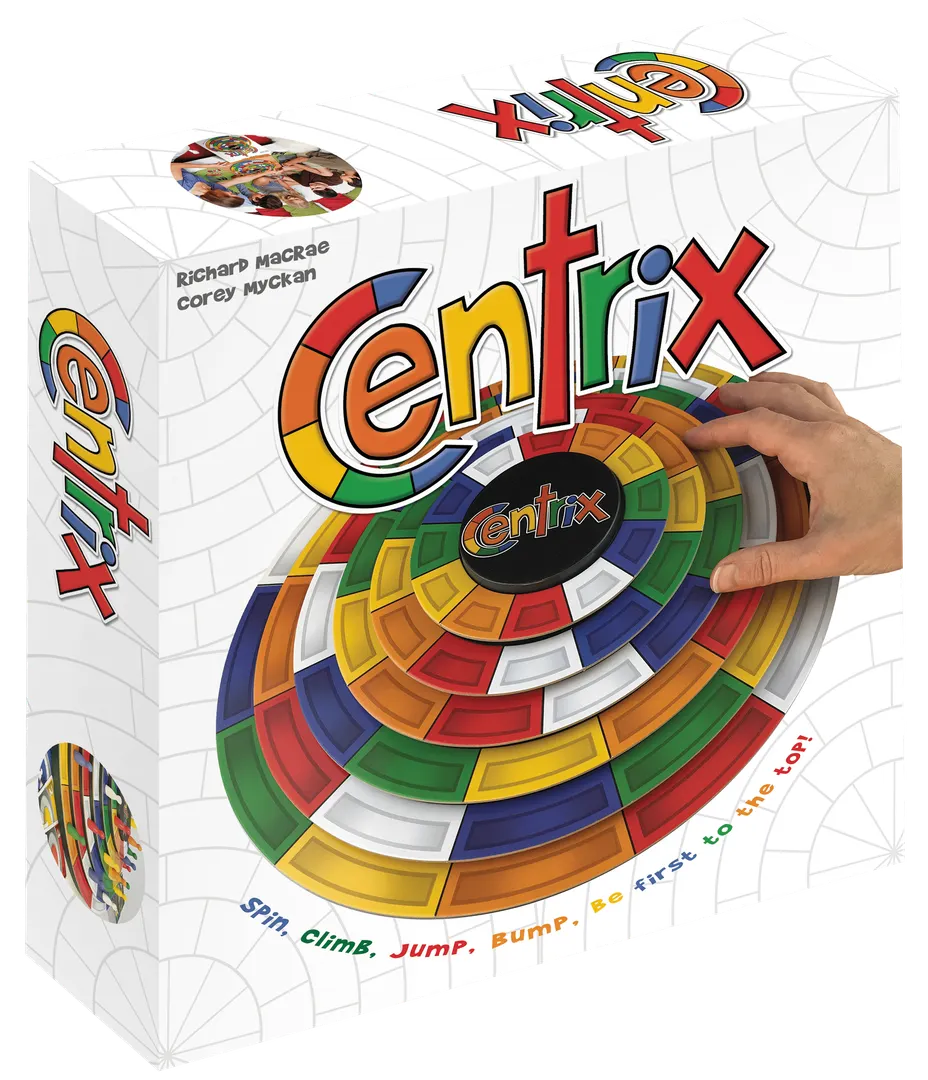
Centrix es un juego de mesa publicado en 2018 para 2–6 jugadores, con partidas de 20 a 30 minutos y a partir de 8 años. Fue diseñado por Corey Myckan y Richard MacRae y sus mecánicas principales son Hand Management y Grid Movement.








En inglés
Centrix is a fun, friendly and family multi-level three dimensional game. Use Card combinations to rotate the rings of the game board and climb your play pieces to the top. Skillfully unlock the best route up the ever-changing game board. Use strategy and tactics to jump over as many play pieces as you can, and prevent other players from getting to the top first by bumping them down. Spin, Climb, Jump, Bump; Be First to the Top GAME MATERIALS - Game Board – Six multi-colored rotatable rings, with 12 colored squares each and a black, stationary top level; - 18 Pawns – Three of each in six different colors – red, orange, yellow, green, blue and white; - Deck of Cards – 42 playing cards, as follows: - 36 cards in six different colors and numbered 1, 2 or 3, - Three ‘any-color’ wild-cards, and - Three ‘unlimited-spin and any-color’ wild-cards. OBJECT OF THE GAME Move all three pawns up the six rings and enter them all onto the top stationary 7th level. First to do this wins the game. Second, third and fourth place winners follow continuing the game until the last pawn reaches the top level. PAWN MOVEMENT - Pawns always move by one, up down or sideways, but never diagonally; - Two pawns cannot occupy the same color square Jumping - A pawn can jump over or ‘leapfrog’ any pawn; - The number of pawns in a row that you can leapfrog is unlimited, provided that the color card played is the same color as the square that the pawn lands on; and - Jumping can start from the first move onto the board and even onto the top 7th level. Bumping - If the square above, adjacent or below is occupied, then you can bump that pawn directly down two levels, by playing the color card of that square and moving your pawn to the occupied square; - If another pawn occupies the square that your opponent’s pawn dropped down to, then that pawn also drops down two levels and so on (even if they happen to be your own pawns); - You cannot leapfrog up to bump an opponent’s pawn down two levels; and - Bumping is only possible by moving up one level, sideways or even down, if you choose to do so. CARD PLAY There are three types of cards in the deck: 1. Numbered color cards are the main cards used in playing the game. RING ROTATION - The number on a card is the number of squares that you can rotate a ring, 1, 2 or 3 either clockwise or counter-clockwise, as shown on the cards; - You can only rotate the ring level that your pawn is on; and - Rotating is optional, you can play the card as a color only card, but if rotating, then move the ring the same number of squares as the number shown on the card and always rotate the ring before playing the color. COLOR PLAY - The color on the card is the only square color that you can move a pawn to, when played; - If after rotating a ring, the square color above where the pawn arrives is the same as the color of the card, then you can climb up to that square, bump another pawn or leapfrog to a higher square of that same color, in a combination move. If not, then play a second color card if you have the color match. 2. Any-color wild-cards, allow you to move one pawn up, down or to an adjacent square from where your pawn is positioned, regardless of the color of that square: - The card also allows your pawn to climb, jump and bump, as explained in Pawn Movement above and to move up to the final 7th level; - This card cannot rotate any rings. 3. Unlimited-spin, any-color wild-cards, allow you to rotate one ring (optionally) any number of squares clockwise or counter-clockwise, provided that you have a pawn on that ring: - The card is subsequently also played as an any-color card, as described above. COURSE OF THE GAME - Youngest player goes first; - Play one card per pawn move, starting off the board; - The square color on which you place your pawn must match the card color (wild-cards are any color); - Play all three of your cards in your hand, if possible; - You cannot bump another player off the bottom first level; and - After you have played as many of the three cards as you can play, your turn ends, you draw new cards for a total of three cards in your hand and the next player takes a turn. END OF THE GAME - From the 6th ring level, play any numbered card that matches the color of your pawns or any of the wild-cards to move up to the 7th safe level at the centre of the game board; - You can leapfrog over other pawns to make this move; - Your pawns cannot be removed, once they reach the top level; and - When all three pawns are at the top, you’re done and if first to get there, you win the game.
Según el catálogo, Centrix admite de 2 a 6 jugadores. Este intervalo corresponde al número de jugadores indicado por la editorial, así que el juego puede prepararse para cualquier grupo dentro de ese margen. La preparación, algunas reglas y la puntuación pueden variar según el número de jugadores; consulta la configuración exacta en el reglamento de tu edición.
La duración indicada para Centrix es de 20 a 30 minutos, la estimación de la editorial para una partida completa. El tiempo real depende del grupo, del número de jugadores y del conocimiento de las reglas: las primeras partidas suelen alargarse y los grupos con experiencia terminan antes. La preparación y la explicación de las reglas no están incluidas.
El catálogo indica Centrix a partir de 8 años. Es la recomendación de la editorial y refleja la lectura necesaria, la complejidad de las reglas y las piezas pequeñas, no solo el tema. Los más pequeños a menudo pueden jugar con ayuda de un adulto: comprueba la edad recomendada en tu edición y la experiencia de tu grupo.
Centrix tiene una puntuación de complejidad de 1,6 sobre 5 según los jugadores de BoardGameGeek, lo que lo convierte en un juego ligero. La puntuación refleja cuánto conocimiento de reglas, planificación y toma de decisiones exige una partida típica. Los juegos exigentes requieren una explicación inicial más larga, así que conviene usar una guía de preparación.
Centrix pertenece a estas categorías: Abstract Strategy. Sus mecánicas principales son Hand Management y Grid Movement. Las categorías describen el tema y la ambientación de un juego, mientras que las mecánicas describen lo que los jugadores hacen realmente en su turno. Cada mecánica lleva a una página del catálogo con juegos similares.
Los autores acreditados de Centrix son: Corey Myckan y Richard MacRae. Estos créditos proceden de los datos publicados del juego y nombran a las personas responsables de su diseño, no a ilustradores ni editoriales. Las páginas de autor de MeepleRules reúnen otros títulos de los mismos autores, algo útil cuando un juego te gusta y buscas otros parecidos.
El catálogo clasifica Centrix como juego base. Se juega por sí solo con los componentes de la caja y no requiere ningún otro título. Las expansiones, si existen, añaden contenido o reglas nuevas y aparecen por separado en el catálogo con un enlace a este juego base.