- Puesto en BGG
- BGG #15
- Puntuación BGG
- 8,6
Slay the Spire: El Juego de Mesa
- 1–4 jugadores
- 30–150 min
- Complejidad 2,9/5
- 2024
- Preguntar sobre las reglas
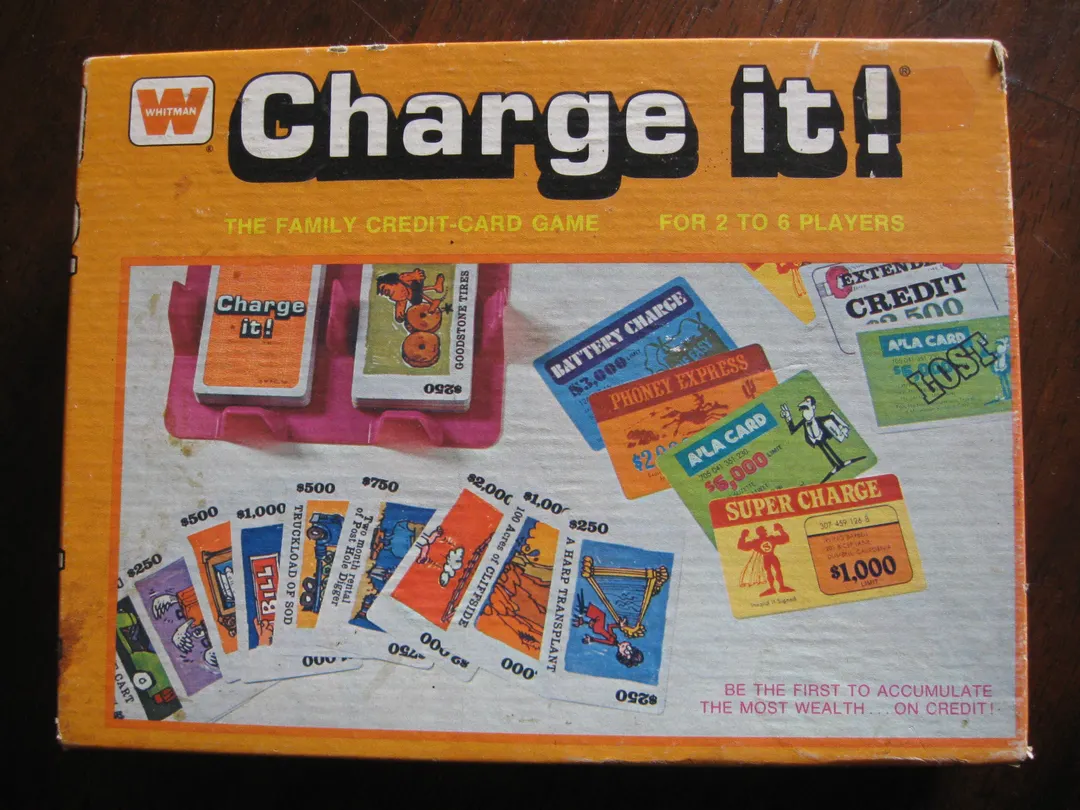
1972
Ayuda con las reglas de Charge it!
Explicaciones claras de turnos, efectos de cartas y situaciones dudosas, con historial de preguntas guardado.
¿Qué quieres saber?
Las respuestas salen del reglamento oficial, con la página para comprobarlo.
Charge it! es un juego de mesa publicado en 1972 para 2–6 jugadores y con partidas de 30 minutos.



En inglés
Players race to be the first to rack up $50,000 in merchandise charges on their credit cards. This game plays like Mille Bornes matched with a memory element. Players draw a card into their hand, and then play one either to the table or discard pile. Playing a credit card to the table allows the player on future turns to play merchandise cards under it. Players are not allowed to look at the values of the merchandise once it is played. Play continues placing cards, either new credit cards (total of 4 types) or merchandise underneath credit cards until a player declares that he has the $10,000 or more, in which they count up the purchases. The person who declares the round over gets a $2000 bonus, providing that the $10,000 has indeed been reached. There is also the ability to spoil your opponents. There are Lost Card cards which are played on an opponent causing them to have to discard a credit card and the merchandise underneath. These can be prevented by playing an Insurance card on your pile before to protect a pile, or play another copy of the same credit card in reaction to a Lost Card being played, similar to a Mille Bornes coup-fourré. Game ends after the round in which total purchases all game exceeds $50,000
Según el catálogo, Charge it! admite de 2 a 6 jugadores. Este intervalo corresponde al número de jugadores indicado por la editorial, así que el juego puede prepararse para cualquier grupo dentro de ese margen. La preparación, algunas reglas y la puntuación pueden variar según el número de jugadores; consulta la configuración exacta en el reglamento de tu edición.
La duración indicada para Charge it! es de 30 minutos, la estimación de la editorial para una partida completa. El tiempo real depende del grupo, del número de jugadores y del conocimiento de las reglas: las primeras partidas suelen alargarse y los grupos con experiencia terminan antes. La preparación y la explicación de las reglas no están incluidas.
Charge it! tiene una puntuación de complejidad de 1,0 sobre 5 según los jugadores de BoardGameGeek, lo que lo convierte en un juego ligero. La puntuación refleja cuánto conocimiento de reglas, planificación y toma de decisiones exige una partida típica. Los juegos exigentes requieren una explicación inicial más larga, así que conviene usar una guía de preparación.
Charge it! pertenece a estas categorías: Card Game. Las categorías describen el tema, la ambientación y el estilo de un juego, no sus reglas. Filtra el catálogo por la misma categoría para encontrar juegos similares si te gustó Charge it! y buscas algo parecido para tu próxima noche de juegos.
El catálogo clasifica Charge it! como juego base. Se juega por sí solo con los componentes de la caja y no requiere ningún otro título. Las expansiones, si existen, añaden contenido o reglas nuevas y aparecen por separado en el catálogo con un enlace a este juego base.


