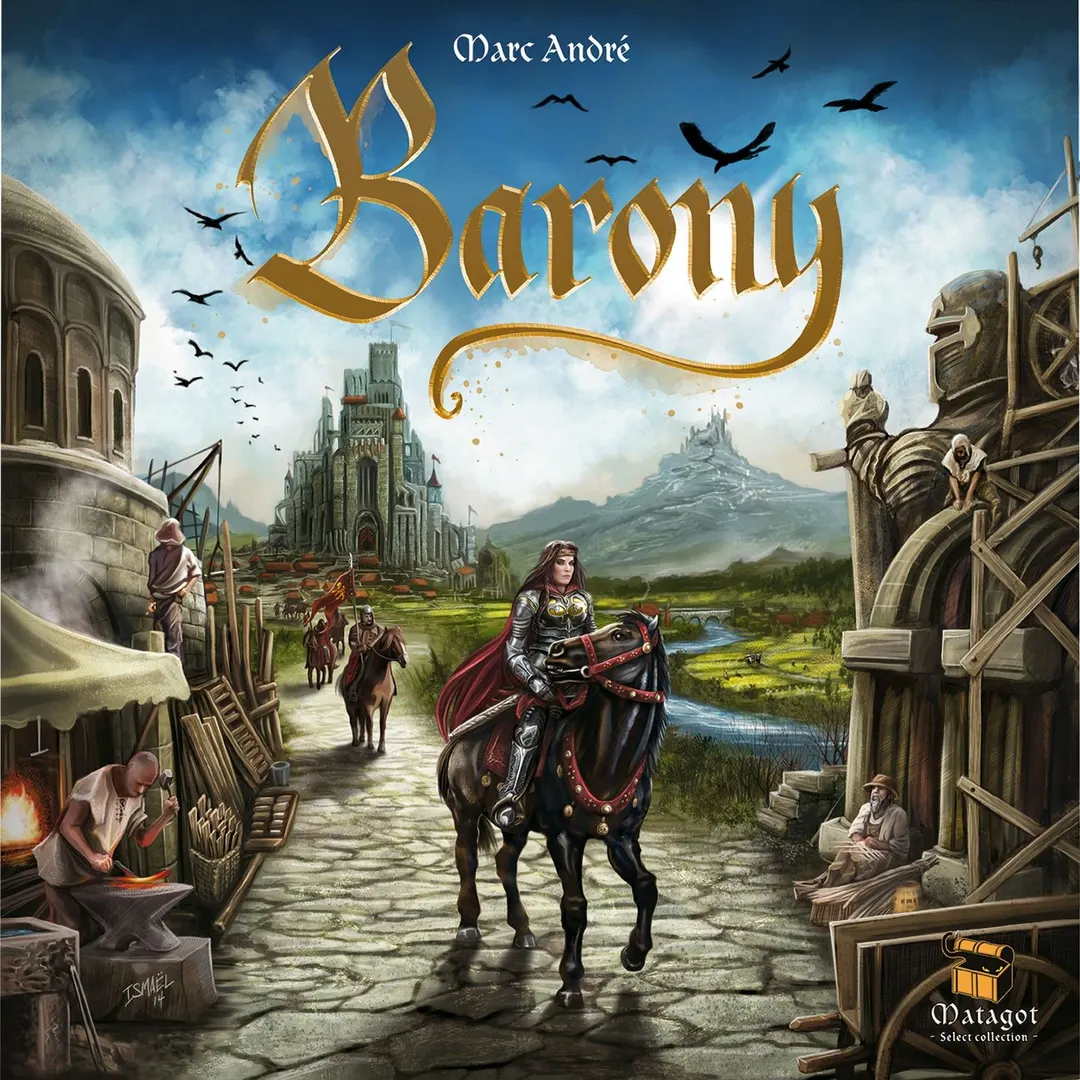
- Puesto en BGG
- BGG #1741
- Puntuación BGG
- 7,1
Barony
- 2–4 jugadores
- 45 min
- Complejidad 2,3/5
- 2015
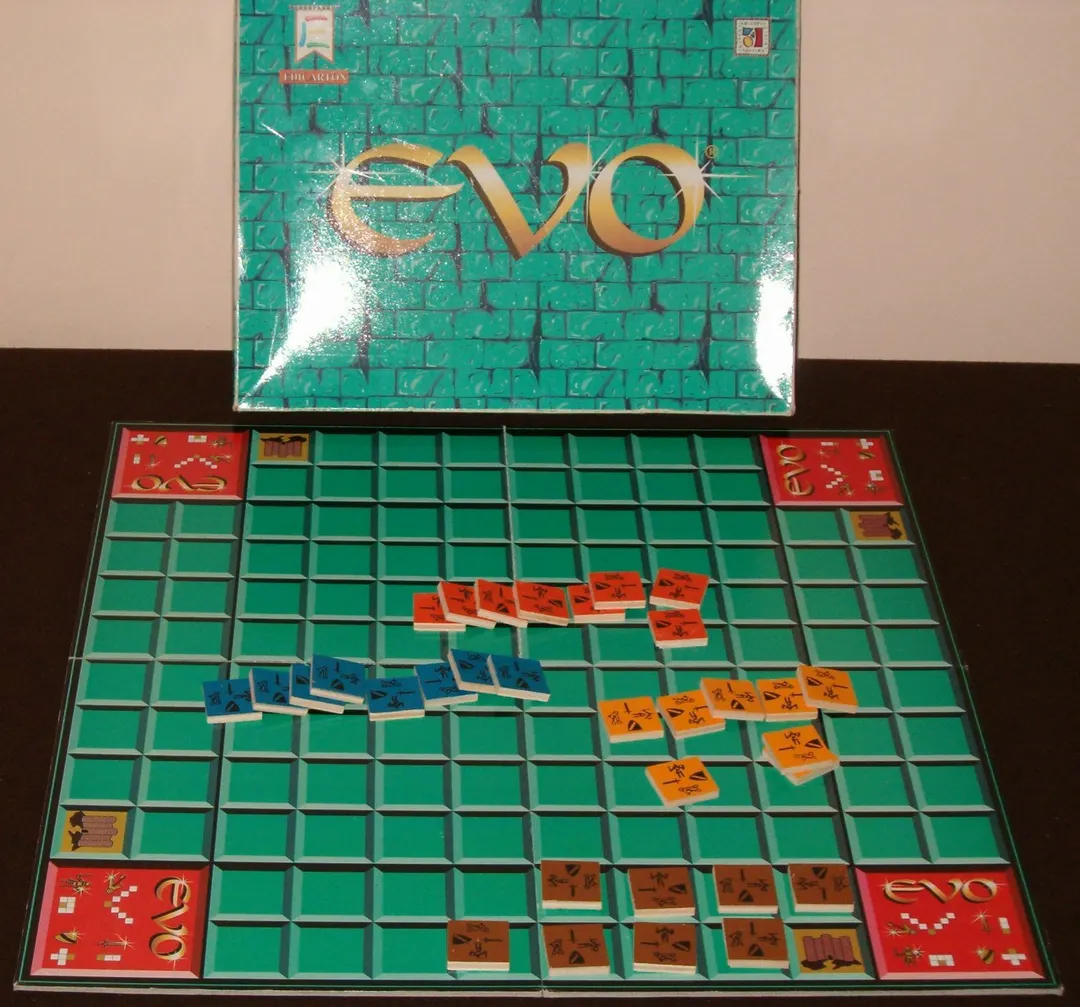

Ayuda con las reglas de Evo
Explicaciones claras de turnos, efectos de cartas y situaciones dudosas, con referencias a fuentes oficiales e historial de preguntas guardado.
¿Qué quieres saber?
Las respuestas salen del reglamento oficial, con la página para comprobarlo.
Evo es un juego de mesa para 2–4 jugadores, con partidas de 30 minutos y a partir de 8 años. Fue diseñado por Giancarlo Rainelli y sus mecánicas principales son Area Movement.




En inglés
Summary and goal of the game Two or four players compete in a shared, cross-shaped board, formed by a central part 8x8 square and four 8x2 “arms”, attached on each side of the 8x8 square. The object for each player is to capture an adversary Castle, an immobile piece of its own color on one of the 4 arms of the board (facing for two players). To achieve this each player will make use of 8 pieces of his own color, initially placed in one of the arms of the cross, around his Castle. The Castle of each player sits in the nearest right corner of the board. The first player that captures an adversary Castle (or conquers the last piece of one colour) wins , thus ending game. Turn action: movement and capture On his turn, a player can move one of his square-shaped pieces. All the pieces (but the Castle, which as said before can not be moved) are equal to each other. Each of them can move in 4 diferent ways, according to the side of the piece facing “north”, north being defined as “forward” from the POV of the owner of the piece. So for example “north” for the player sitting on the east side of table will be westward, wile for the player sitting on the north side of the table it will be southward, and so on. On his turn the player can move one of his pieces in one of these 2 ways: - just rotate the piece in place (thus changing the piece movement type for the next time he will decide to move it); - move the piece and then (optionally) rotate it; A player can capture other players' pieces by moving one of his piece on a square occupied by an opponent's piece. Pieces can never “go through” or “jump over” other pieces, both of the same or different colours. Each piece can be oriented in four different ways (one per each side of the piece) enabling it to four different kind of movement. The active roles is the one facing “north”. These are the four roles a piece can assume: - Warrior: it moves 1 square and can't go backwards, in other words it can move to one of the 5 squares adjacent to it (W, NW, N, NE, E); - Blade: it moves 1 or 2 square “forward” (N); - Catapult: it can move up to 3 squares diagonally going only forward, as usual (NE, NW); - Shield: the only role that can go backwards, it can move up to 2 squares going South or just 1 square going diagonally (SW or SE). Begining of the game The first player to move will be the one opening the table. Then it will be the player on his left the one to move, and so on, going clockwise. We advise you not to distract from what the other players do: you can lose the game even if an enemy don't conquer your Castle (one wins, all others lose).
Según el catálogo, Evo admite de 2 a 4 jugadores. Este intervalo corresponde al número de jugadores indicado por la editorial, así que el juego puede prepararse para cualquier grupo dentro de ese margen. La preparación, algunas reglas y la puntuación pueden variar según el número de jugadores; consulta la configuración exacta en el reglamento de tu edición.
La duración indicada para Evo es de 30 minutos, la estimación de la editorial para una partida completa. El tiempo real depende del grupo, del número de jugadores y del conocimiento de las reglas: las primeras partidas suelen alargarse y los grupos con experiencia terminan antes. La preparación y la explicación de las reglas no están incluidas.
El catálogo indica Evo a partir de 8 años. Es la recomendación de la editorial y refleja la lectura necesaria, la complejidad de las reglas y las piezas pequeñas, no solo el tema. Los más pequeños a menudo pueden jugar con ayuda de un adulto: comprueba la edad recomendada en tu edición y la experiencia de tu grupo.
Evo tiene una puntuación de complejidad de 1,6 sobre 5 según los jugadores de BoardGameGeek, lo que lo convierte en un juego ligero. La puntuación refleja cuánto conocimiento de reglas, planificación y toma de decisiones exige una partida típica. Los juegos exigentes requieren una explicación inicial más larga, así que conviene usar una guía de preparación.
Evo pertenece a estas categorías: Abstract Strategy y Medieval. Sus mecánicas principales son Area Movement. Las categorías describen el tema y la ambientación de un juego, mientras que las mecánicas describen lo que los jugadores hacen realmente en su turno. Cada mecánica lleva a una página del catálogo con juegos similares.
Los autores acreditados de Evo son: Giancarlo Rainelli. Estos créditos proceden de los datos publicados del juego y nombran a las personas responsables de su diseño, no a ilustradores ni editoriales. Las páginas de autor de MeepleRules reúnen otros títulos de los mismos autores, algo útil cuando un juego te gusta y buscas otros parecidos.
El catálogo clasifica Evo como juego base. Se juega por sí solo con los componentes de la caja y no requiere ningún otro título. Las expansiones, si existen, añaden contenido o reglas nuevas y aparecen por separado en el catálogo con un enlace a este juego base.