

- Puesto en BGG
- BGG #9028
- Puntuación BGG
- 7,2
Great War at Sea: Jutland
- 2 jugadores
- 30–120 min
- Complejidad 3,1/5
- 2006
Ayuda con las reglas de Great War at Sea: Jutland 1919
Explicaciones claras de turnos, efectos de cartas y situaciones dudosas, con referencias a fuentes oficiales e historial de preguntas guardado.
¿Qué quieres saber?
Las respuestas salen del reglamento oficial, con la página para comprobarlo.
Great War at Sea: Jutland 1919 es una expansión de Great War at Sea: High Seas Fleet publicada en 2018 para 2 jugadores, con partidas de 30 a 240 minutos y a partir de 12 años. Fue diseñado por Michael Bennighof y sus mecánicas principales son Dice Rolling, Secret Unit Deployment y Hexagon Grid.









En inglés
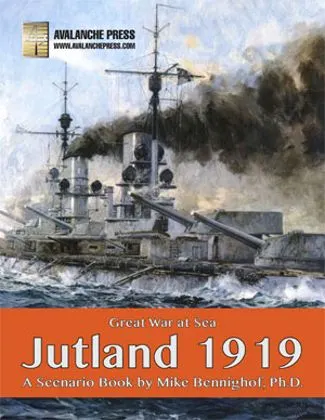
Imperial Germany laid down her last dreadnought in January 1915, and never completed her. But planning continued for new classes of battleships, battle cruisers, armored cruisers and scout cruisers. All understood that they could not possibly be built during the course of the ongoing First World War, but would be laid down afterwards. Reflecting the lessons first of the battles of the Falklands, Coronel and Helgoland Bight, and eventually those of Jutland, the new German designs continued to emphasize protection. At the urging of sea officers, the new ships also now carried armament equal to that of the British, and would make much higher speeds as well. Across the North Sea, the British Admiralty had no clear idea of what the Germans might be planning to build, but could state with certainty that they and other potential enemies would continue to improve their warships. New British dreadnoughts would carry ever-more-powerful armaments, including a new, secret 18-inch gun. Jutland 1919 is a supplement for our Great War at Sea: Jutland game, studying these drawing-board battleships that would never actually be launched. It includes background essays, forty new scenarios, and 80 new silky-smooth die-cut playing pieces (60 double-sized "long" ship pieces and 20 square ones). It is not playable by itself; you’ll need our Jutland game and High Seas Fleet book to play the scenarios. You can, of course, just read the essays and fondle the pieces without owning either. We won’t tell. New pieces include three classes of German battleships designed but never built: a fast battleship with eight 15-inch guns, a battleship with ten 15-inch guns in five turrets, with three of them in a unique triple-stacked arrangement. And an even larger ship with 16.5-inch guns. There are two new classes of battle cruiser, one with 15-inch guns, one with 16.5-inch guns. And two variations on the fast armored cruiser proposed after the Battle of Jutland, one with ten 8.2-inch guns, and one with twenty (20) 5.9-inch guns. Plus there are additional scout cruisers and destroyers. The British for their part receive their improved but slower Queen Elizabeth class, with ten 15-inch guns, and the massive ships proposed to carry eight 18-inch guns apiece, based on the Hood design but slower with battleship-scale protection. Plus their own fast armored cruiser. These are powerful new ships, and now you can lead them into battle. -description from publisher's website
Según el catálogo, Great War at Sea: Jutland 1919 admite 2 jugadores. Es el número de jugadores indicado por la editorial, así que el juego está diseñado exactamente para esa cantidad de participantes. Las variantes para otros tamaños de grupo, si existen, se describen en el reglamento de tu edición; consúltalo antes de preparar otra configuración.
La duración indicada para Great War at Sea: Jutland 1919 es de 30 a 240 minutos, la estimación de la editorial para una partida completa. El tiempo real depende del grupo, del número de jugadores y del conocimiento de las reglas: las primeras partidas suelen alargarse y los grupos con experiencia terminan antes. La preparación y la explicación de las reglas no están incluidas.
El catálogo indica Great War at Sea: Jutland 1919 a partir de 12 años. Es la recomendación de la editorial y refleja la lectura necesaria, la complejidad de las reglas y las piezas pequeñas, no solo el tema. Los más pequeños a menudo pueden jugar con ayuda de un adulto: comprueba la edad recomendada en tu edición y la experiencia de tu grupo.
Great War at Sea: Jutland 1919 tiene una puntuación de complejidad de 3,0 sobre 5 según los jugadores de BoardGameGeek, lo que lo convierte en un juego de complejidad media. La puntuación refleja cuánto conocimiento de reglas, planificación y toma de decisiones exige una partida típica. Los juegos exigentes requieren una explicación inicial más larga, así que conviene usar una guía de preparación.
Great War at Sea: Jutland 1919 pertenece a estas categorías: Wargame, Nautical y Expansion for Base-game. Sus mecánicas principales son Dice Rolling, Secret Unit Deployment y Hexagon Grid. Las categorías describen el tema y la ambientación de un juego, mientras que las mecánicas describen lo que los jugadores hacen realmente en su turno. Cada mecánica lleva a una página del catálogo con juegos similares.
Los autores acreditados de Great War at Sea: Jutland 1919 son: Michael Bennighof. Estos créditos proceden de los datos publicados del juego y nombran a las personas responsables de su diseño, no a ilustradores ni editoriales. Las páginas de autor de MeepleRules reúnen otros títulos de los mismos autores, algo útil cuando un juego te gusta y buscas otros parecidos.
El catálogo clasifica Great War at Sea: Jutland 1919 como expansión de Great War at Sea: High Seas Fleet. Las expansiones añaden contenido, reglas o escenarios al juego base y normalmente no se pueden jugar solas, así que necesitas Great War at Sea: High Seas Fleet para usarla. Comprueba que tu edición de Great War at Sea: High Seas Fleet sea compatible, porque algunas expansiones se revisaron entre ediciones.