

- Puesto en BGG
- BGG #697
- Puntuación BGG
- 7,1
The Fox in the Forest
- 2 jugadores
- 30 min
- Complejidad 1,6/5
- 2017
2016
Ayuda con las reglas de Hocus
Explicaciones claras de turnos, efectos de cartas y situaciones dudosas, con referencias a fuentes oficiales e historial de preguntas guardado.
Para 2 jugadores
¿Qué quieres saber?
Las respuestas salen del reglamento oficial, con la página para comprobarlo.
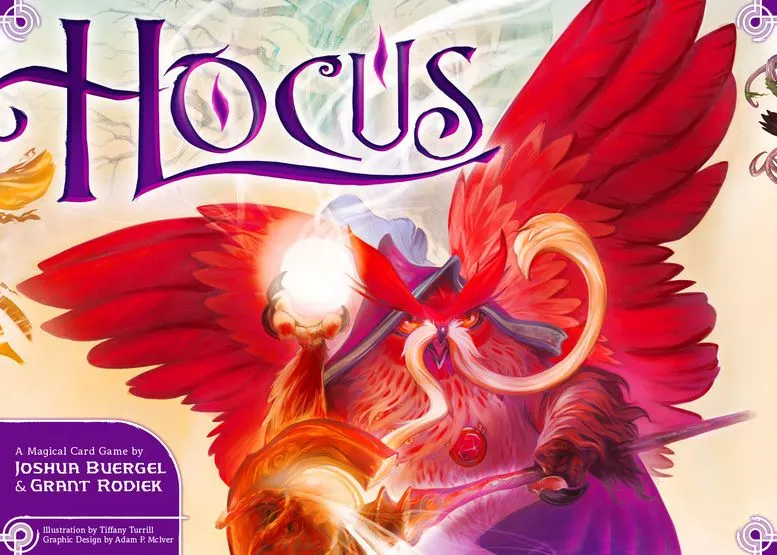
Hocus es un juego de mesa publicado en 2016 para 2–5 jugadores, con partidas de 30 minutos y a partir de 10 años. Fue diseñado por Joshua Buergel y Grant Rodiek y sus mecánicas principales son Variable Player Powers, Hand Management y Pattern Building.





En inglés
For those with the eldritch gift, temptation lurks around every corner, even in leisure. Just consider the possibilities available to the practitioner of magic. Imagine poker with spells! No person could resist such temptation, and even a casual review of history will prove that none could. The famous last play of Ephippus of Athens? It was about Circe’s never ending thirst for cheating at cards. Morgan le Fay and Merlin regularly crossed wits over a deck. Roger Bollingbroke’s most heinous crime was the transparently bogus run of five straight flushes in a row. And so it has gone. The application of magic to card games is as natural as mixing mandrake and worm’s husk. For the first time, however, the rules for a game specifically created for wizards have been pieced together from fragments found in tombs, dusty used bookstores, and in the classified ads of one small newspaper. Though magic has largely been forgotten in the centuries since this game was invented, modern game design has given us a way to imitate the arcana outlined in the reconstructed rules. The result is a “no-magic-required” whimsical romp for 2-5 players. Hocus places the players in the flamboyant boots of wizards, using their powerful advantages to create opportunities, manipulate the game, and alter the flow of cards. Wizards hate being pinned down and live by the mantra “You shall not fold!” Each turn, players choose one Spell to use. As you are new to Hocus, we shall first discuss the three Basic Spells. Use the first basic Spell to play cards to the Community. Play thoughtfully, as everyone shares the cards in the Community! The second Spell is for building the Pot. In addition to Suit and Strength, every card has a point value. Cards played to the Pot contribute their points to the winner of each Showdown. Play cards to build a Pocket with the third Spell. (Never ask to see a wizard’s pocket!) Each player takes one of their Pockets and combines it with the Community to form a hand during Showdowns. The best hand claims all points in the Pot. There is, of course, a twist. Trust a wizard to provide a twist! There are multiple Communities, each with a Pot, and players can compete in multiple Showdowns if they have the Pockets. Hocus is not merely a matter of building good hands, but making a winning hand where your opponents least expect and profiting with a hefty Pot. Timing and careful, targeted play will win the day. And time is limited. You may have conjured a Straight Flush, but it’s worthless with no points in the Pot! Now, look at the other spells in the game. There are eight different spell books, each with their own unique approaches to the game, providing every wizard who plays with their own special abilities. The spell books raise the game to another level, with even more tools for bending luck to your advantage. Travel way back to a dark, dank inn, shuffle the cards, and play the favorite game of the legendary Merlin and Morgan le Fay. Hocus is a little like poker, but a lot more magic!
Según el catálogo, Hocus admite de 2 a 5 jugadores. Este intervalo corresponde al número de jugadores indicado por la editorial, así que el juego puede prepararse para cualquier grupo dentro de ese margen. La preparación, algunas reglas y la puntuación pueden variar según el número de jugadores; consulta la configuración exacta en el reglamento de tu edición.
La duración indicada para Hocus es de 30 minutos, la estimación de la editorial para una partida completa. El tiempo real depende del grupo, del número de jugadores y del conocimiento de las reglas: las primeras partidas suelen alargarse y los grupos con experiencia terminan antes. La preparación y la explicación de las reglas no están incluidas.
El catálogo indica Hocus a partir de 10 años. Es la recomendación de la editorial y refleja la lectura necesaria, la complejidad de las reglas y las piezas pequeñas, no solo el tema. Los más pequeños a menudo pueden jugar con ayuda de un adulto: comprueba la edad recomendada en tu edición y la experiencia de tu grupo.
Hocus tiene una puntuación de complejidad de 2,3 sobre 5 según los jugadores de BoardGameGeek, lo que lo convierte en un juego algo ligero. La puntuación refleja cuánto conocimiento de reglas, planificación y toma de decisiones exige una partida típica. Los juegos exigentes requieren una explicación inicial más larga, así que conviene usar una guía de preparación.
Hocus pertenece a estas categorías: Card Game y Print & Play. Sus mecánicas principales son Variable Player Powers, Hand Management y Pattern Building. Las categorías describen el tema y la ambientación de un juego, mientras que las mecánicas describen lo que los jugadores hacen realmente en su turno. Cada mecánica lleva a una página del catálogo con juegos similares.
Los autores acreditados de Hocus son: Joshua Buergel y Grant Rodiek. Estos créditos proceden de los datos publicados del juego y nombran a las personas responsables de su diseño, no a ilustradores ni editoriales. Las páginas de autor de MeepleRules reúnen otros títulos de los mismos autores, algo útil cuando un juego te gusta y buscas otros parecidos.
El catálogo clasifica Hocus como juego base. Se juega por sí solo con los componentes de la caja y no requiere ningún otro título. Las expansiones, si existen, añaden contenido o reglas nuevas y aparecen por separado en el catálogo con un enlace a este juego base.