
- Puesto en BGG
- BGG #773
- Puntuación BGG
- 7,1
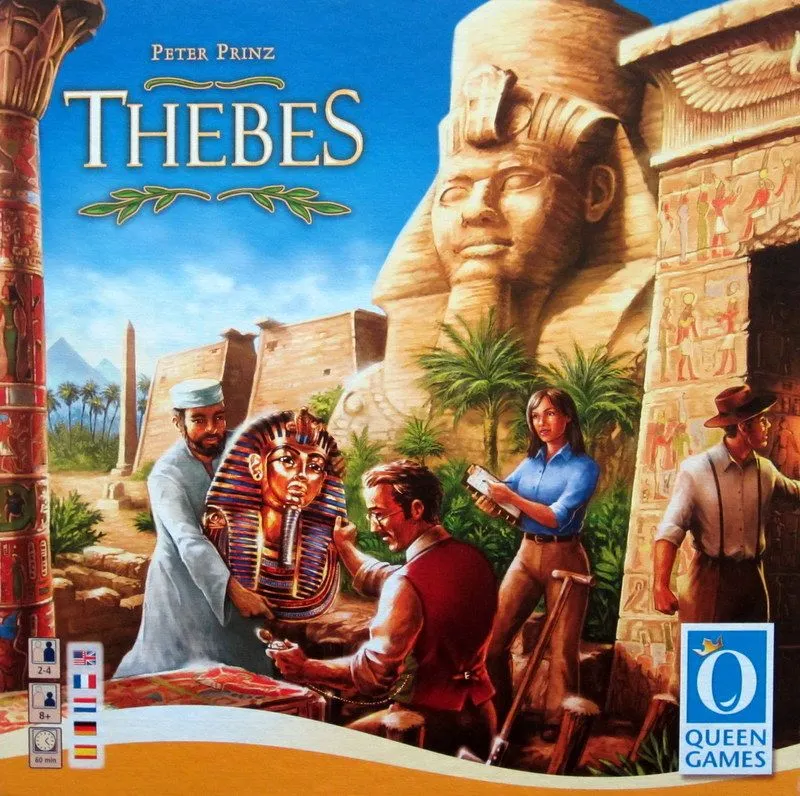
Thebes
- 2–4 jugadores
- 60 min
- Complejidad 2,2/5
- 2007
2004
Ayuda con las reglas de Jenseits von Theben
Explicaciones claras de turnos, efectos de cartas y situaciones dudosas, con referencias a fuentes oficiales e historial de preguntas guardado.
Para 2 jugadores
¿Qué quieres saber?
Las respuestas salen del reglamento oficial, con la página para comprobarlo.
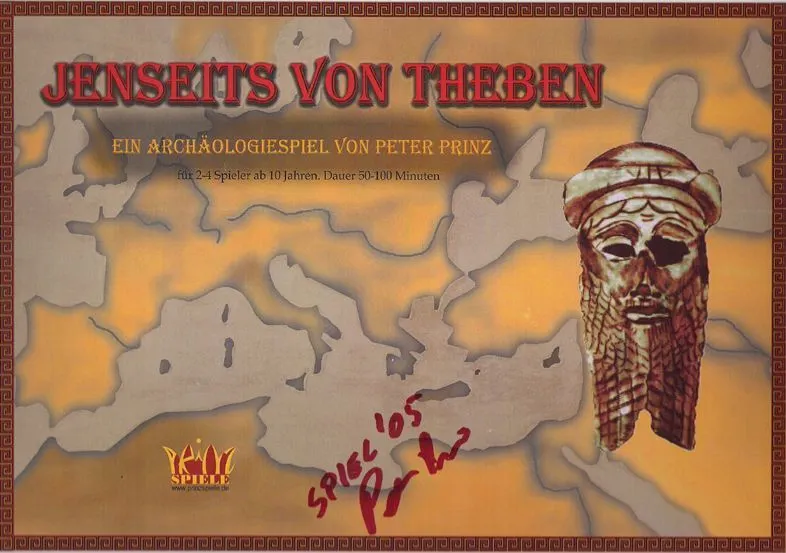
Jenseits von Theben es un juego de mesa publicado en 2004 para 2–4 jugadores, con partidas de 75 minutos y a partir de 10 años. Fue diseñado por Peter Prinz y sus mecánicas principales son Turn Order: Time Track.






En inglés
This entry is for the original Jenseits von Theben; for the new printing by Queen, go to Thebes. Jenseits von Theben is a game of competitive archeology. Players are archaeologists who must travel around Europe to acquire knowledge about five ancient civilizations -- the Greeks, the Cretans, the Egyptians, the Palestinians, and the Macedonians -- and then must use this knowledge to excavate historical sites in the areas of these civilizations. Periodically, there are expositions at major European cities, and the archaeologist who shows up on time with the best collection of artifacts (plus a minor die roll) wins the purse. The archaeologist who learns the most about the civilizations, claims the greatest-valued artifacts, and presents the biggest collection to the European exhibitions will win out over his or her colleagues. The key element to the game is that it is played out over a period of two (or three) years, and each action a player performs takes a certain amount of time -- traveling is a week between cities, gathering knowledge takes time for the level of the knowledge, and actually digging at a cultural site takes time to yield a certain number of artifact cards. The game uses a novel mechanic to keep track of this -- there is a track of 52 spaces around the outside of the board, and each time a player moves and takes an action, he or she moves their player token forward in time. Players take turns based on being the one who is furthest back in "time". So, a player can go to an excavation site and spend 10 weeks digging for artifacts, but that will also mean that the other players will likely be taking several actions in the interim while that player waits for the "time" to catch up. In addition, the artifact cards in each civilization are a hidden number. The deck for each civilization contains twelve treasures of varying point values and two knowledge cards, with another sixteen cards of dirt. At the beginning of the game, seven cards are removed from each deck without the players seeing them. Through the course of the game, when a player excavates at a site, he or she keeps the artifacts that are revealed from a site, but the dirt is shuffled back into the remaining cards. Both the imperfect information element as well as the recycled dirt make for a random chance element that is overcome somewhat by digging at a site where a player has much knowledge -- more knowledge means that more cards will be revealed in a shorter period of time, and a greater chance of revealing treasures that may yet remain after another player has already recovered some treasures from that site. The original run of Jenseits von Theben was hand-produced by Prinz Spiele in a first edition of 100, and a second edition of 300. Re-implemented by: Thebes
Según el catálogo, Jenseits von Theben admite de 2 a 4 jugadores. Este intervalo corresponde al número de jugadores indicado por la editorial, así que el juego puede prepararse para cualquier grupo dentro de ese margen. La preparación, algunas reglas y la puntuación pueden variar según el número de jugadores; consulta la configuración exacta en el reglamento de tu edición.
La duración indicada para Jenseits von Theben es de 75 minutos, la estimación de la editorial para una partida completa. El tiempo real depende del grupo, del número de jugadores y del conocimiento de las reglas: las primeras partidas suelen alargarse y los grupos con experiencia terminan antes. La preparación y la explicación de las reglas no están incluidas.
El catálogo indica Jenseits von Theben a partir de 10 años. Es la recomendación de la editorial y refleja la lectura necesaria, la complejidad de las reglas y las piezas pequeñas, no solo el tema. Los más pequeños a menudo pueden jugar con ayuda de un adulto: comprueba la edad recomendada en tu edición y la experiencia de tu grupo.
Jenseits von Theben tiene una puntuación de complejidad de 2,4 sobre 5 según los jugadores de BoardGameGeek, lo que lo convierte en un juego algo ligero. La puntuación refleja cuánto conocimiento de reglas, planificación y toma de decisiones exige una partida típica. Los juegos exigentes requieren una explicación inicial más larga, así que conviene usar una guía de preparación.
Jenseits von Theben pertenece a estas categorías: Travel y Exploration. Sus mecánicas principales son Turn Order: Time Track. Las categorías describen el tema y la ambientación de un juego, mientras que las mecánicas describen lo que los jugadores hacen realmente en su turno. Cada mecánica lleva a una página del catálogo con juegos similares.
Los autores acreditados de Jenseits von Theben son: Peter Prinz. Estos créditos proceden de los datos publicados del juego y nombran a las personas responsables de su diseño, no a ilustradores ni editoriales. Las páginas de autor de MeepleRules reúnen otros títulos de los mismos autores, algo útil cuando un juego te gusta y buscas otros parecidos.
El catálogo clasifica Jenseits von Theben como juego base. Se juega por sí solo con los componentes de la caja y no requiere ningún otro título. Las expansiones, si existen, añaden contenido o reglas nuevas y aparecen por separado en el catálogo con un enlace a este juego base.